Workforce, Training and Education Bulletins

Introduction

Welcome to the Workforce, Training and Education (WT&E), NHS England, London region web page.

We aim to ensure the NHS workforce in London has the knowledge, skills, values and behaviours they need to deliver compassionate, high-quality health and care to the public.

The WT&E directorate has the statutory responsibility, on behalf of NHS England, to ensure the training, education and plan for the workforce meets the needs of NHS services in London. 

The directorate is responsible for NHS: 

  • Education and training 
  • Staff and learner experience and leadership development 
  • Supply and people services development 
  • Workforce strategy and planning

This is a landing page for all updates relating to our work in the region and is updated every other month in line with our stakeholder newsletter. To stay informed about our work, join the mailing list, or for any questions, please email england.wtedelivery.london@nhs.net.

Regional Updates

Change Programme

This quarter brings significant change for our region as we continue to implement the wider NHS England transformation programme, which affects both national teams and provider organisations. These changes are substantial, and they provide an opportunity to strengthen how we work together across London to improve outcomes for our communities. 


New Director General for Workforce, Training and Education  

I would like to congratulate Danny Mortimer on his appointment as Director General for Workforce, Training and Education in the new NHS England structure. His leadership will be important as we continue to shape a sustainable workforce for the future. 


Theory of Change Workshop  

We recently held a Theory of Change workshop to support a shared understanding of the outcomes we want to achieve, and the actions needed to deliver them. This work will underpin our regional priorities, and I encourage colleagues to engage fully as it develops. 


London People Board 

We are also marking a change in London’s leadership. Dame Marie Gabriel has stepped down as Co‑Chair of the London People Board after many years of dedicated service. I would like to thank her for her significant contribution to workforce transformation across the capital. Nnenna Osuji will continue as Co‑Chair, providing continuity as she moves into her new role at North East London ICB.

Voluntary Redundancy in Systems and NHS England 

On 11 November, details were announced of the voluntary redundancy scheme set to take place this financial year across NHS England and ICBs with applications opening in early December. We recognise that this will be a challenging process and would like to take the opportunity to remind colleagues to reach out and support each other in what could be a difficult time for people. 


Transforming People Services – London as a Pioneer Region  

Following the recent prioritisation exercise to identify the first 2 regions to adopt the new Transforming People Services (TPS) Target Operating Model (TOM), London has been nominated as one of two pioneer regions, along with the South West and with the remaining five regions following thereafter.  

The third workshop took place on 25 November, hosted by NHS England in partnership with KPMG and attended by Chief People Officers from across the country. The purpose of this session was to progress the next phase of TOM design: enabling key stakeholders to input into how we shape the implementation of the model. 

Objectives: 

Continue engaging with key stakeholders, reflecting on the progress to date, and building momentum for the next stage of the programme. 

Define what successful implementation of the TOM looks like and identify the critical elements we need to get right. 

Explore our key outstanding questions to inform the business case. 

Agree on key inputs and next steps. 

More details will be shared in the new year. The programme is sponsored by Caroline Clarke, Regional Director for London and overseen by Thomas Simons, Chief HR and OD Officer, NHS England. 


Neighbourhood Services in London – Establishing the People Programme 

Work on the development of neighbourhood services in London is progressing, with the four pillars of the Neighbourhood People Programme having been confirmed by the Senior Responsible Officers. These pillars are Leadership and Organisational Development, Education and Training, Workforce Planning, and Ways of Working (Funding Flows). Stakeholder engagement and cross-organisational collaboration is ongoing as a work plan for the People Programme is in development. 

We are also pleased to share that Dr Jo Sauvage, Chief Medical Officer for NWL & NCL ICB, has been announced as the ICB Executive Lead for Neighbourhoods. 


Inclusive Executive Programme Update 

The NHS England, London region Inclusive Executive Programme is progressing well. Inclusive Executives have joined London region executive meetings with their buddies to gain organisational insight, contribute to decision-making and share perspectives that strengthen inclusion and innovation. 

Learning from these experiences is feeding into action learning sets, where Inclusive Executives explore ideas further and benefit from peer support. Buddying also helps expand networks, with participation in strategic meetings such as the wider Finance Leadership Team, Clinical Cabinet, London Health Mission and Regional Transformation. 

Next, we’ll focus on inclusive leadership. Yinka Iwu, Assistant Director of Equality, Diversity and Inclusion (EDI), will lead a workshop on this theme. In December, Inclusive and London Executives will meet to build on the programme’s impact, and you can hear more at the London staff briefing. 

Thank you to our Inclusive Executives for their insight and to London executives for championing this work. 


“Through this programme, you’ll build meaningful relationships that extend beyond traditional networking. You’ll access rooms where decisions are made, understand the unwritten rules of executive leadership, and develop the strategic toolkit you need to succeed. NHSE/DHSC needs your voice, your vision, and your leadership at the executive table.” 

Lorraine Hunte, Programme Manager, Learning Disabilities and SEND Team 


“Since joining the Inclusive Executive Programme, I’ve had the opportunity to actively contribute to regional transformation and OD initiatives. From co-designing and delivering development sessions for regional leaders to participating in national staff engagement forums, the programme has opened doors to meaningful collaboration and influence. I’ve also gained valuable insights into senior leadership through rotational participation in London Executive meetings, and had the privilege of attending the Mayor’s London Inclusive Talent Strategy Launch – an inspiring event that broadened my network across regional workforce transformation partners. 

A key highlight has been the supportive relationship with my executive buddy, where regular 1:1s offer space for reflection, career development, and reciprocal learning.” 

Harinder Grewal, Programme Manager Strategic Transformation 


We launched the Inclusive Executive Programme in direct response to feedback from colleagues, adapting the idea from a Shadow Board model to develop something more nuanced to our organisation which we co-designed with a wide range of colleagues.  There has been a lot of learning along the way, and I am grateful to the Inclusive Executives and other colleagues who have worked so hard to get the programme to where it is today.

On a personal level, it has been great to build new relationships and learn from people’s experiences and insights, and building the Inclusive Executive model into our regional governance and change programme is making a meaningful impact on how we work.  I am excited to continue this work in 2026 and grateful to all involved for their engagement and support.  

Lizzie Smith, Director of Workforce, Training and Education, NHS England, London 


Accessible Information Standard 

The Accessible Information Standard (AIS) sets out how all health and social care providers must identify, record, flag, share and meet people’s communication and information needs (e.g., sensory or cognitive disabilities). The Standard was refreshed in June 2025, with key updates including a new sixth step – review – an organisational AIS Lead, a Self-Assessment Framework, and updated e-learning with wider access to training for both NHS and non-NHS staff. Accessible versions of the AIS (Easy Read, audio and BSL video) are available.

We work closely with regional teams and stakeholders to support implementation, and a national evidence-gathering exercise will begin shortly to inform an economic case looking at costs/ benefits of implementing the AIS. We would like to hear of any good practice examples you have within your organisation of implementing the AIS. 

For more information or to connect with the AIS programme, please contact england.aisqueries@nhs.net 

As we transition from summer to autumn, there have been several key updates which this newsletter explores, notably, the publication of the 10 Point Plan to improve the lives of resident doctors, and a call for evidence for the 10 Year Workforce Plan. As well as important work on how London is driving forward the 10 Year Plan’s three key shifts.  

NHS 10 Year Plan 

This month saw the release of the 10 Year Health Plan, and the commitment to a refreshed workforce plan to be published later this year. Delivery of the plan will require a skilled, supported, sustainable health and care workforce. Through our collective work across London and in collaboration with the London People Board we must continue to work to create a culture where people feel supported and valued through unprecedented transformation and change. 

Delivery of the digital transformation set out in the plan will require skills to transform and reform the health and care system at scale and pace whilst maintaining and improving service delivery. We must embrace digital transformation at all levels – through skills, scaling, automation, and AI. The Digital Workforce subgroup of the London People Board meets this month and is driving this work forward with stakeholders from region, systems and providers. 

We must also protect equity and reduce health and wider inequalities through this change, supporting our current and future workforce into neighbourhood teams with new skills, roles and ways of working and reforming education to meet the future healthcare vision. Our Integrated Neighbourhood Teams workforce workshop on 24th July will be key to shaping our workforce response to delivering this exciting programme of change across the capital. 

Please visit this website to read the plan in full.


Neighbourhood Health Service 

Alongside workforce, the move towards neighbourhood health services is a central theme in the 10 Year Health Plan. Work is already underway with initial planning stages for London being led by Andrew Bland, CEO of NHS South East London Integrated Care Board (ICB). To read more, please visit this web page. 

Further details of how to get involved will be shared in future editions of this newsletter.

London People Board

The London People Board has been focussed on aligning London’s health and care workforce priorities with the NHS Long Term Workforce Plan and the 3 shifts; analogue to digital, sickness to prevention and hospital to community. National NHS England and Department of Health and Social Care colleagues have joined recent meetings to ensure London helps to influence and inform the new Long Term Workforce Plan. We have strengthened work on scaling integrated neighbourhood workforce models, ensuring sufficient roles for newly qualified staff, and improving retention through clearer progression pathways.

Key achievements this quarter include setting pan‑London expectations for neighbourhood workforce planning through formal Board guidance and advancing digital workforce capability through the Digital Transformation Subcommittee to support readiness for AI‑enabled and digitally delivered care. The Board’s next meeting will maintain this focus with a dedicated session on digital workforce transformation.

The Board remains committed to equity, inclusion and delivering solutions once for London, using its convening and influencing role to support sustainable workforce transformation across the capital.

Read more about the London People Board here.


Equality, Diversity and Inclusion and EDI Subgroup of London People Board 

Evaluation update: London Workforce Race Strategy (LWRS) 

Ipsos UK and Sea Change Consultancy have now delivered 2 Theory of Change (ToC) workshops to support the evaluation of NHS England’s London Workforce Race Strategy. These sessions have helped shape the emerging ToC and gather valuable insights from stakeholders across the system. 

Workshops held: 

  • 22 January 2026 – Online  
  • 27 January 2026 – Online  

As next steps, the evaluation partners will be connecting with a sample of 6 trusts to participate in case studies. These will explore, in depth, the challenges and enablers for organisations improving, remaining neutral, or declining against Workforce Race Equality Standard (WRES) and Workforce Disability Equality Standard (WDES) metrics. 

Further information will be available: england.london.racestrategy@nhs.net 


Sexual Safety London Programme Update 

The programme of work continues to gain traction with the first in-person sessions for supporting disclosures of sexual misconduct live across our ICB areas. This half day session includes an overview of sexism, sexual harassment and sexual assault in healthcare workplaces; challenges that survivors face and support needed; How survivors may present and steps to work through alongside case studies to develop understanding and discussion.  

On 29 January, we were also excited to kick off our first facilitator training for this programme. This is a really important step to developing the capability across London to scale this learning within organisations.  

Dates for the half-day training are listed below for local cohorts and engagement. Please note, some of these dates have passed. 

Hosts for half day training: 

  • NEL: BHRUT & Barts Health
    • 9 January  
    • 5 March
  • SEL: King’s
    • 9 Janaury
    • 5 February 
  • NCL/NWL: Imperial
    • 15 January (am and pm)
    • 12 February (am and pm)
  • SWL: GESH 
    • 26 February 
    • 3 March 

In the next newsletter we will share information about sexual safety resources and the next stage of the training roll out. 

Further information will be available england.sexualsafety.london@nhs.net 


National Reciprocal Mentoring Offer 

This national programme is designed as a system‑wide approach to organisational change, grounded in the principles to support more inclusive and equitable workplaces. 

Originally developed to help address racial inequalities after the Black Lives Matter movement and the disproportionate impact of COVID‑19 on BME staff and communities, the programme has since broadened to support wider transformation across all protected characteristics—while keeping race equity at its core. 

The programme aligns with national and local priorities including the Equality, Diversity and Inclusion (EDI) Improvement Plan, Messenger Review, 10‑Year Health Plan, and the CQC inspection framework. 

Colleagues within the London region have been trained to ‘train the trainer’ to support a sustainable regional delivery. 

Further information will be available england.london.racestrategy@nhs.net. 


React Toolkit 

The toolkit developed by academics from Liverpool University adopts a data-driven approach aimed at empowering organisations by assessing, planning and evaluating for racial equity, enabling them to develop a positive work culture where everyone, regardless of their race or ethnicity, can thrive. It does not provide a quick fix solution but rather encourages organisations to take strategic steps towards making fundamental changes to their policies, practices and culture, which will have long-lasting positive effects. It is primarily focused on the public sector, but the tools and worksheets available can be adapted for use in both public and private sector organisations. 

We will be seeking interest from 6 initial pilot trusts to join with a view enhancing the work already being done to support London Anti-Racism Collaboration for Health (LARCH) and working alongside the Race Equity Maturity Index (REMI). 

Further information regarding the toolkit can be obtained via england.london.racestrategy@nhs.net. 


Core Managers Programme Update 

The Core Managers Programme platform is migrating from FutureLearn to the NHS Learning Hub, with the updated version expected to go live in March 2026. 

Once launched, all NHS staff and partner organisations will be able to access and enrol easily. A link will be shared widely and included in our next update. 


Workforce Integration Design (WIN) Lab 

The WIN Design Lab is a 10‑month equity and innovation programme supporting employers to build more inclusive workplaces through evidence‑based design. 

Since 2023, 25 organisations across the health sector have participated, with the most recent graduation taking place in November 2025. The next cohort will begin in April 2026. 

Through equity‑centred design and expert facilitation, organisations are supported to: 

  • address underrepresentation and reduce ethnicity pay gaps 
  • develop new workforce and community engagement models 
  • strengthen cross‑trust collaboration 
  • build capability in innovation and equity‑led design 

Participants leave with tested solutions, new insights, and enhanced capability to drive sustained change 

The London People Board continues its work to support the 10 Year Workforce Plan, highlighting key national priorities, operational challenges, and the implications for London.

The November board meeting featured a discussion regarding the Greater London Authority (GLA) Refugee Employment Partnership, outlining progress, challenges, and next steps for integrating refugees into NHS and social care roles. The programme has ambitions to recruit 5,000 refugees into NHS roles over three years, the launch of the refugee info app, and efforts to expand the programme into social care, primary care, and the life sciences sector.

To read more, please visit this page. 


Equality, Diversity and Inclusion and the EDI Subgroup of London People Board 

Evaluations Launched: London Workforce Race Strategy 

An independent Retrospective Realist Evaluation of the London Workforce Race Strategy has officially launched, marking five years since its initial implementation. The evaluation is being conducted by Ipsos, in collaboration with Sea-Change, an evidence-led EDI consultancy. 

Purpose and Impact: 

  • Assess effectiveness of the strategy and its initiatives.
  • Identify lessons learned from implementation across London’s NHS.
  • Inform improvements for future equity programmes.
  • Support strategic refresh for the next five years, ahead of Board sign-off.

This evaluation will provide critical insights into what has worked, what needs refinement, and how to strengthen the strategy’s impact moving forward—with a renewed focus on evidence, equity, and sustainable change. 

If you’d like to contribute to the evaluation, there will be opportunities to get involved through interviews, surveys, and stakeholder workshops. 

For more information, please get in touch at england.london.racestrategy@nhs.net 


Core Managers ‘100’ Campaign 

Join the Core Managers ‘100’ Campaign – Be the Change in Your Workplace 

Are you ready to: 

  • Improve your workplace culture? 
  • Deepen your understanding of the diverse cultures within the NHS? 
  • Become a more effective ally and active bystander? 
  • Strengthen your compassionate and inclusive leadership skills? 

If so, the Core Managers Programme is for you! 

To learn more and register for free online training, please visit the Core Managers Programme page. 

Tips for organisations to achieve ‘100’ Target: 

  • Identify Core Managers Programme Lead to promote CMP and Set Up CMP Network. 
  • Identify individuals or a team to get “100” started. 


Core Managers Programme moves to NHS Learning Hub in January 2026 

The Core Managers Programme will have a new home from15 January 2026 so please register for courses in November 2025 to ensure you have enough time to complete your course by 5 January 2026. 

Details on how to access the programme from January 2026 will be shared with you nearer the time. 


Inclusion Showcase 2025: Advancing Equity Across London’s NHS 

On 16 October 2025, healthcare leaders, practitioners, and stakeholders gathered for the Inclusion Showcase—a full-day conference dedicated to driving meaningful change in workforce diversity, leadership development, and patient care across London’s NHS. The event featured keynote speeches, expert panels, interactive workshops, and programme spotlights that underscored the power of collaboration, innovation, and evidence-based inclusion. 

Opening Address: Dame Caroline Clarke 

Dame Caroline Clarke opened the day with a compelling keynote, reminding attendees that London is the second most diverse city in the world—and that diversity is our strength. She reaffirmed NHS England London region’s enduring principles (Inclusion, Innovation and Improvement) 

Panel Discussion: Strategic Insights 

Chaired by Dame Marie Gabriel, the panel brought together leading voices in healthcare and inclusion:  

  • Professor Elena Doldor: “Start with the data, you can’t change what you can’t see.” She encouraged celebrating immigration, building compassion, and asking brave questions. 
  • Lizzie Smith (FCCIPD): “EDI isn’t an add-on; it’s a core value.” She emphasised listening, believing lived experiences, and embracing discomfort. 
  • Rachel Clare Evans: “Inequity costs the system. Investing in equity isn’t just moral, it’s smart.” 
  • Dr Nnenna Osuji: Shared strategic reflections on systemic challenges and opportunities in healthcare inclusion. 

Afternoon Workshops: Collaboration at Scale 

The workshops showcased the thriving EDI workstream developed through the Once for London approach—collaboration and innovation done once, done well, and done for London. Participants, including EDI, HR and OD, and clinical workforce leads, explored how to: 

  • Co-produce solutions tailored for London. 
  • Embed inclusion and equity into every decision. 

The energy in the room reflected a shared commitment to driving change. 

Programmes Driving Inclusion and Career Progression 

Talent Development and Career Progression: 

  • Whittington Health BME Career Development Programme: Expanded to cohorts 5 and 6, supporting bands 2–7 staff with targeted development. 
  • Imperial College Healthcare Leaders Fellowship: Delivered through “Get On” and “Go Further” pathways, this programme supports BME professionals into senior roles via mentoring, coaching, and executive learning. 
  • Calibre Disability Leadership Programme: Launched its second London-wide cohort, offering tailored leadership development for neurodiverse and disabled staff. 

Medical Leadership Pipeline 

  • PULSE Network: Enrolled 30 diverse mid-career consultants across primary and secondary care. The 12-month programme includes masterclasses, coaching, mentoring, and action learning sets to build a robust pipeline of senior medical leaders. 

 Ask Aunty Programme 

A visionary initiative supporting international NHS recruits through four key pillars: 

  • Reciprocal Mentoring: Pairing new staff with an ‘Aunty’ or ‘Uncle’ for mutual support. 
  • Training: Courses on equality legislation, NHS culture, psychological safety, and age discrimination. 
  • Excursion Day Trips: Opportunities to explore London and connect with the local community. 
  • Ask Aunty App: A mobile resource hub offering practical support for relocation and integration. 

Evidence-Based EDI 

The day concluded with a call to action for EDI practitioners to champion evidence-based approaches, grounded in four key sources:  

  • Place: Organisational data—progression, retention, engagement. 
  • People: Lived experience—qualitative insights from staff. 
  • Expertise: Professional knowledge from HR, L&D, and D&I specialists. 
  • Evidence: Academic research, especially systematic reviews. 

Slides and all resources from the day can be found here: Future NHS Platform. Whether you’re looking to revisit a specific session, share insights with your team, or explore the programmes in more depth, the full set of materials is available for continued engagement. 


Sexual Safety London Programme  

This targeted programme provides sexual safety support, training and research opportunities across London. 


London Sexual Safety Community of Practice 

This well-attended session runs every two months for those leading sexual safety work in healthcare across London. The aim is to share and grow good practice and areas of focus have included data, intersectionality, communication, training and domestic abuse.  


Intersectional Impact of Sexism and Sexual Violence Research 

Over the last nine months we have led a piece of research looking at the staff survey sexual safety data through an intersectional lens and have worked with two students from the London School of Economics (LSE) to look at NHS policy in relation to sexual safety. Research findings are being shared across London and recommendations from the research being developed. 


Sexual Safety Training and Resources 

We have consulted on sexual safety training needs across the region and released four major offers, with a fifth in development: 

  1. The Core Managers Sexual Safety Module: Ten hours of online learning designed for all managers across London to understand issues of sexual safety and responsibilities and opportunities as leaders in depth. 
  1. Receiving and Supporting Disclosures of Sexual Misconduct: Half-day live training sessions designed for Freedom to Speak Up (FTSU) and other roles likely to receive or support disclosures in an effective, trauma informed way. 
  1. Facilitator Training to train others in Receiving and Supporting Disclosures of Sexual Misconduct: One-day live session designed for those such as sexual safety leads, L&D leads or others in a position to train groups most likely to receive or support disclosures in an effective, trauma informed way. 
  1. Managing Reports of Sexual Misconduct: Three-day training sessions to conduct or support sexual misconduct investigations and to train others to do the same (this is an extension of the national offer to ensure adequate coverage across London). Designed for roles such as HR staff, Employee Relations leads or others that need to support cases of sexual misconduct. 
  1. London Sexual Safety Bitesize Learning: offer in development. This comprises a small series of short videos and infographics designed so that all healthcare workers, including those who work unsociable hours, are not based at a computer and all bands, can access essential learning about sexual safety. 


All trust Chief People Officers and named leads for domestic abuse and sexual violence have been invited to make nominations for the sexual safety training offers.  

You can find out more about any of these offers by contacting: england.sexualsafety.london@nhs.net 

The London People Board continues to play a vital role in driving alignment across regional and system workforce agendas. With dedicated subgroups now focused on digital skills, health and wellbeing, and leadership, the board remains a critical forum for collaboration and innovation.  

At our last meeting in mid-September, Jo Lenaghan, Interim Director General of People, joined us to discuss, how we can enable the delivery of the 10 Year Plan’s three shifts (hospital to community, analogue to digital, and sickness to prevention) through work on integrated neighbourhood teams, workforce transformation, and digital support.  

To read more, you can access the meeting minutes here.  

Our thanks to all those contributing to this important work. We look forward to hearing your reflections and welcome your feedback on how we can continue to shape and improve our future briefings.   

To learn more about the board and the work we have been doing, please visit this page. 


10 Year Workforce Plan Call for Evidence Launched 

A call for evidence was launched on Friday the 26th of September, to run for 6 weeks and closing on the 7th of November, asking NHS partners and stakeholders to support the development of the 10 Year Workforce Plan. 

This is an opportunity to contribute directly to the plan’s development as we look to understand how we will bring through sufficient numbers of people, with the skills the NHS will need, in a reformed system that has delivered the three shifts set out in the 10 Year Health Plan. 

We are asking for examples of best practice and innovation that can be scaled to meet the 10 Year Health Plan ambitions, as well as feedback on our research and modelling. 

This plan aims to create a sustainable workforce that is fit for the future, ensuring the NHS has the right people, in the right roles, with the right skills, so that every patient receives world-class care whenever they need it. It will support staff to work flexibly, grow their skills, and feel fulfilment in their careers.   

We will need the insight and expertise of our partners to ensure this work is robust and evidence based. Together we can create a workforce plan that empowers staff, delivers world-class care, and secures the future of the NHS for decades to come.

Access Call for Evidence Portal Here.


Equality, Diversity and Inclusion (EDI) and the EDI Subgroup of London People Board  


Inclusion Showcase Event – Thursday the 16th of October 2025  

Whether you lead people, shape strategy, or champion inclusion on the ground, this is your moment to connect, contribute, and lead real change. Be part of the Inclusion Showcase on Thursday the 16th of October 2025.  

Listen to experts, collaborate with peers, and discover practical tools that can help you drive equity across your organisation.  

October marks five years since the launch of the London Workforce Race Strategy, and we’re proud to host an Inclusion Showcase Event to celebrate the progress made and share the innovative work being carried out across London to evaluate this strategy.   

When: Thursday the 16th of October 2025  

Location: (Venue details provided upon registration)  

Time: 09:30 to 15:30  

A light lunch will be provided (dietary needs to be captured via registration form).  

This event reflects our continued commitment to supporting and scaling inclusive practices across London’s health and care system. The showcase will feature key programmes and collaborations, including:  

  • London Workforce Race Strategy Evaluation – by Ipsos and Sea Change  
  • Workforce Integration Network (WIN) Design Lab – in collaboration with Greater London Authority (GLA) 
  • Clinical Leadership – Pulse Network update  
  • London Anti-Racism Collaboration for Health  
  • Sexual Safety for London – key updates  
  • Disability Inclusion – Calibre Leadership Programme progress  

Who should attend?  

  • Chief People Officers / People Leads  
  • EDI Leads  
  • Organisational Development Practitioners  
  • Clinical Leads (Nursing, Midwifery, Allied Health Professionals, Doctors, Health Care Scientists, etc.)  
  • Primary Care Leads  

Register to attend   

Please note: Due to venue security and capacity, all attendees must register in advance. We encourage you to share this with colleagues and stakeholders involved in workforce transformation and inclusive practice.  


WRES / WDES Progress Update: Progress made, but work is far from done  

The latest Workforce Race Equality Standard (WRES) and Workforce Disability Equality Standard (WDES) reports indicate steady progress; however, some of the wicked challenges remain namely disciplinary.    

WRES:  

  • Improvements in representation and career progression.  
  • Concerning decline in disciplinary outcomes – the first negative shift in this area in two years.  

WDES:  

  • Year-on-year gains in declaration rates, reduction in harassment, and improved career progression.  

While the trends are encouraging, progress remains slow. Persistent inequities require sustained and focused effort, particularly in ensuring accountability and expanding efforts to include other protected characteristics.  


Chief People Officer/EDI Leads session update 

Thank you to those who attended and contributed to the rich discussion. We have amended the 4 pillars down to 3, which are:  

  • Pillar 1: Leadership and Accountability – Embedding inclusive leadership and measurable responsibility.  
  • Pillar 2: Strategic EDI: Culture, Justice and Behaviours – Integrating EDI into strategy and ensuring fair, inclusive practices.  
  • Pillar 3: Empowering and Developing Our People – Creating equitable growth and advancement opportunities.  

We are seeking volunteers to shape this work and have so far had volunteers who wish to progress forward with pillars 1 and 2. We are still seeking support for pillar 3 that will enable us to both respond to the existing mandated work, such as WRES /WDES, but will also be a catalyst for us to think beyond the controls and have mechanisms to support our workforce based on the unique challenges and experiences that we identify.  


Calibre Disability Leadership Programme 2025  

As part of improving the WDES metrics, the Calibre Disability Leadership programme is a CPD accredited course designed to enhance the careers of disabled staff. Thus far, we have delivered successful cohorts to North East London ICB , North West London ICB and North Central London ICB. The sessions for South East London ICB are about to start mid-September, with preparation underway for the fifth and final cohort for South West London ICB starting mid-October.   

This year’s Calibre Disability Leadership Programme has had;  

  • More than 25 trusts take part  
  • Over 100 applications  
  • Graduation planned for early 2026  

Applications for South West London are still open, but anyone else who is interested, please contact rezwana.juhe@nhs.net to be added to the waiting list for the programme next year.   


We Launched the Core Managers Programme: Sexual Safety in Healthcare  

The profile of sexual safety at work has never been greater. In September 2023, NHS England launched its first-ever Sexual Safety Charter, reinforcing our commitment to creating safe and respectful workplaces.  

Building on this, throughout 2025 the EDI team in NHS England, London, has been developing a course to support line managers and supervisors. This programme is designed to:  

  • Equip managers with the skills to respond effectively to unwanted, inappropriate, or harmful sexual behaviours in the workplace.  
  • Provide practical strategies to create environments that reduce and ultimately eliminate such behaviours, fostering a culture of respect and psychological safety.  
  •  At the launch, we also shared good employer practice on supporting staff experiencing domestic violence.  


Core Managers ‘100’ Campaign  

Join the Core Managers ‘100’ Campaign – Be the Change in Your Workplace  

Are you ready to:  

  • Improve your workplace culture?  
  • Deepen your understanding of the diverse cultures within the NHS?  
  • Become a more effective ally and active bystander?  
  • Strengthen your compassionate and inclusive leadership skills?  

If so, the Core Managers Programme is for you!  

This free online training is available to all NHS staff and offers a suite of seven short self-directed courses designed to build inclusive, compassionate workplaces and support behavioural change, ultimately leading to better patient care and greater trust in healthcare settings.  


What’s new?  

Next month, the NHS London People and Culture, EDI team is launching the Core Managers ‘100’ Campaign. The goal? To encourage 100 staff per NHS trust or organisation in London to sign up and complete the programme.  

By joining, you’ll become part of a growing network of Core Managers sharing learning, supporting each other, and driving positive change in workplace culture.  


What’s in the programme?  

  • Seven flexible online short courses  
  • Start with the Inclusive Leadership course (required before others)  
  • Designed for line managers and supervisors who want to lead with compassion, inclusion, and belonging  

This initiative supports Recommendation 8 of the London Workforce Race Strategy and aims to create a ‘critical mass’ of enlightened staff who can influence and transform NHS culture from within.  


Ready to join?  

Hundreds of colleagues across London have already taken part. Don’t miss your chance to be part of this movement.  

Register here (Core Managers Programme 

Let’s build a more inclusive NHS, one Core Manager at a time.  


NHS London Talent Escalator   


Since 2023, the NHS England London People and Culture EDI team has supported the scale-up of successful EDI innovation pilots.   

In 2025, two NHS trusts collaborated to launch the Talent Escalator, a two-stage career development pathway for ethnically minoritised staff, thereby providing a rich source of talent for the region.   


Stage 1: Black and Minority Ethnic (BME) Career Development Programme for London   

Led by: Whittington Health NHS Trust   

Funded by: Once4London Equity Initiatives   

Duration: September – December 2025   

Participants: 50 staff across NHS organisations and Primary Care in London  

Focus:  

  • Career development skills 
  • NHS system knowledge 
  • Networking and peer support 
  • Confidence building and leadership development   

Delivery: Expert-led modules and structured learning   


Stage 2: Healthcare Leaders Fellowship Development Programme   

Led by: Imperial College Healthcare NHS Trust   

Planned Start: Early 2026   

Funded by: Once4London Equity Initiatives   

Participants: 200 across North West London and North Central London   

Focus:  

  • Reducing disparities in career progression 
  • Empowering managers to support BME staff 
  • Creating inclusive environments for future leaders 
  • Scaling proven development models across North West and North Central London and beyond 


To find out more, please contact: england.london.racestrategy@nhs.net  


WIN Design Lab Programme – Update and Opportunities for NHS Trusts 

We’re pleased to share an update on the WIN Design Lab programme, a bespoke, design-led, 10-month EDI initiative. The programme is delivered in a collaboration between the London region’s EDI team and the GLA and aims to support NHS organisations in embedding sustainable EDI change.  


New Opportunity – 10 Places Available  

We’re excited to announce that 10 new places will be available for NHS trusts to join the next cohort of the WIN Design Lab programme. The London region EDI team is working closely with the WIN Lab team to finalise details, and further information will be shared shortly.  


Legacy Offer – Continued Support for Previous Participants  

In addition to the new cohort, we will continue to support the trusts that participated in the January 2021 cohort through a legacy offer. These organisations include:  

  • King’s College Hospital NHS Foundation Trust  
  • West London NHS Trust  
  • NHS North Central London ICB  
  • Guy’s and St Thomas’ NHS Foundation Trust  
  • North East London NHS Foundation Trust  
  • Oxleas NHS Foundation Trust  
  • Royal Free London NHS Foundation Trust  
  • Barts Health NHS Trust  
  • NHS Blood and Transplant  
  • Great Ormond Street Hospital  
  • Imperial College Healthcare NHS Trust  


We look forward to working with both new and returning organisations to drive forward meaningful and lasting EDI transformation.  

If you have any questions or would like to express interest in the upcoming cohort, please don’t hesitate to get in touch with the EDI team.  


Inclusive Talent Brokerage (ITB) Programme 

The GLA’s Workforce Integration Network is launching the new Inclusive Talent Brokerage (ITB) Programme to help London-based employers build diverse and skilled workforces. The programme matches employers with job-ready talent from underrepresented backgrounds, providing an additional recruitment solution and driving inclusive growth across the capital.   

Participating employers will obtain the following benefits:   

  • Direct access to a pool of diverse, skilled candidates ready to fill vacancies.   
  • Complimentary job brokerage service with no associated costs.   
  • Guidance to enhance inclusive recruitment practices.   
  • Collaborative recruitment by building relationships with community-based organisations to establish partnerships to access suitable candidates.  

If you have any questions, please email workforceintegrationnetwork@london.gov.uk. 

Multi-professional Workforce Development

NHS England London Funding to Become an Advanced Practitioner 

NHS England is supporting the development of Advanced Practitioner roles in 2026-27 by offering a package of funding that must be used to support trainees. We are pleased to inform you that the demand scoping for 2026-27 advancing practice training is now open to applications for funded places. All applications funded by NHS England are required to meet the criteria outlined in the overview letter and handbook which will be found on our webpage Regional Faculty for Advancing Practice London – Advanced Practice. There are 3 Advancing Practice training pathways and employers are invited to put forward requests for funding under the training pathways outlined below. There is the intention, subject to budget sign off, to provide funding as detailed in the following table. 


Training pathway  Tuition fees  Training grant 
Advanced Practice MSc Qualification  Full tuition fees paid to the HEI for a period of up to 3 years practice.  £2,627 
Advanced Practice Apprenticeship  Level 7 apprenticeship mitigation funding paid directly to employers via the Education Funding Agreement (see Q10 for details)  £6,304 
Top-up modules required to complete a full AP programme of study: 


Tuition fees paid to the HEI for named modules as agreed between NHS England and the employer. Modules must be completed within the academic year and must upskill the individual to fully meet the Multi-Professional Advanced Practice Framework   N/A 


Please email england.acpenquirieslondon@nhs.net for further information or questions. 


10-Point Plan for Improving Resident Doctors Working Lives (IRDWL) 

The London core 10-Point Plan for Improving Resident Doctors Working Lives team have continued the important work on this programme. This has included communicating with our valued trust colleagues in relation to: 

  • Safe Learning Environment Charter (SLEC) goals and engagement 
  • recruiting and supporting the resident doctor peer representatives  
  • continuing to gather updates on the progress on available amenities 

We have continued to collaborate with the London system deans, particularly with regards to the improving amenities to further support the first point – improving the working environment and wellbeing of resident doctors.  

The Resident Doctor Peer Leads met on 11 December, and we will be setting up quarterly pan-London meetings and monthly regional meetings (with the system Dean for each region).  We continue to keep our resources and communications updated on the IRDWL 10-Point Plan Futures page 

Further communications have been distributed to stakeholders, including:  

  • 27 November – reminders to trusts to send us any outstanding elements. 
  • An early December challenging survey deadline was met with a 100% response rate! A huge thanks to our trust colleagues for this.  
  • 17 December – individual survey results were sent out to all London trusts with requests to confirm that they had reviewed this second data set, along with the original baseline survey, and that their resident doctor peer lead and trust board lead had met to discuss the outcomes.  

A special mention to 3 London trusts who had submitted a hundred percent of the requested criteria in November 2025. These were: 

  • Barts Health NHS Trust 
  • London North West University Healthcare NHS Trust (LNWH) 
  • North East London Foundation Trust 

Your hard work and dedication are truly appreciated.  

We are in the process of reviewing the data trusts have sent us and will continue to work with the resident doctor representatives, as well as taking part in a number of 10-Point Plan national initiatives which focus on embedding the 10-Points and nurturing cultural change.  

The London IRDWL Oversight Group met on 26 January and continue to drive the momentum for real change and innovation.    

Dr Ruth Brown, Associate Dean, Secondary Care Workforce Transformation 

Dr Gary Wares, Regional Postgraduate Dean, NHS England London 

Dr Liz Carty, Postgraduate Dean, NHS England London 

England.IRDWL@nhs.net 


Medical Leadership Update

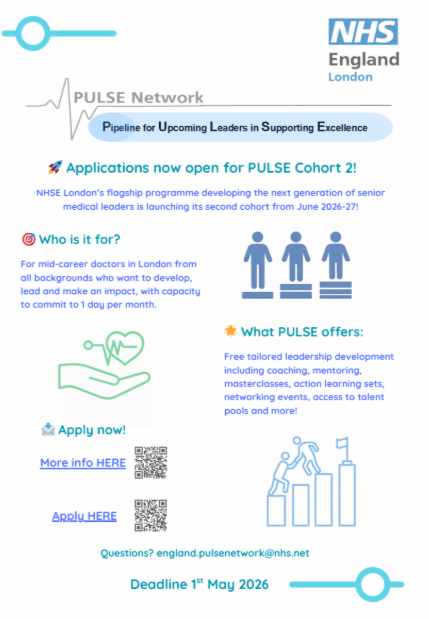
The PULSE (Pipeline for Upcoming Leaders in Supporting Excellence) Network is now halfway through cohort 1 and already showing exciting progress. PULSE was created to address a key gap in the system by supporting mid‑career medical leaders across London, with a core focus on developing a diverse leadership pipeline and propelling participants into senior clinical leadership roles.

Our inaugural cohort of 30 doctors are developing their leadership capability through a rich programme of coaching, mentoring, masterclasses, action learning sets, networking opportunities, and more. Cohort 1 will culminate in a celebration and showcase event on 29 April, with keynote speakers including Dame Caroline Clarke, Professor Kevin Fenton, and National Medical Director Clare Fuller.

Watch this space!… Communications for cohort 2 will be launching shortly. Huge thanks to colleagues across the Medical Directorate, the EDI subgroup’s ‘Once 4 London’ approach, and the People & Culture team for helping shape the next phase. If you know potential participants or have suggestions for the programme, please get in touch at: england.pulsenetwork@nhs.net. 

Looking ahead, we are beginning to bring our 5‑year medical leadership strategy to life. PULSE is one important component of our wider ambition to build a strong, connected, and diverse ecosystem of clinical leadership across London. 

Dr Savita Ghattaora, Associate Medical Director for Clinical Leadership 

England.pulsenetwork@nhs.net  


Innovate MD London Fellowships 

Our London System Dean, Dr Richard Bogle, led his cohort of Innovate MD Fellowships at their Academic Programme Day, kindly hosted by St Thomas’ Hospital Education Centre on the 22 January 2026.The day was a resounding success with a focus on clinical leadership and enhancing doctors’ working lives.

The keynote speaker was our own PULSE model lead, Dr Savita Ghattaora, GP and Associate MD for Clinical Leadership NHS England, London. Savita presented ‘From Leadership Identity to Networked Influence: the PULSE Model’.

Savita felt that “The real inspiration came from the fellows. Just 4 months in, and alongside busy clinical roles, they are already delivering practical, innovative solutions to many wicked problems in the NHS!”  

Many of the fellows presented their wonderful projects. A dynamic programme provided space for structured reflection and paired discussions. It was a lively day with a wonderful group of keen and passionate fellows.  

The presentations were grouped into those projects that were focused on Clinical Leadership: Redesigning Pathways and Systems and those that covered Enhancing Doctors’ Working Lives. The former included such varied topics as ‘Optimising Resident Doctor Resource Allocations to Improve Productivity’ and ‘Transition from Neonates to Paediatric Intensive Care’. The latter, in the second half of the day, focused on ‘Enhancing Doctors’ Working Lives: from Individual to System’ with projects diving into the challenges and opportunities in this area and the Capital Doctor programme, which has the goal of attracting, developing and retaining doctors in London.

The Innovate MD Futures page is available here. Please contact us if you wish if you would like to be a member: England.LondonFellows@nhs.net or if you would like to know more about the programme. 

Applications for the 2026-27 Innovate MD Fellowship programme will open on Monday 23 February 2026.

You can find more details on the Futures page here, including eligibility criteria and application form access.

Dr Richard Bogle, System Dean for North West London 

England.LondonFellows@nhs.net 


SAS (Specialty, Associate Specialist, and Specialist) Excellence in Development Recognition Award (SEiD)   

Please find below a message from Professor Geeta Menon, National Clinical Lead for Workforce for Cancer and Diagnostics, and National Dean for Inclusive Integrated Careers, Workforce Training and Education Directorate NHS England: 

I am writing to you with the exciting news that the SAS Excellence in Development (SEiD) Recognition Award scheme is now live and NHS trusts in England can now apply for the recognition award via the online application platform hosted at https://poll.hee.nhs.uk/s/SEiD_Award/.   

We believe that all SAS doctors deserve to work for an organisation that is committed to their development and their needs. Many trusts can struggle to retain and develop their SAS doctors, as the specific and varied needs of this diverse section of the medical workforce can often take a back seat. If a trust can evidence and showcase that it is a great place to work and develop as a SAS doctor, it can aid them in both the retention and recruitment of its SAS doctors. 

The SEiD Recognition Award scheme has been developed to incentivise trusts and employers to support their SAS doctors to have a better professional experience, by improving equitable promotion and ensuring options for career diversification and development. Not unlike previous ‘Charter Mark’ schemes or the ‘Athena Swan’ award, the SEiD Recognition Award scheme aims to drive improvement and competition between trusts. The core aim of the SEiD award is to retain and develop this often underutilised and underappreciated part of the medical workforce. 

The SEiD Recognition Award will be awarded in the form of a digital badge, with 3 levels of award available (gold, silver and bronze). Trusts who are able to demonstrate their excellence in developing and supporting SAS doctors will be able to advertise themselves as such with one of the 3 levels of award. Trusts will be able to reapply for a higher level of award in subsequent application rounds, provided they are able to demonstrate significant improvements against the agreed criteria. 

If you have any questions about the scheme or the application process, please contact england.pgmedreform@nhs.net. 

The London SAS Development Lead is Dr Marion Norbrook. 

You can contact the London team at england.SASdoctors@nhs.net  

GMC National Training Survey (NTS): Letters of Commendation 

The annual General Medical Council (GMC) National Training Survey (NTS) ran from 19 March to 16 May with over 69% (7,609) of postgraduate medical resident doctors completing it within London. The survey identifies areas of excellence and improvement to enhance medical education and training environments. The 2022-2025 trend data shows that the number of green outliers (positive) generated through the GMC NTS for resident doctors is staying consistent, whilst red outliers (negative) continue to show a declining trend line potentially indicating a shift in views of resident doctors away from the extremes and more into a middle range of results. 

NHS England’s Education Quality team commended 34 organisations and specialties for consistent improvements in postgraduate education, issuing Letters of Commendation from the Regional Postgraduate Dean. 

In contrast, the NHS England Education Quality team highlighted 175 areas that required further investigation. Of these 175 areas of concern, 2 warranted Urgent Concern Reviews to be undertaken, to ensure safe, high-quality training environments in line with the NHS England Quality Framework. 

Educator Workforce Strategy: Maturity Matrix Pilot 

The NHS England National team implementing the educator workforce strategy has developed a self-assessment maturity matrix which allows organisations to evaluate where they are in planning and supporting the multiprofessional educator workforce.   

We are pleased to report that we already have 5 London trusts who have volunteered to pilot this tool and give feedback on utility and ease of use.  

The maturity matrix involves completing a questionnaire that explore the six principles of the Educator Workforce Programme - each of which have some key indicators.  The matrix has three levels, the foundation key indicators – such as a named board level individual responsible for the educator workforce, the fundamental indicators which build on the foundation, and then the comprehensive indicators which show an organisation has a truly effective and multiprofessional approach to the educator workforce.  

The purpose of this pilot is to test out the questions and indicators that are being explored, and to further support the work on the Educator Workforce Strategy. We will report back after the pilot and give an update on the implementation plan of this and other aspects of the educator workforce strategy. 


Healthcare Science Virtual Work Experience 

The NHS England Workforce, Training and Education London Healthcare Science Team has been recognised on The Impact List 2025, which celebrates organisations that are breaking down barriers, driving social mobility, and creating real opportunities for young people.

This follows the success of their innovative virtual work experience programme which launched in July 2025 in partnership with Springpod. The programme has reached over 5,000 young people so far and provides interactive tasks, career insights, and post-programme support, covering T-levels, apprenticeships, and alternative pathways for widening access. Ongoing evaluation aims to further expand reach, equity, and long-term career outcomes for underrepresented students in healthcare science.

London Simulation Network Update  

The Workforce, Training, and Education medical workforce team would like to welcome Asanga Fernando to the team. Asanga will be starting with us on the 1st of October as the Training Programme Director for Simulation. Asanga is a Consultant Psychiatrist specialising in the care of cancer patients.  


He has clinical leadership, research, and educational roles in cancer care and psychiatry at St George’s in south London. He has experience and expertise in integrating mental health and physical healthcare and translating policy into practice by setting up clinical services and pathways.  

He has been passionate about innovation in education for decades and has held educational roles throughout his medical career, including at the South London and Maudsley, where he also held senior roles at Maudsley Simulation. Asanga has been Clinical Director for Simulation at St George’s Hospital for the last 6 years, where he has collaboratively set up several inter-professional educational programmes encouraging a human factors and patient safety-led approach across subjects. He is an honorary senior lecturer and has extensive research and quality improvement experience and has previously also worked on mental health policy nationally. 

He is particularly keen, with the London Simulation Network’s help, to build a collaborative community, whilst preparing it for the future by optimising the simulation response to the clinical, workforce, and technological challenges of today’s NHS in London. He is looking forward to working with you all!  


London Simulation Network meeting  


The NHS medical workforce team held their most recent London Simulation Network (LSN) meeting on the 4th of September. The meeting was well attended, and the chat was dynamic. Thank you to those who shared links. We would also like to thank Kristine Damberg, Shreena Shah, and Tom Pepper for presenting to the group.  


The presentations were:   

  • Internal Medicine Stage 2 Simulation Group 1 Specialties: Shreena Shah, a Physician in Acute and General Internal Medicine from Chelsea and Westminster Hospital, presented an update on the stage 2 simulation training programme, outlining curriculum changes, successes, challenges, funding processes, and actions for trusts.  
  • Maxillofacial Dental Core Trainee Simulation Programme: Tom Pepper, Director and consultant from King’s College Hospital, presented the design, outcomes, and future plans for a simulation training programme for maxillofacial dental core trainees at King’s College, with discussion on human factors, resource challenges, and potential for in situ simulation.  
  • Embedding Environmental Sustainability in Healthcare Simulation: Kristine Damberg, Senior Simulation Practitioner from St George’s, Epsom and St Helier, delivered a comprehensive presentation on integrating environmental sustainability into simulation-based education at Epsom St Helier, detailing educational strategies, operational changes, and collaborative initiatives, followed by a discussion on faculty development and adaptation to climate impacts.  


The London Simulation Network Future NHS workspace is now live and has been shared with LSN members: London Simulation Network – Futures.

Please contact the LSN team if you have any questions: England.LSN@nhs.net


Specialty and Specialist (SAS) Doctor Development Across London  

NHS England funds a number of training initiatives through the London trusts for SAS doctors. The medical workforce team was excited to receive activity reports from the trusts providing details of the wide variety of training they have been hosting, supporting the growing number of SAS doctors.   

In the previous financial year, the courses, conferences, and training hosted by trusts have supported many SAS doctors to receive training related to coaching, leadership, communication, management, and teaching. The courses also include training tailored to improve their skills in teaching, presenting, and facilitating.  It was also inspiring to see the number of courses focused on equality, diversity, and inclusion, including Understand the different dimensions of culture. As well as focusing on wellbeing and resilience, topics such as burnout, team bonding games, and wellbeing days are being included on the agenda.   


SAS Tutor and Advocate Away Day – 9th October 2025, Thursday  

Marion Norbrook, NHS England SAS Clinical Lead, would like to welcome London SAS tutors and advocates to the annual London SAS Tutors and Advocates Away Day.

Please register for the event by completing the form here: https://forms.office.com/e/fZSpSwiZg2   

Please contact the team for any queries: england.sasdoctors@nhs.net     


Speakers include:   

  • Jo Wren, Head of General Medical Council, London  
  • Helena Smith, SAS Advocate and Tutor at University College London Hospitals  
  • Elizabeth Swatkins, Head of Specialist Applications, General Medical Council   
  • Rupal Shah, Professional Support Unit, NHS England, London  
  • Geeta Menon, National Dean for Inclusive Careers

Pharmacy

London continues to be a training destination of choice for pharmacy learners. Training offers commissioned by WT&E Pharmacy in the capital, are helping to grow the workforce across the region to better meet the health and care needs of Londoners.  

In line with strategic policy direction and the shared ambition to make London the world’s healthiest global city, we are supporting the development of pharmacy professionals to deliver services fit for the future.  

  • Over 500 independent prescribing places have been commissioned this year for pharmacists based in the capital to access 
  • London has greatest number of Foundation Trainee Pharmacists (FTPs) in the country!  
  • In the 2025/26 academic year there will be 738 FTPs in the region 
  • Following a recent call for community-based Pre-registration Trainee Pharmacy Technician (PTPT) training places, we were inundated with expressions of interest and expect to fill over the 100% of planned placements   

To get in touch with the pharmacy team, please email: england.wtepharmacy.london@nhs.net  


Specialty and Specialist Doctors (SAS) 

June SAS Tutor Update Meeting  

It was wonderful to host the SAS tutors at our NHS England headquarters at Canary Wharf. Everyone was delighted to be able to network, with those early in their role able to buddy up with the more experienced tutors and leads.

Best practice that came up during conversation included:  

  • SAS induction program: East London Foundation Trust   
  • Specialist appointment panel: to support current specialty doctors to move to the specialist role

It was a great opportunity for us to discuss regional and national updates and sharing systems and resources to further strengthen our SAS London network. The group are looking forward to SAS Week – 6th to 10th of October 2025, and the GMC SAS Educators Away Day on the 9th of October 2025.

The group are keen for a London SAS Conference, and this is something we will be taking forward along with systems group meetings and more face-to-face opportunities to support each other. Further updates to follow.   


SAS Excellence in Development (SEiD) Award Roundtable Launch   

The SEiD award was launched in June.

The NHS Long Term Workforce Plan (2023) committed NHS England to work with the Government and employers to support SAS doctors by improving equitable promotion and options for this group to diversify their careers. In response, NHS England has been working with stakeholders to establish and deliver the SEiD recognition award, that will formally recognise NHS trusts in England that are meeting specific outcomes in promoting an inclusive culture and supporting the development of their SAS workforce. This recognition award will be a valuable tool for employers to demonstrate their continuous support and commitment to this group, enabling them to continue to recruit and retain SAS doctors as an important part of the medical workforce.

Professor Sir Stephen Powis, National Medical Director of NHS England, discussed the importance of the SAS workforce and Dr Navina Evans, Head of Workforce, Training and Education, discussed the role of SAS doctors in the 10-year workforce planning. Professor Geeta Menon, National Dean for Inclusive Integrated Careers who has led on this project presented the SEiD awards.

NHS organisations will be able to apply for three levels: bronze, silver, and gold. They will apply against specific criteria including practices and policies based on the three pillars: Train, Retain and Reform. Criteria and applications will be open in Autumn. Further information about this will be disseminated.

Marion Norbrook, Associate Dean for SAS Workforce, London, England.SASDoctors@nhs.net   


PULSE Network Launch: Supporting the Next Generation of Medical Leaders 

On the 17th of June, we launched the PULSE network (Pipeline for Upcoming Leaders in Supporting Excellence), a collaboration between the Medical Directorate and WT&E aimed at improving cross sector collaboration and developing a diverse, sustainable pipeline of future medical leaders across London.

Designed to bring together a diverse range of clinicians from primary and secondary care, the network offers bespoke leadership development to its participants, including coaching, mentoring, action learning sets and networking opportunities.  

The launch event featured keynote contributions from Dr Nnenna Osuji, Dr Agatha Nortley-Meshe and Dr Zoe Penn, who reflected on their leadership journeys and the importance of inclusive leadership pathways. Participants also heard from Dr Savita Ghattaora on her research underpinning the network’s design.

The energy in the room was powerful, and with strong engagement and enthusiasm from attendees, we are planning five further events this year.

We’re also beginning work to identify and address further gaps in the clinical leadership pathway, and we welcome collaboration from those with insight or interest in this area!

Savita Ghattaora, PULSE Network Lead England.pulsenetwork@nhs.net

Postgraduate Medical and Dental Education

Important Update to Medical Specialty Training and Foundation Programme Recruitment (2026)  

The Government has introduced a bill to prioritise UK medical graduates for foundation training and give preference to UK graduates and doctors with significant NHS experience for specialty training. This legislation is now going through Parliament. Please find below links below for more detailed information:

Subject to the successful passage of the Bill, the changes will apply to all current applicants, even though applications have closed. 

Please refer to the NHS England Frequently Asked Questions which provides the information we have so far. We will provide further updates as they become available. 

10-Point Plan for Improving Resident Doctors Working Lives  

In the London region, the core 10-Point Plan for Improving Resident Doctors Working Lives (IRDWL) team have led discussions with the trust medical education and staffing managers regarding this important programme. We reviewed the 10 points with them and encouraged sharing of successes and challenges. The questions raised at this meeting have been answered and included on our FAQ on the IRDWL Futures page 

The London IRDWL Oversight Group met and agreed additional membership and terms of reference for the group, as well as discussing plans for London-specific metrics. We are working on a resident doctor network and will ensure that their voices are included in this vital piece of work.  

The London NHS England IRDWL programme held a virtual meeting open to all resident doctors on Thursday 6 November, to share the London baseline data and provide the opportunity to ask questions and contribute ideas for innovations and improvements.  

A webinar for senior leads for doctors in training at London trusts took place on Thursday 13 November to update colleagues on London’s progress so far and provide an opportunity to share best practice. Updates and recordings from both meetings will be available on the IRDWL Futures platform.

On 21 October, the team presented an update on the IRDWL programme to the broader London Workforce, Training and Education team, engaging internal stakeholders with the view for potential collaboration and innovation. We have also collaborated with our Quality team and system deans to ensure that the 10-Point Plan metrics are discussed in all stakeholder meetings. Themes on 10 point plan issues have been added to our Key Lines of Enquiry for quality interventions. 

We remain focused on this important work and look forward to working with our many stakeholders to deliver meaningful change. 


National Education and Training Survey  

The National Education and Training Survey (NETS) opened on 7 October and will close on 2 December. NETS offers a platform for healthcare learners and trainees to share their experiences and shape the future of healthcare education. Since 2019, NETS has been the only national survey open to all resident doctors, healthcare students, trainees, and apprentices in England. The survey covers key themes like induction, clinical supervision, facilities, learning opportunities, and teamwork.

Of the seven NHS England regions, London currently has the lowest rate of responses. The more responses we have, the more we are able to understand our learners’ experiences and use the data to drive improvement in their future clinical training and placements.

Please promote the survey to any learners or educators in your networks, the survey link is here and promotional material, including posters and videos, is available on the Futures site. 

London Update on the 10 Point Plan

In April 2024, former Chief Executive of NHS England, Amanda Pritchard wrote to the health services leaders detailing the actions required nationally and locally to improve the working lives of resident doctors, building on previous guidance and advice.  

In August 2025, current Chief Executive of NHS England, Sir Jim Mackey and Professor Meghana Pandit wrote to NHS trust chief executives, medical directors, and chief people officers, setting out a 10 Point Plan to improve resident doctors’ working lives.  


Summary of the 10 Point Plan: 

  1. Trusts should take action to improve the working environment and wellbeing of resident doctors. 
  2. Resident doctors must receive work schedules and rota information in line with the Code of Practice.
  3. Resident doctors should be able to take annual leave in a fair and equitable way, which enables wellbeing.
  4. All NHS trust boards should appoint two named leads: one senior leader responsible for resident doctor issues, and one peer representative who is a resident doctor. Both should report to trust boards. 
  5. Resident doctors should never experience payroll errors due to rotations.
  6. No resident doctor will unnecessarily repeat statutory and mandatory training when rotating.
  7. Resident doctors must be enabled and encouraged to Exception Report to better support doctors working beyond their contracted hours.
  8. Resident doctors should receive reimbursement of course-related expenses as soon as possible.
  9. We will reduce the impact of rotations on resident doctors’ lives while maintaining service delivery.
  10. We will minimise the practical impact upon resident doctors of having to move employers when they rotate.


NHS England, Workforce, Training and Education (WT&E) will be working closely with trust colleagues across London to help deliver on this plan. We are holding a webinar for key London colleagues during September to update them on progress to date. We have also set up an oversight group.

We are already looking at and challenging where these changes should and would have a wider benefit to the wider NHS workforce and will be testing our approach against this challenge.  

We look forward to working with you to improve the working lives of our workforce and will provide updates in future bulletins.  

Foundation Recruitment   

This is the second year of Preference Informed Allocation (PIA) where individuals can preference the 18 national Foundation Schools (15 in England plus 3 devolved nations) with the subsequent allocation to school based on an algorithm.   

PIA this year enabled 84% of individuals to be matched to their first-choice school and 95% to get their top 5 school. https://foundationprogramme.nhs.uk/wp-content/uploads/sites/2/2025/02/UKFP2025-Comparison-of-FP-allocation-results.pdf 

Also of note, 100% of candidates allocated to London Foundation school put London as their first choice school.


Placeholder Programmes  

This year London was able to offer 106 Specialised Foundation Programmes and 1,042 standard programmes, total 1,147 programmes – our largest cohort yet.   

In February, we were then allocated 1,238 candidates. This meant that in March, we had 91 placeholder candidates – incoming F1 doctors who did not initially match to a programme. This did leave some foundation doctors in holding placements.   In London, we have now been able to identify programmes through withdrawals, deferrals, less than full-time slot share, and a few new programmes. Thank you so much to all the trusts who have aided us with proactive communications to the school about incoming candidates not engaging. This has helped identify vacancies early.

This has been a huge team effort, and we wanted to extend our thanks to all trusts and their medical education teams for their support.

Nursing and Midwifery

Return To Practice Impact: Positive Feedback from NELFT 

We are pleased to share feedback from a recent Return to Practice (RtP) nurse at North East London NHS Foundation Trust (NELFT), highlighting the value of high-quality placements and strong practice support in enabling successful returns to the workforce. The returner described increased confidence through the programme, noting that skills developed during time away from practice supported her transition back into clinical settings, alongside renewed engagement with learning and lifelong professional development. 

The feedback also emphasised the breadth of placement exposure across services including Child and Adolescent Mental Health Services (CAMHS), the Falls Service and Community Children’s Nursing, and the importance of consistent support from both a practice assessor and the trust’s practice experience facilitator. This provides a clear example of how well-coordinated placements and dedicated practice infrastructure contribute to workforce supply and retention objectives. A sincere thank you to Paul Burcombe, Isabella Jones and colleagues at NELFT for their continued commitment to supporting returners.


Capital Clinical Support Worker (CapitalCSW)

CapitalCSW was established in 2025 and joined the Capital Programmes family, alongside CapitalNurse, CapitalMidwife, CapitalAHP, and CapitalDoctor.

CapitalCSW brings together London’s Healthcare Support Workers (HCSWs), Maternity Support Workers (MSWs), and Allied Health Profession Support Workers (AHPSWs) under one shared identity, recognising their collective contribution to patient care and creating a platform for development, inclusion, and recognition. 

“Every London Clinical Support Worker (CSW) is a CapitalCSW.”

Its vision is: to build a connected clinical support workforce where every support worker is skilled, valued, supported to grow, and empowered to deliver excellent care through shared identity and collaboration.

The CapitalCSW programme will: 

Attract and Include  Recognise and Value  Grow and Develop 
Attract and widen access to support worker roles through inclusive, innovative and sustainable recruitment that reflects London’s diversity.  Raise the profile of support workers by celebrating their contribution and building a shared identity across all professions and settings.  Enable learning, progression, and cross-professional development through targeted support, skills enhancement and opportunities. 

Some of our current programmes of work include: 

  • development of a support worker digital passport 
  • care certificate quality assurance working group  
  • higher development award and digital skills development  
  • career development  
  • recognition and value of support workers  

For more information about the CapitalCSW, visit: Be a London Clinical Support Worker – Capital Nurse
 

Launch of NHS Excellence Awards 

NHS England has launched the new NHS Excellence Awards, to help recognise, celebrate and share the most innovative and impactful work driving real improvements across health and care.

The awards will shine a light on local projects and teams who are driving the changes set out in the 10 Year Health Plan and inspire others to adopt and adapt proven ways of improving access, quality and patient experiences.

This is the only awards programme run by, and for, the NHS so it will be completely free to enter. Entries open on Monday 19 January and close at 5pm on Friday 6 March. We encourage Nursing & Midwifery colleagues to submit nominations.  


Celebrating EDI in the Educator Workforce 

Dr Ruth Brown has kindly shared the below with us to support with raising awareness with our nursing and midwifery educators and encourage them to register.

If you would like to attend, please find the registration link to the webinar on 25 February 2026 10:30am – 11:30am: Celebrating EDI in the Educator Workforce | NHS England Events 


Launch of Chief Nursing Officer and Chief Midwifery Officer Student Awards 

Nursing, Midwifery, Nursing Associate Students and Apprentices Awards 

Our nursing, midwifery, nursing associate students and apprentices represent the future of our health and care workforce. Whether in university settings or on practice placements, they make meaningful contributions – providing compassionate care to individuals and communities and offering important support to colleagues and fellow students across diverse environments.

Their dedication, professionalism, and impact deserve recognition. Through this initiative, we will celebrate the invaluable role of our student support workforce and highlight the difference they make to patients’ lives. 

If you have any questions about student awards, please review the frequently asked questions document  on the Futures collaboration platform (this platform requires a log in) or email england.studentawards@nhs.net.

Please remember to share the Student Hub with our learners – Student Hub | NHS England | Workforce, training and education. 

London Success in Multi-Professional Preceptorship Excellence: Celebrating London’s Leadership in National Preceptorship Standards 

Preceptorship is a structured period of support that helps newly registered professionals across nursing, midwifery, and allied health professions transition confidently into their roles. 

All five of our London early adopter organisations have successfully achieved the National Preceptorship Quality Mark (NPQM) recognising excellence in delivering high-quality, multi-professional preceptorship. 

This success reflects the commitment, collaboration, and leadership of our London teams in shaping and delivering the national approach to early career support. 

Awarded organisations:  

  • Royal Free London NHS Foundation Trust Group 
  • Central London Community Healthcare NHS Trust 
  • Royal Marsden NHS Foundation Trust 
  • London North West University Healthcare NHS Trust 
  • South West London Training Hub 

To find out more, please contact Jacqueline Robinson-Rouse jacqueline.robinson-rouse@nhs.net 


Supporting Newly Qualified Nurses, Midwives, and Nursing Associates Into Employment 

This year has seen an increase in the number of newly qualified staff (nurses, nursing associates and midwives) who have not secured employment on graduation. The reasons are complex and multi-factorial and include:  

  • High retention of staff resulting in fewer vacancies.  
  • Reorganisation of some services as a part of the operational planning requirements resulting in the redeployment of staff into vacancies that newly qualified staff would have previously had access to.  
  • Unexpected changes in the job market from the point of recruitment to programme when vacancies were high. 
  • Vacancies not available in preferred locations or specialties, and limits on travel distance. 
  • Poor interview technique. 


To support the London region to optimise recruitment of new graduates into the workforce a London region Task and Finish Group has been convened to develop and direct appropriate support both for those who have just graduated and those currently in their final year of study.

Actions taken by the group include: 

  • Determining actual data using graduate and trust surveys to identify the areas of greatest need. 
  • Mutual aid both at Integrated Care Board (ICB) and regional trust level, and inter-regionally, to identify vacancies which have been offered to graduates from a different London trusts and out-of-region opportunities, including accommodation offers. 
  • Creating a central resource point for sharing employment opportunities. 
  • Implementing the London region graduate support offer (relaunched June 2025), which included all London universities, primary, secondary and community care organisations, and graduating learners. This offer aimed to ensure nursing, midwifery and nursing associate learners felt confident and well-prepared for their careers. It has now been superseded by the National Graduate Offer on the Student Hub and has been shared widely. 
  • Hosting a Student Employment in Social Care Webinar, hosted by NHS England, Skills for Care and The Social Care Advisory Council. This covered myth busting about working in social care and advice regarding applying for roles in these settings. The webinar has been uploaded to the NHS Learning Hub site for London: Resource details. 
  • Offering primary care recruitment support through the five London region training hubs. This year, 50% of applications for recruitment into this sector through an NHS England-supported training route were from newly graduating nurses. 


  • Review of trust implementation of the actions required stated in the Graduate Guarantee letter from the National NHS England team including a review and support of National initiatives:  
    • Midwifery offer (financial incentive to increase establishment of midwifery preceptorship roles). 
    • Bank preceptorship offer (less scope to implement currently due to reduction in bank and agency usage). 
  • Collaborating with the universities to highlight resources to support graduates with job seeking in a competitive market  
  • Exploring opportunities to engage with Private Chief Nurses group in the London region. 

Next steps: 

The regional Task and Finish Group is now seeking to understand:   

  • The anticipated number of graduates expected in Spring and Summer 2026. 
  • How recruitment to positions within the region can be best supported to ensure all graduates have equal access to any vacancies identified within their specialist field of practice. 
  • How expectations can be managed for learners enrolling in healthcare programmes. 
  • How final year learners can be supported with preparation for the employment process by their university and placement partners. 

For further information, please email england.nursingandmidwiferyldn@nhs.net 

Supporting Nursing and Midwifery Students and Student Nursing Associates into Employment: 

Updated Student Hub Provides Career Support for Student Nurses, Midwives, and Nursing Associates 

In August 2025, the Secretary of State for Health and Social Care announced a Graduate Guarantee: a commitment that every newly qualified nurse and midwife in England will have the opportunity to join the health and social care workforce.   

To support this commitment, we have updated a dedicated Student Hub to help ensure nursing, midwifery, and nursing associate learners feel confident and well-prepared for the next step in their careers. This enhanced hub now includes targeted resources to support job searching and interview preparation, helping students and newly registered professionals feel more confident and better equipped as they start their new careers across health and care.  

The Student Hub has been developed in collaboration with students, professional bodies, health, care, and higher education partners, and will be regularly updated to reflect evolving needs. The Student Hub aims to:  

  • Empower learners and newly registered professionals to explore the diverse health and care career opportunities available.   
  • Share quick job site links for a range of vacancies across the NHS, social care, independent sector, and charitable sector.   
  • Provide practical tools and guidance to support job search, applications and interview processes.   
  • Bridge the gap between academic studies and professional employment, ensuring graduates feel informed and ready to take the next step into the health and care workforce.   


Raising Awareness of Other Health and Social Care Jobs  

To support graduating nurses to understand and consider careers across the breadth of health and care settings, the London region, working with Skills for Care and the London Social Care Nursing Advisory Council, hosted a Social Care Nursing London Careers Webinar on the 28th of August 2025.  

Further information can be found at Nursing careers in social care and on the NHS Learning Hub https://learninghub.nhs.uk/Catalogue/londonrepair 

Jobs for Newly Qualified Nurses and Midwives

On the 3rd of June 2025, the refreshed graduate offer to support nursing and midwifery learners within the region to apply for roles on graduation was launched: CapitalNurse Newly Qualified Nurse (NQN) Graduate Offer – FutureNHS Collaboration Platform. This webinar invited employers and universities within the region to an event to understand the wraparound resources which are available for them and learners during their transition into the workforce to ensure there is a consistent message for them at this time.  

The offer provides guidance around the process of moving into the workforce, what to expect, and how to apply for roles and prepare for interview.

Actions Taken

In response to the concerns being raised with regards to sufficient roles being available for learners within the London region, we have undertaken a piece of work with our workforce planning and intelligence colleagues to identify if there is a match between the number of graduating learners from the region compared with the anticipated vacancies identified within NHS organisations on Electronic Staff Record (ESR).

Our analysis is based on an assessment to assume a proportion – based on past numbers and staff flows – of newly qualified joiners in London and then compare with expected vacancies.

Whilst we acknowledge that a reduction in turnover or alteration in vacancy rates will impact the data, it suggests that for nursing (all branches) and midwifery, there should be sufficient vacancies within the region for all those who wish to apply.

Due to the work to retain staff in the region these roles may not always be in the areas of the learners first choice which is addressed within the graduate offer toolkit that was launched.

  • We have held a series of events across the region to discuss this work in more depth including with:  
  • Review of Midwifery and Roundtable: 24th of April 2025  
  • Learning Disability Assembly: 4th of June 2025  
  • CPO (Chief People Officer) London Region Network Meeting: 17th of June 2025 
  • Review of Child Pre-Registration Nursing Roundtable: 23rd of June 2025  
  • CNO (Chief Nursing Officer) London region Meeting: 24th of June 2025
  • SFP (Social Partnership Forum): 26th of June 2025 
  • ICS CPO network: 7th of July 2025

We have developed the Student Movement Dashboard which follows the student journey.  It includes the movement of students from The Universities and Colleges Admissions Service (UCAS) application through to starting in NHS as newly qualified joiners. The data generated has been used to carry out an analysis that is available in the dashboard.

While the dashboard does not yet include the alignment to the trusts’ turnover and vacancy rates, it does provide an estimation of expected newly qualified students to enter the workforce. This is based on the historic trend of student to employment transition rates and is intended to be used to aid conversations rather than predict exact starter numbers.  This has been utilised in a variety of forums, in conjunction with our nursing and midwifery colleagues in the NHS England region to provide an analysis of newly qualified nurses and midwives and the likelihood of them securing a job in the next 12 months.  


Other Workforce Training Updates

  • We have recently confirmed and allocated a training grant to support multi-professional non-medical prescribing within the region following scoping undertaken by the ICB to determine organisational need for this in November last year.   
  • Continuous Professional Development (CPD) has also been identified and will be allocated to NHS organisations and Primary Care Training Hubs in July to support them with the development of their allied health professionals, nursing, nursing associate and midwifery staff in this financial year.  
  • We have also had a training grant agreed to support organisations to upskill their nursing associate or assistant practitioner workforce to achieve their nursing registration. Scoping was undertaken regarding organisational demand for this by ICBs in November last year and commissioning letters have been sent to those organisations who indicated they would like to utilise this to develop their workforce. 

Additional Resources

Delivery and Oversight

Cancer and Diagnostics  

The Reporting Radiography upskilling programme is now in its eighth year. Alongside supporting current trainees, London continues to offer a supplementary mentorship programme for previous trainees and qualified radiographers, providing teaching sessions and pastoral support. In 2024-25, the team has worked more closely with the Imaging Academy, taking a more national approach, piloting new teaching platforms, and hosting expert speakers on emerging topics such as the medicolegal implications and early lessons from AI. We’re also pleased to share that an abstract has been accepted at the European Congress of Radiology: “Scaling the training of reporting radiographers: an evaluation of 7 years of London regional mentorship.” 

In addition, a project funded 3 years ago through the Royal Marsden Partners and North West and South West London Cancer Alliance, ‘Improving the Early Diagnosis of Cancer Quality Improvement Scheme’ has been shortlisted as a finalist for the Health Service Journal (HSJ) Innovation and Improvement in Reducing Healthcare Inequalities Award. This recognition reflects the value of sustained investment and long-term commitment in driving meaningful change, particularly in early diagnosis and tackling health inequalities. 


Mental Health 

Important update on Reasonable Adjustment Digital Flags (RADF): 

The new Information Standards Notice (ISN) released in December 2025, mandates all NHS and publicly funded health and social care service providers to share, read, and write reasonable adjustment digital flags by 30 September 2026.

The RADF is set to significantly benefit millions of disabled individuals, ensuring they receive reasonable adjustments whenever and wherever they access publicly funded health and social care services. The digital flag, a visible marker on a person’s NHS National Care Records Service record, indicates the reasonable adjustments required by a person with a disability. These adjustments are a legal requirement under the Equality Act 2010.

3 crucial changes in the new information standard include: 

  • Mandatory Compliance: From December 2025, all NHS and publicly funded service providers must be compliant with the new standard and its guidance. See this summary checklist of actions for service providers. 
  • Consent Change: The basis of consent has shifted from explicit to implied consent, although individuals can object to data sharing at any time. The Mental Capacity Act 2005 should be consulted with regards to decisions about capacity and competence. 
  • Compliance Timeline: Full compliance is required by 30 September 2026. If a provider’s software is not onboarded by this date, they must use the NHS’s National Care Records Service to share reasonable adjustment data.

To meet these requirements, providers must: 

  • Identify and record reasonable adjustments for individuals accessing their services, preparing for data sharing by 30 September 2026. 
  • Be capable of sharing, reading, and writing reasonable adjustment data by the deadline, either through onboarded software or directly via the National Care Records Service.


NHS London Anchor Programme   

Celebrating 5 Years of Anchor Partnerships in London – A Milestone for LAIN and the NHS London Anchor Programme 

The London Anchor Institutions’ Network (LAIN), together with the NHS London Anchor Programme, hosted an anniversary event at City Hall in February, marking 5 years of impactful anchor partnerships in the capital. The event, delivered in partnership with the NHS and the LAIN team at the Greater London Authority, brought together over 100 senior leaders dedicated to advancing anchor work across London. 


Championing Anchor Institutions 

Dame Caroline Clarke, Regional Director for the NHS in London, addressed attendees by highlighting the NHS’s role as a critical and founding anchor partner. Other distinguished speakers Richard Watts, Deputy Chief of Staff to the Mayor of London, and Rob Anderson, Research Director at Centre for London shared their perspectives on the powerful influence of anchor institutions in driving positive change. 


Shared Purpose: Driving Social, Economic, and Environmental Change 

Lizzie Smith, Co-Chair of LAIN and Director of Workforce, Training and Education for the NHS in London, reflected on the importance of a united approach. “We may come from different sectors, but we’re united by a shared purpose – to use our collective resources to affect positive social, economic and environmental change – never has this been more important for the NHS specifically to tackle the wider determinants of health,” she remarked. 


Showcasing Success 

An exhibition of case studies at the event highlighted the diverse achievements and impacts of member organisations, with many NHS initiatives featured. The showcase demonstrated progress under the anchor pillars of good employment, sustainability, and procurement, illustrating how anchor institutions are contributing tangible social value across London communities. Case study boards are live on the LAIN website here. 


NHS London Anchor Programme’s Evolution 

In 5 years, the NHS London Anchor Programme has grown from being a conscious contributor to a leader in the anchor movement. This shift offers new opportunities to embed anchor principles and practices throughout Integrated Care Systems. To keep anchors at the centre of health service delivery and broader social and economic progress, innovative approaches are needed at both neighbourhood and system levels. The mission remains clear: build a sustainable health and care system for Londoners, advance social justice, reduce inequalities, and empower local communities.


Collaboration: The Key to Lasting Impact 

The continuing progress of the NHS London Anchor Programme is a testament to strong collaborative work across the region. Through strategic partnerships within the NHS and with organisations across the capital, the NHS stands as a committed Anchor Institution – helping to build healthier, more equitable, and economically vibrant communities. 

Image Gallery: LAIN Celebrates 5 Years of Impact 2026 | London Anchor Institutions’ Network 


Anchor Strategy and Change Network Event: Sharing Progress and Inspiring Action 

Highlights from the NHS London Anchor Programme’s Latest Gathering

The NHS London Anchor Programme recently hosted a vibrant Strategy and Change Network Event on Wednesday, 28 January at Hackney Town Hall. This gathering aimed to provide a platform for sharing and learning about the progress, challenges, and achievements made in the delivery of local change programmes and corporate anchor strategies. The event drew an impressive crowd, with over 100 delegates attending from across the London region.


Opening Remarks and Keynote Sessions 

The event was opened by Caroline Woodley, the Mayor of Hackney, followed by an insightful session from Dame Caroline Clarke, Regional Director for NHS England London. Dame Caroline offered a valuable perspective on the broader London and Integrated Care System (ICS) context, setting the stage for a day of meaningful discussion and collaboration. 


Spotlight on Local Initiatives 

Led by the City and Hackney Place Based Partnership, the event focused on the theme of ‘Working Well in Neighbourhoods’. Participants benefited from a series of lightning talks delivered by partners from across the network. These talks highlighted lived experiences and practical examples, such as the journey from neighbourhood resident to workforce member, maximising social value through voluntary and community sector (VCS) partnerships, supporting career progression and development for all, and harnessing data and clinical skills to drive anchor priorities. 


Drivers and Opportunities 

The event concluded with a panel discussion focusing on the drivers and opportunities for maximising our anchor potential in neighbourhoods across the partnership. Lizzie Smith, Director of Workforce, Training and Education for the London region and the SRO for the NHS London Anchor programme, remarked: “This event in London was a fabulous example of the power of local anchor impact.”


Acknowledgements 

The NHS London Anchor Programme extends heartfelt thanks to the City and Hackney Place Based Partnership for their exceptional work in coordinating the event. Special appreciation goes to all those who participated and attended, especially the residents and service users with lived experience, whose stories and insights made the event truly memorable. 


London NHS Trusts Shine in Work Experience Quality Standard Awards 

The NHS London Anchors Team are excited to share some fantastic news about our recent achievements concerning the Work Experience Quality Standard (WEQS) award. This prestigious award gives organisations the assurance that the work experience they offer reaches the highest possible standard. 

 The Quality Standard framework is a comprehensive tool that allows organisations to assess the quality of their work experience placements against a set framework. To earn this award, organisations must demonstrate excellence in planning, delivering, and evaluating their work experience placements. The quality standard framework includes all the criteria necessary to qualify for the bronze, silver, and gold quality standards. These criteria are carefully broken down into 6 sections, which correspond to different stages of a work experience placement: healthcare organisation, pre-placement, placement induction, during placement, reflection and review, and post placement. 

 The award is valid for 2 years and acknowledges the quality of work experience provision. We are delighted to announce the organisations in our region that were awarded in the most recent and final cycle: 

  • Barking, Havering and Redbridge University Hospitals NHS Trust – Gold 
  • Croydon Health Services NHS Trust – Bronze 
  • Epsom and St Helier University Hospitals NHS Trust – Silver 
  • Homerton Healthcare NHS Foundation Trust – Bronze 
  • London North West University Healthcare NHS Trust – Gold 
  • South London and Maudsley NHS Trust – Bronze 
  • West London NHS Trust – Bronze 

Each of these organisations has been provided with an awarding letter that included their strengths, areas for improvement, alongside a certificate and logo to display and celebrate their achievement. 

Nationally, this has been the most successful cycle in the history of the Work Experience Quality Standard.  Although the Work Experience Quality Standard has been paused for now, we will soon have updated information on the NHS England website regarding how the WEQS Framework and Guidance documents can be utilised by trusts and organisations moving forward. If you would like to join our stakeholder list and receive information on any changes to this programme, please click on this link to add your details. 

The Anchor Programme Team is incredibly proud of the 10 organisations in London that have achieved this standard over the past 3 years. We would like to extend our congratulations to everyone who has applied and worked diligently towards this standard as access and quality of work experience provision is highly valued by young people in our communities. 

Anchor Institution Programme: 

Launch of the Inclusive Talent Strategy and Get London Working Plan by the Mayor 

Lizzie Smith, Regional director of Workforce, Training and Education spoke on a panel alongside Deputy Mayor Howard Dawber and other experts in this space, on the importance of collaboration to bring this work to life at the launch on 23 October – you can watch the launch here.

The Inclusive Talent Strategy presents a bold, ambitious plan to build the pipeline of diverse talent we need to deliver inclusive growth. Allowing businesses of all sizes to recruit the talented people they need to succeed, because investment will be targeted at the courses which produce them. The strategy takes a three-pronged approach of:

  • Putting employers at the centre of driving inclusive growth.  
  • Ensuring Londoners can find the right training and support to help them find and stay in good quality jobs.  
  • Tackling the barriers to retaining talent.

The Get London Working plan sets out London’s whole-system partnership approach to tackling economic inactivity and ensuring that every Londoner can access and progress in good work.  It is our local approach to progressing the ambitions set out in the government’s Get Britain Working White Paper.  It has been developed through a partnership of GLA, London Councils, Jobcentre Plus, London NHS partners, and working closely with Sub-Regional Partnerships, to support the government’s target of an 80% employment rate.

You can find out more here. 


Living Wage Week 2025: The Difference it Makes 

Living Wage Week (10–16 November) celebrates the power of fair pay to transform lives. This year’s theme “the difference it makes” highlights how the real Living Wage, Living Hours, and Living Pension support stability, dignity, and economic growth. 

With over 16,000 accredited employers, including NHS England, the movement continues to grow. The NHS London Anchor Programme proudly champions good employment and economic resilience – especially as the cost of living rises.

Learn moreor contact the London Anchor Programme team at england.ldn.anchor@nhs.net 


London Anchor Network FutureNHS Site 

This workspace connects you with Anchor colleagues and resources, including blogs, learning session recordings and updates. Please request to join using this link.

NHS London Anchor Programme: Building a sustainable health and care system for Londoners by advancing social justice, reducing inequalities, and empowering communities. Please let us know how improve this site to provide a valuable resource via england.ldn.anchor@nhs.net. 


London Anchor Institutions Network (LAIN) Impact Report Published 

LAIN’s latest Impact Report for 2024/25 was recently published on the website. 

It shows what happens when over 20 of London’s biggest institutions come together to build a fairer, greener, and more prosperous city. Highlights include: 

  • £3.3billion directed to small and diverse-led businesses to date (since 2021). 
  • 11,000+ Londoners receiving pay rises through the London Living Wage. 
  • 3,861 new apprenticeships created last year, up 38% in one year. 
  • Hundreds of thousands of tonnes of carbon saved. 


Mental Health:  

Parent and career PSW training 

We’re pleased to share that applications are open for the first intake of the Parent Carer Peer Support Workers (PC PSWs) training, commissioned by NHS England. The training will commence in the first week of January 2026.  

This fully funded course is open to parents and carers with lived experience, working in partnership with a supporting service. Training PCPSWs is a vital step in enabling the shift to community-based care as outlined in the 10 Year Health Plan, equipping them to work in an integrated, evidence-informed, and safe way that improves outcomes for families. 

The deadline for completed applications is Friday 28 November 2025 at 6pm. The Charlie Waller Trust has some helpful resources here for anyone interested in applying or who may have questions.  


Psychological Professions Week (10 – 14 November 2025) 

The week offered inspirational virtual and in-person events hosted by the regional Psychological Professions Network (PPN). PPN London and Oxleas NHS Trust co-hosted an insightful and engaging virtual roundtable discussion with senior psychological therapists, which touched on various topics, from their experiences as trainees, conceptualisations of mental health difficulties of psychological distress and thoughts regarding where they are in terms of care for those experiencing mental health difficulties in the NHS of today and the future. 

Cancer and Diagnostics: 

Over the past month, we have focused on developing our Education and Training Activity Plan for Cancer and Diagnostics. This has now been signed off at London level and is undergoing a national check and challenge process. 

We will be going out again to ask for expressions of interest in upskilling opportunities. There is still a small amount of resource remaining after the last round of grants. We will be engaging with cancer and diagnostics leads in this regard. 

In our next update, we will provide an update on targets for next year.  

Public Health: 

Our 2025 scheme practitioners are now underway with their portfolios, submitting their first (of three) commentaries over the past two weeks. We have now recommended all 2024 practitioners to the UK Public Health Register (UKPHR) for registration, adding 15 registered practitioners to the London public health workforce. 

The Public Health Practitioner Level 6 apprenticeships for 2026 are now at advertising and recruitment stage.  There should be 10 new starters across eight London boroughs in January. 

In the last month, we have created and advertised a Light-Touch scheme (with less facilitation and support) to fill the gap in practitioner registration whilst we navigate the procurement of a new facilitator.  This is aimed at more senior practitioners nominated by their organisation to apply for a place on this scheme.  We hope to recruit five practitioners to participate in this. 

There will be a Public Health Practitioner network meeting online in December, to bring the London public health workforce together to share programmes and interventions, network, and connect before the Christmas break.  We are exploring offers from local authorities to host face-to-face network events in 2026. 

Anchor Institution Programme 

Celebrating Future NHS Leaders: London Industry Placement Scheme Marks a Milestone  

August 2025 marked a proud moment for NHS London as the first cohort of the Industry Placement Scheme (IPS) came together to celebrate the completion of their 12-month salaried placements. This scheme is part of the NHS London Anchor Programme and was piloted by North West London. It welcomed second-year undergraduates from Brunel University and the University of Westminster, showcasing their contributions in a range of non-clinical roles across the NHS.  

Later this month, the second cohort of students will be welcomed by their host organisations, and we will explore how we can scale the scheme further. The NHS London Anchor Programme remains committed to creating inclusive pathways into NHS careers, nurturing talent, and supporting the leaders of tomorrow.   

To find out more, please email england.ldn.anchor@nhs.net   


Careers and work experience  

Both the careers engagement initiative led by the London Anchor Programme and work experience offered across NHS employers in London directly contribute to the quality of careers education that young people receive in London and support schools in meeting the Gatsby Benchmarks 

Over the last 3 years, talks on different NHS careers, including nursing, medicine, allied health professions, healthcare science, and pharmacy, have been offered to secondary school students in London, via a network of 1,000 health ambassadors. Since 2022, over 101 career talks have been held in London secondary schools, with over 15,000 young people reached in the 2024/5 academic year via both career talks and ambassador representation at careers fairs. 100% of teachers felt the career talks meant their students were more likely to choose a career in the NHS. The careers engagement initiative will continue in the 2025/26 academic year.   

Since 2022, face-to-face work experience has been reinstated across London, and there has been a focus on increasing accessibility to state school students, alongside existing schemes to all young people regardless of their socio-economic background. An impressive 5,000 plus, face-to-face placements for young people are now offered on a yearly basis, and five NHS employers have been awarded the Work Experience Quality Standard. A regular support call is held for London employers to discuss shared learning and good practice in terms of work experience.   


Mental Health  

The Staying Safe from Suicide e-learning module, which complements the Staying Safe from Suicide guidance, was launched on the 11th of September. The comprehensive training module is designed to support all mental health practitioners to provide consistent, high-quality approaches to suicide risk assessment and management across the entire mental health sector whether in the NHS, private, voluntary or charity sectors.  All mental health practitioners are requested to complete this training as soon as possible and no later than the 30th of September 2026.  


Mental Health Act Reform Webinar – What will it mean for people with a learning disability and autistic people  

1st of October 2025, 2:00pm – 4:00pm 

This session is designed for ICB colleagues and people who provide services and support for people with a learning disability and autistic people in local systems, to consider what the changes to the Mental Health Act will mean in practice for people with a learning disability and autistic people, and how partners working in systems can prepare for these changes.  

Please sign up to attend the event by using the following link to MS Forms 


Cancer and Diagnostics 

In the last newsletter, we updated you on the range of programmes being commissioned in 2025/26. Quarter one delivery was strong, and we are now moving towards ETAP planning for 2026-27.  


Public Health 

Five new population health fellows are starting their postgraduate certificate and placements at Royal Free NHS Trust, East London Foundation Trust, Bexley Council, City and Hackney Council, and Southwark Council. This year’s fellows are two nurses, a physiotherapist, a dietician, and a director of strategy. 

Cancer and Diagnostics  

Imaging Upskilling  

Building on last year’s successful programme, which supported over 100 radiographers, we are pleased to confirm the renewal of funding for upskilling the imaging workforce.   

This flexible funding supports registered practitioners progressing to enhanced practice, aligned with regional priorities. While the main focus remains clinical upskilling, development in leadership, research, and education is also supported.  

Key aims:  

  • Support development goals identified through appraisal/preceptorship  
  • Improve retention of early career radiographers  
  • Build workforce capacity in imaging and oncology services  

For more information contact Gabri Massa.


Mental Health, Learning Disabilities and Autism  

Psychological Professions Workforce Development Programmes  

We are pleased to announce that additional funding has been agreed in 2025/26 for the Psychological Professions Workforce Development programme. The programme outlined is aimed at increasing the specialist skills, as well as the diversity of the psychological professions workforce. Last year’s bidding process unearthed a huge amount of demand for these programmes which we will be using this year’s funding to address. No further action is required for trusts or services who submitted demand last year. The relevant programmes are:  

  • Family and systemic psychotherapy  
  • Clinical neuropsychology  
  • Paid work experience for aspiring clinical psychologists  
  • Funding support for trust mentorship programmes for clinicians from disadvantaged backgrounds  


Psychological Professions Network (PPN)  

In the last edition of the newsletter, we shared that funding for the London PPN had been approved for the first quarter of 2025/26 while we awaited confirmation of funding for the rest of the financial year. We are delighted to announce that this funding has now been approved so the PPN can continue with its activities.  

The PPN plays a vital role in maximising the impact of psychological professions for the public by providing clinical and professional advice to the NHS England regional team and by bringing together communities of practice that connect professional and the public.


Oliver McGowan Training for Learning Disabilities and Autism 

The Oliver McGowan draft code of practice on statutory learning disability and autism training has now been published. The code of practice sets out the standards for training on learning disability and autism for Care Quality Commission (CQC)-registered health and social care providers and their staff.  


Anchor Institution Programme  

Widening Access Demonstrator Programme   

The NHS London Anchors team have the opportunity to be part of the Widening Access Demonstrator Programme. Supporting NHS England Workforce & OD, we will be part of the regional support for NEL and SEL ICBs who were selected along with 8 other ICBs nationally to participate.   

We are looking forward to working together on this important area in support of the Government’s ambitious target to achieve an 80% employment rate within the next decade as set out in the ‘Get Britain Working’ White Paper.   

As the largest employer in the UK and globally, the NHS is uniquely positioned to support this ambition by helping people into work, giving young people a strong start, and contributing to a healthier population and economy.  

The Secretary of State for Health and Social Care, Wes Streeting below emphasizes the importance of these kinds of programmes, as well as the value of Anchor institutions and maximising their potential impact for communities.   

https://www.gov.uk/government/speeches/health-and-social-care-secretary-speech-on-health-inequalities


London Living Wage   

Claire Southwood, Project Manager, in the NHS London Anchors team has won a London Living Wage Champions Award for 2025 in Health and Social Care. The award is in recognition of the work she has led in London as well as her role in NHS England’s accreditation. Claire went to the awards ceremony in Newcastle on Thursday 3 July, accompanied by Lizzie Smith, Director of Workforce, Training and Education London region as well as the Anchor Senior Responsible Officer.


NHS Careers Untapped  

We are delighted to share with you that the NHS Careers Untapped resources are now available on the Healthcare Horizons Platform via this link. You will need to register for a free account. A flyer is attached with the full details.   

Summary of project  

NHS Careers Untapped was established in the London region 2021/22 and ran over 3 academic years until 2023/24.  The purpose of NHS Careers Untapped was to showcase clinical and non-clinical careers on lesser-known roles in healthcare, using videos, podcasts, and webinars to young people. The rationale for establishing the project was firstly because during Covid-19 there were minimal/ no face-to-face work opportunities available for young people and secondly to improve perceptions in young people and careers advisors about the range of roles available in the NHS.   

This project was primarily focused on young people aged between 13-19 and aimed to support them to learn more about careers in the healthcare sector in an accessible, equitable and flexible way to both widen participation and provide opportunity to young people from disadvantaged backgrounds.  It aimed to encourage and promote awareness of careers in healthcare to all young people, thus contributing to the development of the future NHS workforce.   

Over the duration of the Careers Untapped project, over 100 out of the 350 different careers in the NHS were showcased.  


Public Health  

We are pleased to announce our support for seven London-based organisations in placing ten Level 6 Public Health Practitioner apprentices, commencing in January 2026. The primary aim of this initiative is to enhance accessibility to public health roles for under-represented groups. Currently, we are supporting six apprentices who began their journey in January of this year.  

Our 2024 Practitioner Registration Scheme is nearing completion, with twelve practitioners submitted to the UK Public Health Register (UKPHR) for registration, and an additional six awaiting their verification panels. The 2025 scheme is already in progress, with twenty-two practitioners working towards their initial commentary.  

We have successfully recruited five new verifiers for the scheme, which is a significant achievement given our limited pool of verifiers. This expansion will greatly facilitate the registration process for practitioners who have completed their portfolios.  

In April, we hosted the second event of 2025 for the London Practitioner Network. The theme was ‘networking,’ providing an opportunity for practitioners from across the region to engage in discussions, share their programs and practices, and exchange successes and challenges. The event fostered a strong sense of community, with many participants continuing to connect afterwards.  

The next session is scheduled for August.

People and Culture

Leadership  

Women of Colour  

Potential to Power launched in January 2026 and runs until March 2026. This programme supports Women of Colour in Bands 4–6 across NHS London to build confidence, strengthen key skills and take purposeful steps towards career progression thereby developing our talent pipeline for future leaders. Created in response to feedback that early-career colleagues often feel overlooked in development opportunities, this pioneering 3-month programme supports a cohort of 30 women through a clear, action-focused leadership and career progression journey. Every session is designed to create momentum, enabling participants to make tangible changes that bring them closer to their next career move — ensuring talent is seen, invested in and empowered to thrive. 


Leading for System Change 

We launched Leading for System Change in London in January as part of the national suite of leadership development offers, focusing on strengthening Integrated Neighbourhoods. The programme develops a strong understanding of systems leadership and how to tackle complex, place-based challenges that cannot be solved by a single organisation. 

90 participants from 10 London boroughs are working on locally identified priorities aligned to neighbourhood partnership strategies. The 90 participants are equally split between the NHS, local authorities and the voluntary sector. Through this, they are building the behaviours, relationships, and skills needed to lead across organisational boundaries. 

The programme encourages leaders to rethink how they collaborate within a system—how they influence, remove barriers, and create the conditions for more integrated care and better outcomes. Participants also gain practical tools to support real world work and navigate system level challenges through a systems leadership lens. 

The 10 participating places are: Barnet, Bexley, Camden, Ealing, Havering, Hounslow, Islington, Newham, Sutton, and Wandsworth.


Talent

Applications for cohort 2 of the Aspiring Chairs programme closed on 31 January 2026. 

This year there are 40 places. National have received 75 applications, of which 16 were submitted from London. 

The assessment of candidates for cohort 2 of the Aspiring Chairs programme will take place in March 2026. Good luck to all our colleagues who submitted their applications. 


Aspiring CEO Programme – London Update 

We are delighted to share that 4 talented leaders from across the London region have successfully graduated from the national Aspiring Chief Executive Programme. This marks a significant milestone in their professional journeys and reflects the strength and ambition of leadership across our system. 

Congratulations to Azara Mukhtar, Edwin Ndlovu, Rachel Clare Evans and Tina Benson! 

The Aspiring CEO Programme is a nationally recognised development offer designed to prepare senior leaders for their first chief executive role. It provides a challenging and enriching learning experience, focusing on system focused, compassionate, and inclusive leadership. Participants explore what it truly means to lead complex organisations, place local populations at the centre of decision making, create conditions for staff to thrive, and actively address inequalities faced by both the workforce and service users. 

Leadership 

Leading for System Change  

This programme aims to provide practical support to enable the growth of leaders with systems-thinking skills across London. It has supported groups drawn from across the three sectors to work on complex challenges and to build greater systems leadership capabilities, and networks. 

Cohort 1 was successfully completed in September, with 40 applications allocated equally across Health (14), Local Authority (12) and Voluntary, Community and Social Enterprise (VCFSE) (14) – all working together to support better health outcomes for people with long-term conditions. 

Two further cohorts will support 80 applicants focusing on neighbourhood health and care services.  We are currently finalising approach, with the launch in Q3 and programme commencement in Q4.
 

WoC (Women of Colour

A successful networking event in June 2024 with over 250 attendees where women shared lived experiences and showcased positive actions to support women of colour colleagues across NHS organisations.  This event launched a new mentoring scheme to support women of colour to advance in their careers. This work was also showcased at the NHS confederation conference in the summer with a view to expanding the programme nationally.

Women of Colour Conference 2025 – Still I RISE Photos and Videos: Women Leaders Conference 2025 – Still I RISE – London Leadership Academy. 


Potential to Power

From Potential to Power is a six-week development programme for NHS Women of Colour within NHS England – London Region, designed specifically for colleagues working at Bands 4–6.  This empowering initiative offers a supportive space to grow personally and professionally, helping participants to build confidence, enhance key skills, and take meaningful steps toward their career goals. 

If you are preparing for promotion, exploring new opportunities, or strengthening your personal brand, From Potential to Power is designed for you. 

Apply now: From Potential to Power 

Applications close Monday, 1 December 2025. 


PULSE (Pipeline of Upcoming Leaders in Supporting Excellence)  

PULSE is a leadership and talent programme targeted at initiatives developed by NHS England London’s Medical Leadership Steering Group (MLSG).  It supports a diverse cohort of 30 doctors in London to improve their leadership skillset and supports their career development into senior clinical leadership roles.   

The team have supported the first cohort by providing: 

  1. Coaching sessions for each participant throughout the 12-month programme. 
  1. Five in-person action learning sets for 30 participants. 
  1. Access to HLM 360+ feedback session for 30 participants. 
  1. Masterclass facilitation depending on needs assessment of the group.

Planning meetings will commence in January 2025 to identify and scope requirements for a second Cohort. Conversations are ongoing about entry into the London Aspiring Executive Directors pools.  


Talent 

We are progressing with our Talent Programme.  Our next Board meeting will take place on 26 November, where we will continue to strengthen relationships with our professional leads and agree strategic direction.  Amongst other items, we will be sharing the learning from an EDI Focus Group on how we can debias and ensure our readiness assessment is inclusive. 

We are also launching our Praxis Groups, which are confidential, facilitated spaces for our aspiring Chief Executives to deepen their leadership practice alongside peers on a similar journey. These groups will be led by expert leadership development facilitators and are designed to support continued growth, connect individuals with a network of senior leaders, and strengthen readiness for the complexity of Chief Executive roles across the NHS. 

Each group will bring together six to eight participants in a high-trust environment, where they begin by exploring their leadership journeys, co-create ground rules, and then shape the learning journey together. Through reflection, inquiry, and shared dialogue, they will explore key leadership challenges, surface insights, and support one another in taking meaningful action to share challenges, and can offer a sounding board well beyond the life of the programme. 


Staff Experience and Engagement 

National Staff Survey Reminders  

The National Staff Survey fieldwork period closes on Friday 28 November 2025, please support your organisations in increasing their staff engagement in the survey    

  • 21 November: Organisational Deadline for submitting list of leavers/ineligible to contractor.  
  • 28 November: Closing date for the survey fieldwork. 
  • 5 December: Data submitted to survey Coordination Centre by contractors.  
  • 9 January: Free text data submitted to Survey Coordination Centre by contractors. 


National Quarterly Pulse Survey (NQPS) 

The NQPS gives all NHS staff the opportunity to share feedback on their organisation every quarter, providing a consistent measure of employee engagement. Data is collected in quarters 1, 2 and 4 (April, July and January), with no requirement to run the survey in quarter 3 when the annual NHS Staff Survey takes place. 

Each participating trust asks all staff the nine engagement questions from the annual survey. The method of data collection is flexible — trusts may use their own systems or the national People Pulse, which offers an online analytics platform and automatic central data submission. 

Trusts using People Pulse receive results within four working days after each wave closes, while others submit data via the Strategic Data Collection Service. 

Together with the annual NHS Staff Survey, the NQPS supports each trust’s ongoing employee listening strategy—offering timely insights to help improve staff experience throughout the year. 

Please remind your organisations about Q4 completion of the National Quarterly Pulse Survey and aiming to have 15% completion rates. 

Leadership  

Leading for System Change is a national programme, which aims to develop the system thinking and leadership skills of leaders from across the NHS, local authority and VCFSE (voluntary organisations, community groups, faith-led organisations and social enterprises). It was launched in March 2025. Thirty-eight leaders attended the 6-month programme, working in small groups on live issues. The focus was on using new system thinking skills to address their group issue and learn more about each other’s sectors at the same time. Themes included participative decision-making models, the Cynefin framework, and creating rich pictures to fully understand the complexity of the issue and the interconnections.  


Participants really appreciated working across the sectors and learning from each other by seeing a different view of the same process, understanding new perspectives, forging powerful networks, and understanding that building trust and investing in relationships is key to successful system leadership.

Cohort two is currently in design and will be launched soon.  This cohort will focus on Integrated Neighbourhood Teams.  


Talent  

NHS England Talent is focused on supporting two talent pipelines: the Aspiring CEO pipeline and the Aspiring Executive Director pipelines. Representatives from across the ICBs and NHS providers in London came together to design a new development centre process to assess the readiness of individuals in the talent pipelines to take up their next level role. This is seen as an essential part of the mobilisation of our very senior talent and a way of recognising the quality of individuals as they seek to progress their career to the next level.  


Other issues were explored, including a fair and transparent entry process into the pipeline, creating robust developmental offers across the system, including stretch opportunities, job shadowing and mentoring, as well as the importance of linking the talent pipelines to the NHS provider succession plans.  

This approach was further discussed and endorsed at the Capital Talent Board, co-chaired by Jinjer Kandola MBE, Chief Executive North London NHS Foundation Trust and Lorissa Page, Chief People Officer, NHS South West London.  


Staff Experience and Engagement  

Over summer 2025, we spoke with twelve NHS trusts across London to explore common challenges in staff engagement with the National Staff Survey. The resulting resource brings together key themes, research, good practice examples, and case studies designed to inspire and guide colleagues towards practical solutions.  

Although developed with London in mind, the issues highlighted are not unique to the capital. We hope this resource will also support trusts across England as they prepare for this year’s NSS fieldwork.

You can access the resource here.

Women of Colour  

On the 11th June 2025, the Women of Colour Leadership Development Network was proud to deliver a high-impact session at NHS Confed Expo 2025. This year marked the first time NHS Confed introduced dedicated network sessions, with our team selected as one of only 10 featured across the event – a recognition of the importance and growing influence of this work.

The session was designed to create a safe, inclusive space for women of colour and their allies to connect, reflect, and strengthen their agency in shaping their careers and leadership pathways within the NHS.  

The session received excellent engagement and strong feedback from attendees.  

Participants valued the interactive, peer-led format and the opportunity to be heard in a supportive environment.  

Many reported a renewed sense of confidence, clarity of purpose, and connection to a wider leadership community.  

This session was a significant milestone in amplifying the voices of women of colour within the NHS and exemplifies our continued commitment to inclusive leadership development at scale.  

On Thursday, the 19th of June 2025, the second NHS Women of Colour Conference took place under the theme ‘Still I RISE’, inspired by Maya Angelou’s renowned poem. The event brought together 250 participants from across the NHS in London for a powerful day of learning, connection, and leadership development.  

The conference aimed to amplify the voices of women of colour within the NHS, focusing on four key pillars: restore, inspiration, strength, and empowerment. Attendees engaged in a dynamic programme featuring keynote speakers, interactive workshops, and panel discussions on leadership, intersectionality, and allyship.  

Key achievements of the event included:  

  • Restoring confidence and encouraging self-worth among women of colour in leadership pathways  
  • Inspiring action through the stories and insights of established role models  
  • Strengthening networks across NHS organisations and communities  
  • Empowering attendees with tools and strategies to progress their careers  

With overwhelmingly positive feedback, the conference served as both a celebration of progress and a catalyst for continued action towards equity, inclusion, and representation within NHS leadership.  


Parent Leaders  

The survey and interviews for the parent and carer research are now complete. There has been an even split between clinical and non-clinical staff responses with several common themes emerging. The London School of Economics MSC students undertaking this research will now analyse these results and compare and contrast with other industries and literature before making recommendations about support for parents and carers within the NHS.  


Talent Board

The first board meeting of the London Talent Board took place on the 8th of July, with a number of professional representatives from across the London region from NHS England, providers, and systems.  The Board set out London’s ambitious and necessary approach to strengthen its pipelines of executive board level leadership across the capital.  We want a ‘once for London’ approach recognising the urgent need for skilled, inclusive, resilient system leaders to navigate the NHS’s complex and evolving landscape.

The Board will continue to meet bimonthly to discuss, influence and support the capital with this agenda. Our programme will implement the recommendations of the recent independent talent review, commissioned by NHS London region to support governance arrangements, develop further offers, assessments for readiness, and succession planning. 

Workforce, Transformation, Planning and Insights

Striving to Improve Health Equity Through Workforce Innovation in Primary Care Settings in London 

NHS London was pleased to recently partner with London Integrated Care Systems Training Hubs to deliver a Health Equity-themed workshop at the Society for Academic and Primary Care (SAPC) South East Conference in January 2026.  

Led by Professor Russell Hearn, Primary Care Dean for London, the session shared examples of how Training Hubs across London are improving health equity through workforce innovation initiatives, with the aim of attendees being able to translate these lessons into practical action and research ideas.  

Case studies showcased approaches such as embedding quality improvements in general practice for improved patient safety, strengthening approved learning environments to better tackle local inequalities, building flexible education models across complex systems to increase knowledge and skills, and using collective networks to reimagine how teams work within underserved communities. 


Supporting our Workforce to Deliver Neighbourhood Services in London 

The commitment to building a Neighbourhood Health Service is embedded in the 10 Year Health Plan.   

In London, 2collaborative workshops have now been held with stakeholders, with the aim of exploring the workforce implications and opportunities surrounding neighbourhood services in London. Both events have brought together stakeholders from across the London region, ensuring multi-sector representation from social care, local authority, the voluntary sector, primary care, and health. We have heard practical examples and opportunities of integrated working, and discussions have shaped the development of the People Work Plan. 

The People Work Plan covers 4 key pillars: Leadership and Organisational Development, Education and Training, Workforce Planning, and Ways of Working (Funding Flows). Definitions, suggested workstreams, outputs, and outcomes have been drafted for each pillar and programme leads have been assigned to each pillar. Clinical leadership is also crucial to the delivery of the Neighbourhood People Programme, and clinical leads for each pillar are currently being confirmed. 

A London Neighbourhood People Task and Finish Group has been established, which will oversee the delivery of objectives for the People domain to support the implementation of the Target Operating Model.  

Next steps include the continued mapping and engagement of key stakeholders, confirming Clinical Leads, assessing priorities, timescales and resources, and sign off of the Work Plan with the London Neighbourhood People Task and Finish Group.  

For more information, please contact the team at england.wtelondonprimarycare@nhs.net. 


London Workforce Planning and Transformation Upskilling Programme – Building on Success! 

Supporting NHS Staff across the Capital 

Our Masterclass for Workforce Planning Upskilling for London NHS organisations got off to a great start in 2026 with our 17th cohort commencing in January. Our programme helps NHS staff apply the best-practice 6‑Step Workforce Planning Methodology to real challenges in their organisations. Current participants are working on projects such as reshaping the psychological workforce in line with new models of care, supporting a service quality improvement initiative, reviewing workforce needs in a health sciences specialism and understanding neighbourhood-level staffing requirements. 

Our 18th masterclass in workforce planning upskilling will commence in March 2026, bringing together teams operating in acute and other settings across London.  


Free Learning Opportunities for NHS Staff 

Our popular myth‑buster webinar, ‘Demystifying Workforce Planning’, provides an easy introduction to the 6‑Step Methodology. It is ideal for any NHS staff wanting to understand the basics of workforce redesign. The 75-minute webinar course is delivered online every 6 to 7 weeks, allowing a generous capacity for registrations. More than 50 people have already registered for the February webinar with places still available on this and other webinar sessions for the course scheduled in 2026.  

Our half‑day workshop, Fundamentals of Workforce Planning, is fully booked up to March 2026, with more dates opening in June 2026.  

NHS staff in London who would like to access any of these opportunities can visit the London Workforce Planning Resource Hub on the NHS Futures platform and register their interest. 

Student Movement Dashboard Tool rolled out nationally   

A new dashboard has been published on the national Workforce Intelligence Portal – the Student Movement Dashboard. The dashboard was developed in London but has been developed further and now is available across the country 

This tool combines the student dataset, utilising data from the Student Data Collection (SDC), with NHS workforce data, via the Electronic Staff Record (ESR), to gain an understanding of student flows and projections as they study, complete and enter the NHS workforce. 

The first release includes student completers from the 2021/22 academic year for nurses and midwife courses. 

Use this dashboard to: 

  • Explore the projection of students estimated to enter the workforce to begin conversations on future workforce planning. Note the projections are based on historic student movement patterns and are not intended as an accurate indication of starters in NHS. 
  • Track the movement of student cohorts from applications, acceptances, starters, and through to completers. 


London Workforce Planning and Transformation Upskilling Programme Goes from Strength to Strength! 

Masterclass and Fasterclass for Workforce Planning Upskilling 

Applications for the London Workforce Planning and Transformation Masterclass closed at the end of October 2025 with places oversubscribed. Interested parties are to be notified from early November 2025 and the new cohorts will launch in January and March 2026.  

In October 2025, NHS England worked with Oxleas NHS Foundation Trust to deliver a three-day ‘Fasterclass’ on simulated workforce planning for a group of mainly human resources colleagues. Participants were fast-tracked and upskilled in best practice techniques, including: 

  • Competency mapping. 
  • Supporting staff to work to the top of their licence. 
  • Redesigning clinical pathways. 

We encourage all trusts in London to consider their workforce planning critical mass, to bolster successful workforce plans and business case approval through these challenging times of increased activity.   


North West London Workforce Redesign Programme 

The North West London Workforce Redesign Programme, a joint initiative between the Regional Team and North West London Integrated Care System, continues to build momentum, with 42 colleagues on the programme across three cohorts.  

Participants have applied their learning to a wide range of impactful redesign projects, spanning urgent community response, midwifery, allied health professions, physio musculoskeletal (MSK), primary care reception and operations team, community adult rehabilitation services and corporate services among others.  

In October 2025, the programme launched its first Community of Practice and Learning (CoPL) session, attended by Cohort 1 colleagues from:  

  • Central North West London NHS Foundation Trust 
  • Imperial College Healthcare NHS Trust 
  • London North West University Healthcare NHS Trust  
  • London Ambulance Service NHS Trust.  

The CoPL aims to create a sustainable, collaborative learning environment that supports the ongoing redesign of workforce and services across the North West London Integrated Care System.  

The CoPL will provide a space for participants from all cohorts and sectors to:  

  • Share learning and experiences.  
  • Co-develop practical solutions.  

With Cohort 3 now beginning to apply their learning to live projects, the programme continues to foster innovation and collaboration across the region.  

Participation of our programme as a whole has increased to over 1,700 attendees to date, enhancing capabilities in strategic workforce planning across the London region.  


Medium Term Planning 

National guidance on the Medium Term Planning Framework has now been issued. It marks a new way of working and a transition from the current one-year national operational planning framework to a three- to five-year planning horizon. 

In the Workforce Planning, Transformation and Insights team in NHS England London, we have supported our trusts and systems through a range of webinars, engagement sessions and developing a series of tools, workforce information dashboards and other supporting intelligence aimed at our London chief people officer workforce and other workforce leads. The support included three data engagement sessions demonstrating the workforce intelligence portal and a guide to how to utilise the intelligence to best support multi-year planning. This is informed by historical workforce trends, supply side intelligence (including the Student Movement Tool) and other key workforce data. Our workforce redesign upskilling support programme has also been highlighted.  

Initial returns are due in mid-December 2025. 


Celebrating Excellence: Achievements of London Training Hubs 

We are pleased to work in partnership with London’s Training Hubs as they continue to drive innovation and equity in healthcare education: 


North West and North Central London 

North West London Training Hub plays a pivotal role in supporting the NWL Deep End Programme, a pioneering initiative tackling health inequalities through education and grassroots leadership. Their work has earned national recognition, winning a prestigious Health Services Journal (HSJ) Award for ‘Driving a Social Movement: Empowering Local Leaders to Tackle Health Inequities and Transform Healthcare Systems’ – see their interview here 

Across the capital, another North London Training Hub is also making significant strides. Since 2019, the North Central London Training Hub’s Nursing Associate Collaborative has enabled the recruitment of over 800 Student Nursing Associates, championing widening participation and diversity through partnerships with Anchor networks.  


North East London 

North East London Training Hub Patient Safety and Quality Improvement Team has delivered over 30 impactful projects – earning them two national HSJ Patient Safety Awards for ‘Patient Safety Team of the Year’ and ‘Primary Care Initiative of the Year’. They were also shortlisted for HSJ Award ‘Workforce Initiative of the Year’, for the Community and Maternity Champions Project, in partnership with the Royal Borough of Kensington and Chelsea and Westminster City Council. 


South London 

South East London Training Hub have expanded their multi-professional mentoring and fellowship support, improved the coordination and quality of learner placements, and made real progress in general practice nurse (GPN) recruitment and early-career support. Through the Primary Care Support Team, they have also helped practices navigate the cultural and operational realities of total triage and modern access.  

South West London Training Hub is driving workforce innovation. Their Primary and Secondary Care Clinical Innovators Programme is bridging the gaps between sectors and breaking down barriers in integrating care. In November 2025 they hosted a well-attended ‘Integrated Neighbourhood Teams in Practice: Building Better Neighbourhood’ conference to explore the role of primary care in neighbourhood working and building stronger, healthier communities. 

London GP Assistant Celebration: Connecting, Sharing, Achieving!  

This summer, GP Assistants (GPAs) from across London came together at Glaziers Hall, in central London, for their first in-person regional celebration. The event was hosted by our London regional GPA Provider (South East London Workforce Development Hub), and featured engaging discussions about the GPA role, its impact on patient care, and the current challenges. The event also marked the launch of the inaugural London GPA Community of Practice, set to begin in September 2025, creating a new space for peer support, collaboration, and shared learning. Newly qualified learners received their GPA award certificates and we congratulate them on their achievement.   

Learn more about the GP Assistant role, which is part of the Additional Roles Reimbursement Scheme to expand our workforce in primary care to meet the needs of our local population.  


Developing Neighbourhood Services in London: Workforce Implications and Opportunities  

The commitment to building a Neighbourhood Health Service is embedded in the 10 Year Health Plan 


In London, a collaborative workshop was held in July 2025 across the London People Board and the London Integrated Neighbourhood Teams (INT) Programme, with the aim of exploring the workforce implications and opportunities surrounding neighbourhood services in London.   


The event brought together a wide range of stakeholders from across the London region, including colleagues from NHS England, ICBs, trusts, and Primary Care Training Hubs, and provided a valuable opportunity for shared learning and cross-organisational collaboration.  


The workshop featured updates on national and regional work around neighbourhood health services, the 10 Year Plan, and the roles of national, regional, and system teams within this, delivered by senior responsible officers from NHS England and partner organisations. The London Target Operating Model was highlighted. Clinical colleagues showcased some practical examples and opportunities for integrated working. There were also discussions on key workforce themes, including leadership and organisational development, education and training, workforce planning, and how these areas can support the workforce to enable the delivery of neighbourhood health services across London.  


Next steps following the workshop include the formation of a People Sub-Committee of the London Neighbourhood Health Delivery Board, the development of guiding principles for workforce planning, and the continued exploration of opportunities for learning and relationship building across organisational boundaries.   


London Workforce Performance Monitoring Dashboard Supporting Trust Operational Planning  

NHS England, London region, has received early positive feedback from London trusts over its new Workforce Performance Monitoring Dashboard which has been designed to help provider trusts with live monitoring of their organisation’s performance against operational plan.   

The dashboard tool continues to be refined to serve end user need. Alongside workforce data, financial indicator data has now been introduced. This allows for monthly tracking of performance against plan based on spend or workforce whole time equivalent (WTE), and for trusts to benchmark their organisation’s performance compared to other trusts or the regional average. The tool also includes some key workforce performance indicators such as turnover and sickness, to highlight areas for improvement.  


London Workforce Planning Upskilling Programme  

NHS England, London’s Workforce Planning Masterclass has just launched its 16th Cohort, supporting Lewisham and Greenwich NHS Trust, Epsom and St Helier University Hospitals NHS Trust and East London NHS Foundation Trust to develop their workforce projects through the lens of the Six-Step Workforce Planning Methodology. Upcoming opportunities include two further cohorts to be launched in January and March 2026.

The 3-day fast track version of this, aptly named ‘The Fasterclass’, set against an NHS-based scenario, is due to take place in October 2025, working with Oxleas NHS Foundation Trust. Upcoming opportunities include December 2025 onwards.  

The popularity of our ‘Fundamentals of Workforce Planning’ workshops continues to grow, with the next available sessions in March 2026. In the interim, ‘Demystifying Workforce Planning’ and ‘Workforce Intelligence Portal Training’ webinars will be run, with opportunities for booking as early as October 2025.

NHS workforce participation in our programme has increased to 1,600 plus to date, enhancing capabilities in strategic workforce planning across the London region.  

If you would like to access any of the opportunities above, please connect to our team via the NHS Futures platform, NHS England London Workforce Planning Resource Hub. 

London General Practice Nurse (GPN) Celebration Event

The London Annual GPN Celebration recently took place on the 6th of June at Regent’s University in Regent’s Park, London, with over 300 General Practice Nurses (GPNs) in attendance. The event was organised by the South East London Primary Care Workforce Academy and was a moment to reconnect, reset, and reaffirm the shared commitment to patient care and professional growth. It also provided opportunities for professional development and networking, with clinical sessions, Nursing and Midwifery Council (NMC) updates and celebratory items on the agenda.  

Professor Michelle Bateman, Deputy Chief Nursing Officer for England, and Karen Bonner, Chief Nurse for London, addressed the attendees, emphasising the crucial role of GPNs in the healthcare system.   

On behalf of NHS England, we extend our gratitude to all participants for their dedication and enthusiasm.  


Performance Monitoring Tools Updates  

NHS England London Performance Monitoring Dashboard

Our new dashboard is now live and has been shared across the London Chief People Officer (CPO) network.  It provides insight into provider, integrated care board, and regional level data, allowing chief people officers consistent and timely access to headline assessments of workforce performance data including staff in post (WTE), performance against plan including substantive & non-substantive (bank and agency), sickness, turnover and vacancy.  Trusts will be ranked by performance metrics, allowing interventions to be tailored to the organisations with the most critical workforce issues.

The dashboard was further enhanced at the end of June to include the latest workforce position using Electronic Staff Record (ESR) data as at (month 1) the 30th of April 2025. The Provider Workforce Return (PWR) data (including staff in post, bank and agency use, and vacancy) is now available earlier and is included in the dashboard with workforce position as at (month 2) the 31st of May 2025.  The next update will be due on the 25th of July. This will include ESR workforce as at (month 2) May 2025 and PWR data as at (month 3) June 2025 with the addition of finance reporting against operational plan.  


Workforce Movement Tool

NHS England, London region has developed a product to provide insights into the movements of London’s NHS workforce. The tool can be used to draw out information relating to a provider’s joiners, returners, internal movers, newly qualified staff, leavers, international recruits and more. Users can also explore and identify trends by integrated care system, organisation, staff group, and profession.

For more information, and access to the tool, follow this link and create an account: workforce-movement-tool.   


Student Movement Dashboard  

The Student Movement dashboard has also been developed which follows the student journey. It includes the movement of students from UCAS application through to starting in NHS as newly qualified joiners. This has been road tested in London with a view to sharing nationally.

The dashboard provides an estimation of expected newly qualified students to enter the workforce. This is based on the historic trend of student to employment transition rates and is intended to be used to aid conversations rather than predict exact starter numbers. This has been utilised, along with vacancy and turnover data, in a variety of forums, in conjunction with our Nursing and Midwifery colleagues in the NHS England region to provide an analysis of Newly Qualified Nurses and Midwives and the likelihood of them securing a job in the next 12 months.  


Developing Capabilities in Workforce Design   

To date, over 1,500 NHS staff have been upskilled in workforce redesign methodology to increase capabilities that systems and providers urgently require.

The London Workforce Redesign Resource Hub continues to build its membership – now with 1,140+ members, we encourage all recipients of this newsletter to join and gain instant access to the full range of workforce tools & resources that support strategic workforce planning – such as working to the top of licences, using the full breadth of roles for multi-disciplinary teams and considering how workforce modelling and data insights can support evidence-based improvements. 

The hub can be accessed using the following link: FutureNHS. Please note, you will need to register for an account if you have not already done so in order to log in.

During July 2025, the North West London (NWL) Workforce Redesign Programme (a collaborative between NWL Integrated Care System & NHS England London) has onboarded its second cohort of members to the programme. Stages include establishing a baseline knowledge of workforce planning via a 3-day intensive ‘Fasterclass’ of simulated workforce planning and ‘Applied Workforce Redesign Sessions’ that practically support participants from an idea to a viable business case. NWL members interested in joining this programme with a workforce issue to address can contact the team at england.workforceintelligence.london@nhs.net.

In August 2025, we look forward to developing capabilities in workforce redesign in South-West London, with participants from St Georges, Epsom and St Helier Hospital Group.  

Workforce and Organisational Development

Consultant Job Planning 

London has made strong progress in consultant and SAS doctor job planning, with consultant sign‑off rates across the capital increasing from 59% in April 2025 to 84% in January 2026, and SAS doctor sign‑off rising from around 43% to 69% during the same period. Monthly data is now circulated to all providers, and we would encourage trusts to continue to improve their sign-off rates to reach 95% by 31 March 2026.  

For further information please contact alison.dear1@nhs.net.  

Engagement activity has been a major enabler, including a well‑attended accelerator event in November involving all London community, mental health, acute and specialist trusts alongside national colleagues. Targeted 1:1 engagement has also supported progress, with all trusts across London involved in individual meetings with NHS England and regularly attending the programme’s Regional Improvement Network. 

To further strengthen consistency and alignment between workforce capacity and service need, 4 trusts have volunteered to pilot a service‑level job planning approach beginning in the new year. Work is also underway to explore different methods of tracking activity against job plans currently used across London. These workstreams will inform the region’s strategy for 2026-27 and provide a clearer, more data‑driven understanding of how consultant time supports clinical services. 

Collectively, this work is building a more transparent and consistent approach to job planning across London, helping strengthen workforce demand and capacity planning, improve productivity and support safer, more sustainable care. 


Temp Staffing 

We are coordinating efforts to help trusts meet targets by reducing bank and agency spend. Agency spend has dropped £9M from £23M to £14M across London between April and November 2025-26, putting us below plan. We continue to assist the 8 off‑plan trusts. Bank spend, however, has increased, and we are actively working with trusts to address this. 

On 28 November, we brought together colleagues from across the system for a Temporary Staffing Away Day focused on medical staffing. The agenda featured presentations from the South East Region, Barts Health, and the Regional Job Planning Team, followed by round‑table discussions. Key themes included the need for stronger London‑wide collaboration, more consistent rate management, improved workforce planning, and better use of technology and data sharing. 

Following the recent updates to agency rules, trusts must put in place plans to completely stop the routine use of agency workers in band 2 and 3 by the end of January 2026. Trusts not meeting this objective will receive additional support from both the region and national team. 


Regional HR Statutory Support 

Working alongside the programme team, significant collaborative work has been undertaken to support ICBs in implementing the Model ICB, with a strong emphasis on coordinated transition planning and the effective oversight of large‑scale transformation. This has included working closely with systems to shape their configuration, embed new structures and functions, and ensure reforms are delivered consistently and sustainably.  

Through ongoing engagement, assurance, and targeted guidance, we have supported ICBs to strengthen governance and mature operational capabilities, and drive improvements. In addition, robust oversight and assurance processes have been put in place to ensure that all ICB and trust exit payments are fully compliant with national guidance, reinforcing transparency, accountability, and best use of public resources. 

The Job Evaluation Programme, a regional Job Evaluation group, chaired by Dame Janice Sigsworth, Imperial Chief Nurse, has been set up to provide oversight and shared learning across London. The group’s membership consists of Chief Nurses and Chief People Officers (CPOs). 

The group is currently agreeing a set of regional principles, including a cut-off date for backdated pay and a clear timeframe to complete the exercise. These principles will be formally signed off by Chief Nurses and CPOs. 

To support a consistent London-wide approach, legal support will be funded regionally. 

London achieved a 100% submission rate for the January data collection. Data and updates will be reported via an exception report to the regional Social Partnership Forum. 


London Workforce Supply 

The regional Supply Steering Group now meets bi-monthly to discuss and align developments within the different supply programmes across the capital. The National Supply Forum continues to meet monthly, and work is underway to ensure alignment with the national Supply business plans which were circulated at the start of the month. 

The London Time to Hire Community of Practice met on 26 January to review metrics and discuss challenges in the shortlisting stage. The group agreed to pilot a vacancy using scenarios or values‑based questions, with findings to be discussed in February. 

Care Leavers: 

All 33 London local authorities have now appointed Family Business Model leads responsible for developing strategies that include education and training opportunities for care leavers. The next step is to link these leads with local NHS trusts and ICB representatives. A reflection and celebration meeting is planned for 4 March, alongside communications to highlight achievements and shared learning. 

The London Heads of Resourcing group last met on 15 December, where UCLH presented their Hard to Fill AHP programme. The meeting, which took place on 9 February, focused on neurodiversity and exploring different local approaches to providing reasonable adjustments for neurodiverse applicants in recruitment processes. 

Widening Access Demonstrators:  

The Widening Access Demonstrator programme aims to support people from deprived or hard to reach communities into entry level roles within their local NHS health and social care providers. 2 London ICBs were successful in securing funding through this programme: NEL and SEL. They received £490k to support 12 individuals into employment across health and care roles. 

To date, 8 staff across London are in post through the programme. Progress has been impacted by recruitment freezes across healthcare, as reported by ICBs. 

An external evaluation by Wavehill is underway and will inform ongoing discussions between the national team and the Department of Health & Social Care about the potential for continued funding. 

Industrial Action: 

Resident doctors took industrial action between the 14 and 19 November. The main issue continues to be around the pay element of the dispute.  

We stood up our regional response including our ICB progress calls last week. Rotas included a new Patient Safety Mitigation (PSM) lead role which was filled with volunteers from the Workforce, Training and Education directorate in NHS England London to gain additional experience with training provided. This role was critical to the response. 


Temporary Staffing 

On 28 November we are holding a Temporary Staffing away day focusing on medical staffing. The event will present a valuable opportunity to:  

  • Reflect on our collective efforts.  
  • Showcase best practice that could be adopted across London.  
  • Agree what more we can do in London in this space. 
  • Strengthen the support networks essential to help achieve the bank and agency targets for the remainder of this financial year and into the next.  

Following national consultation and evaluation, providers will no longer be permitted to procure agency staff for Bands 2 and 3 roles. Provisions to break the glass will remain to safeguard patient and service user safety. This change goes live in November 2025, with all usage ceased by January 2026. 

As part of our focus on reducing bank and agency spend, we’re coordinating efforts to support trusts in reaching the targets set for this year. Regionally we are reviewing data on performance and are working with eight trusts who are off plan for agency and bank usage to get them back on target. Following the first round of meetings, we are already seeing a significant reduction in agency spend.    


Consultant Job Planning: 

The programme is engaging with trusts in various ways, including 1:1s, monthly community of practice meetings, and an in-person accelerator event that took place on 12 November. 

Currently we are focusing on supporting trusts with getting their job plans in place for 26/27 and making sure this is linked into the wider 26/27 planning cycle. 

Work continues to gather best practice models, develop regional guidance for the 26/27 job planning cycle, and finalise a regional toolkit to support service-level job planning across London. 

Overhauling Recruitment (OHR) Programme: 

The aim of the OHR programme is to overhaul and modernise NHS recruitment to support wider access into NHS employment and grow a diverse and skilled workforce to meet future demands on healthcare. Time to hire (TTH) is a key action outlined in the NHS Long Term Workforce Plan. There is a target of re-engineering the standard recruitment process to a six-week maximum (from advert placed to completion of pre-employment checks), enabling an improved candidate experience.  

We are continuing to analyse the trust-level data via the TTH dashboard which utilises the monthly Provider Workforce Return (PWR). The London region TTH is currently at 9.1 weeks; National TTH is 10.6 weeks. There are ten metrics which are being analysed to assess the length of time for the different stages within the recruitment process.  

We have established a London Community of Practice (CoP) which is discussing shortlisting processes and occupational health delays in order to improve TTH across the region. Our first CoP meeting took place on 29 September with 16 London trusts represented. The group is meeting monthly. 

Flexible Working: Getting it right for your team   

The flexible working programme, ‘Getting it Right for your Team’, has been shortlisted for two Nursing Times Awards!   

We have been shortlisted for Best Staff Wellbeing Initiative and Best Workplace for Learning and Development.  

Our project was led by Kate Gardiner; it was supported and endorsed by CapitalNurse, and the Project Management Office team delivered several great sessions on continuous improvement. A real London region collaborative effort!  

We are thrilled that this has been recognised as this project has been so joyous and meaningful to work on. We have been able to see the real change and impact that this has had on the ward managers’ working lives, and they themselves have been truly inspiring to work alongside.  


Temporary Staffing  

The temporary staffing steering group refreshed its membership to include a wider range of colleagues from across professions, including pharmacy and healthcare science.  

A second away day will be held in November to focus on medical workforce, showcase key projects and discuss key areas of focus.  

The team are carrying out monthly meetings with trusts to support on bank and agency spend where this is over plan. A pack and checklist supporting best practice has been shared with all trusts.  


Consultant Job Planning  

A regional community of practice has been set up with participation from all trusts, and the first Regional Improvement Network meeting took place on the 16th of September.   

A regional steering group has been established, and the team is developing processes for data and activity returns.   

Joint planning is underway with the South East region for a programme accelerator event on the 12th of November.   

Work continues to gather best practice models, develop regional guidance for the 26/27 job planning cycle, and finalise a regional toolkit to support team job planning across London, drawing on examples from the Royal Free and King’s College Hospital trusts.   


Overhauling Recruitment Programme 

The team continue to collate Time to Hire data from all London trusts via the Provider Workforce Returns into the regional dashboard and have established a London community of practice group to support trusts in reducing their Time to Hire figures.  

Meetings with Barts Health colleagues are underway to explore new innovations in modernising recruitment. A future session is also planned to assess options for creating a London employee staff passport.  


Widening Access Demonstrator Programme  

Two London ICBs were successful in gaining funding for this programme and the regional team is regularly meeting with the individual ICBs in conjunction with Anchor and Widening Participation colleagues to support delivery of their plans for the programme.  


Industrial Action 

The 4-week window for British Medical Association (BMA) resident doctors’ negotiations with the government has ended, and we are now awaiting an update on whether there will be further resident doctor strikes or if a deal has been reached.  

The indicative ballot for BMA SAS and consultant doctors has ended and due to low turnout rates, it seems unlikely this will move to a formal statutory vote.  

There remains the potential for further national industrial action, for example with the Royal College of Nursing, as well as local disputes/action from various staff groups and unions going forward.  

The regional team are currently updating the regional operational process and creating a training pack for managing Trust Patient Safety Mitigation requests to the BMA. 

Temporary Staffing

The regional programme aims to achieve a significant reduction on spend in all areas, as well as improvements in data, monitoring and assurance, and sharing good practice in across the capital.  

  • Band 2/3 elimination of agency was be added to agency rules on the 1st of July 2025, with a deadline for removal by the 30th of September 2025 
  • The national team are compiling guidance and FAQs for trusts 
  • Monthly meetings are being scheduled to support trusts with most off-plan usage based on month 1 and month 2 performance data against agency and bank targets 
  • A supporting pack and checklist have been developed and will be used to guide these discussions 


SUPPLY  

1. Overhauling Recruitment (OHR) Programme

The OHR programme remains a priority for the Workforce and Organisational Development (WF&OD) team, in collaboration with Anchor colleagues. Current efforts focus on analysing Time to Hire (TTH) data across London trusts, with improvement strategies being discussed at the London Heads of Resourcing Group.  

Attendance at the National Community of Practice on the 15th of July 2025 will support a deeper understanding of the TTH dashboard and its implications.  

Meetings with Barts Health colleagues are underway to explore new innovations in modernising recruitment. A future session is also planned to assess options for creating a London employee staff passport.


2. Universal Family: Care Leavers Programme 

North Central London (NCL) is involved in 25/7 Spectra programme and the regional team are feeding into the national TRAC programme which is due to be launched to coincide with Care Leavers month taking place in November 2025.  

The quarter 1 (2025/26) data return has been circulated to the London ICBs with a deadline of Friday the 18th of July.


3. Widening Access Demonstrator Programme 

Two London ICBs were successful in gaining funding for this programme and will be attending the national launch event taking place on the 8th of July 2025. We have set up follow-up meetings with the individual ICBs to gain an understanding of their widening access objectives and delivery plans following the launch event.  


4. London Supply Steering Group  

This group meets monthly, and we are currently compiling a survey for London Supply Steering Group members to inform priorities and future utilisation of this group.  


5. London Supply Data / Reporting  

We are currently exploring data available in the Workforce Performance Monitoring Framework to gain an understanding of vacancy rates and workforce gaps across London to inform the workings of the London Supply Steering Group.  


Careers Events   

The team hosted a large Virtual Careers Event Pilot for all of London health and care providers on the 22nd of May. The event attracted 2,800 attendees from the unemployed population, those in education, those working in other industries and staff currently in the NHS. 38 NHS and partner organisations took part providing 20 webinars and an extensive collection of in-depth information and resources for candidates exploring a wide range of careers in health. We have undertaken an evaluation of the event which has been submitted to the national team.  


Consultant Job Planning
This programme aims to enhance the maturity of medical consultant job planning across the majority of trusts in the region by March 2026. Regular programme meetings are underway, with medical consultants already appointed and recruitment in progress for a medical workforce lead to support delivery. An initial meeting with the regional team has taken place, and collaboration with the South East region is ongoing. A joint event is being planned for the autumn.  


RETENTION  

1. Flexible Working: Getting it Right for Your Team   

The first cohort of training to equip ward managers to lead and sustain flexible working practices within their teams has now finished. Resources for this training can be found here: https://future.nhs.uk/gettingitrightforyourteam   


2. People Promise Exemplar Programme   

The second cohort is drawing to a close. Ongoing support will continue through the regional community of practice (and individual meetings with the remaining People Promise managers at Chelsea and Westminster Hospital NHS Foundation Trust,  Oxleas NHS Foundation Trust, Great Ormond Street Hospital for Children NHS Foundation Trust, St George’s, Epsom and St Helier Hospital Group, King’s College Hospital NHS Foundation Trust, East London Foundation Trust, and Barking, Havering and Redbridge University Hospitals NHS Trust.  


3. Retention Scoping Group   

The Regional Retention Steering Group is concluding its first round of meetings in July, having covered all seven People Promise themes and identified related retention initiatives across the region. The group will now focus on how to effectively communicate existing support offers to providers, Primary Care Networks, and social care settings.   


Human Resources Statutory Functions  

The team has been supporting ICB HR directors with the operational implementation of the cost reduction change programme. This includes NHS England approval of redundancy papers as well as supporting ICBs to ensure the statutory requirements of the change programme are being met. Regular audit exercises are conducted to ensure that ICB and trust severance payments comply with the relevant NHS England or HMT statutory and regulatory requirements.   


Industrial Action   

Resident doctors have voted to strike in England and are requesting a 29.2% pay increase. The British Medical Association (BMA) said 55% of its 48,000 resident doctor members voted in the ballot with 90% supporting industrial action.  

A regional incident management team has been established, with representation from teams across the region. This work is currently in the planning phase and will now escalate to a full response as strike action is announced.   

Many of the other unions who represent our staff are currently consulting their members on potential strike action and this situation is also being monitored.