
Analogue to digital
When the 10 Year Health Plan was published in July 2025, it placed technology at the heart of how we deliver healthcare. Making health services more digitally accessible means it becomes more efficient, and ever more personalised.
At this time of huge transformation, the NHS organisations across the North West are already making significant progress, and pioneering new ways of using technology to deliver more personalised care for everyone.
Explore how services across the North West are already delivering the shift to digital
Faster, Earlier Lung Cancer Diagnosis at Wythenshawe Hospital
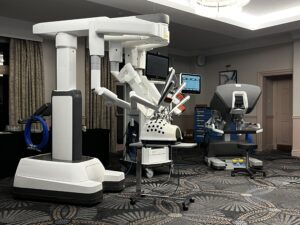
Wythenshawe Hospital is one of the first in Europe to adopt the Ion Endoluminal System, a robotic-assisted tool that enables doctors to detect lung cancer in its earliest, most treatable stages.
Building on the success of the Greater Manchester Lung Health Check programme, which has diagnosed over 600 early-stage lung cancers, the hospital is now able to reach previously inaccessible lung nodules for biopsy — without the long delays associated with traditional methods.
Lung nodules are often too small or deep to sample safely, meaning patients face months of “watchful waiting” before diagnosis. The Ion system changes this, using a flexible robotic catheter to navigate deep into the lungs and collect accurate biopsies earlier than ever before.
The result is faster diagnoses, quicker access to treatment, and significantly improved outcomes — all while reducing patient anxiety and uncertainty.
Supported by Manchester University NHS Foundation Trust and local charities, this innovation marks a major step forward in tackling the UK’s leading cause of cancer death and sets a new standard for early detection and care.
East Lancashire Hospitals NHS Trust (ELHT) has been successful in its use of AI to support pre-operative assessments.
Launched in September 2024 as part of an NHS England pilot, the CLEARnotes tool records consultations between nurses and patients, transcribes them into structured notes, and uploads them directly into the patient record. This reduces admin time and allows staff to focus more on patient care.
By February 2025, CLEARnotes had been used in over 1,700 consultations, increasing daily patient capacity from 55 to 63 and boosting productivity by up to 10%. The result is shorter waiting times, improved documentation, and a better experience for both patients and staff.
The tool also enhances consistency within the Electronic Patient Record (EPR), supporting safer and more efficient care.
This project demonstrates how digital innovation can ease pressure on frontline teams while improving care quality across the system.
Learn more: elht.nhs.uk/news-and-media/news/east-lancashire-hospitals-nhs-trust-shortlisted-hsj-digital-award
Stroke patients at Countess of Chester Hospital NHS Foundation Trust can now access neurorehabilitation from home, through an innovative online service launched in September 2024. The Neuro Rehabilitation Online (NROL) programme delivers real-time group therapy sessions via Microsoft Teams, led by experienced NHS therapists across Cheshire and Merseyside.
NROL offers a comprehensive rehabilitation experience, including physical and cognitive therapy, talking therapy, and community support. Each session is designed to enhance patients’ understanding of brain and body functions, boost confidence, and provide practical symptom management strategies.
Funded by the Stroke Quality Improvement for Rehabilitation team (SQUIRE), this service aims to expand access to supervised therapy by offering flexible, convenient support. Stroke patients currently receiving care at Countess of Chester Hospital, Cheshire and Wirral Partnership Trust, and other trusts in the Cheshire and Merseyside system can be referred by their therapists to join the programme, increasing the frequency and intensity of their rehabilitation.
Find out more: cheshireandmerseyside.nhs.uk/posts/countess-of-chester-hospital-hosting-new-online-neurotherapy-service/
A round-the-clock digital health service is helping thousands of Liverpool care home residents avoid unnecessary hospital admissions by providing immediate access to NHS clinicians.
In 2024, the Immedicare service supported over 13,000 virtual consultations across CQC-registered care homes in the system. Around 90% of these were resolved without needing to transfer residents to hospital.
Available 24/7, Immedicare supports care homes for older adults and individuals with learning disabilities. The service provides expert guidance in key areas such as falls prevention, wound care, medication safety, end-of-life support, and nutrition—helping care home staff manage complex health needs on-site.
Delivered in partnership with NHS Cheshire and Merseyside, the service is closely integrated with local teams including primary care, Mersey Care Community Matrons, NWAS, and PC24 out-of-hours providers. Together, they’ve developed streamlined care pathways to ensure residents receive timely, appropriate care while remaining in familiar surroundings.
With 41% of emergency admissions from care homes considered avoidable, this approach is making a measurable impact on system pressures while improving patient experience.
By reducing avoidable hospital visits, improving continuity of care, and supporting care home staff with rapid clinical input, Immedicare is helping build a more efficient and compassionate model of care for Liverpool’s most vulnerable residents.
Find out more: cheshireandmerseyside.nhs.uk/posts/digital-service-keeping-care-home-residents-out-of-hospital/
Virgin Media O2 Business has partnered with Pennine Care NHS Foundation Trust to launch a new Digital Hub at Birch Hill Hospital in Rochdale, helping NHS staff boost digital skills and improve access to essential tech support.
Serving 1.3 million people across Greater Manchester, the Trust identified a need to improve digital maturity. In response, Virgin Media O2 Business has supported the rollout of three Digital Care Hubs, alongside major infrastructure upgrades across 88 sites.
The new hub offers walk-in IT support and training, enabling staff to resolve issues quickly and use digital tools more confidently freeing up time for patient care.
As part of the wider transformation, the Trust has implemented a secure, high-speed SD-WAN network, improved WiFi, and introduced over 4,100 mobile connections. Staff can now access real-time patient data securely, while patients benefit from managed WiFi during their stay.
The partnership is modernising healthcare delivery, reducing admin burdens, and building a digitally confident workforce—ensuring technology enhances both staff experience and patient outcomes.