Revenue
1. The NHS remains broadly in balance for the year to date at month 10, with a revenue (non-ringfenced RDEL) position to the end of January 2026 showing a £71m overspend (0.04% of year to date (YTD) allocation).
Table 1: YTD system financial position at month 10
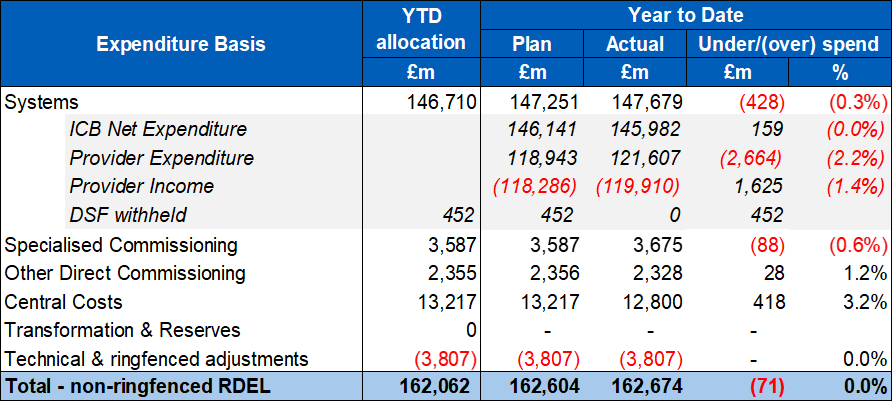
2. The month 10 YTD financial position is driven by overspends in systems of £428m. This figure reflects the impact of held-back deficit support funding (DSF).
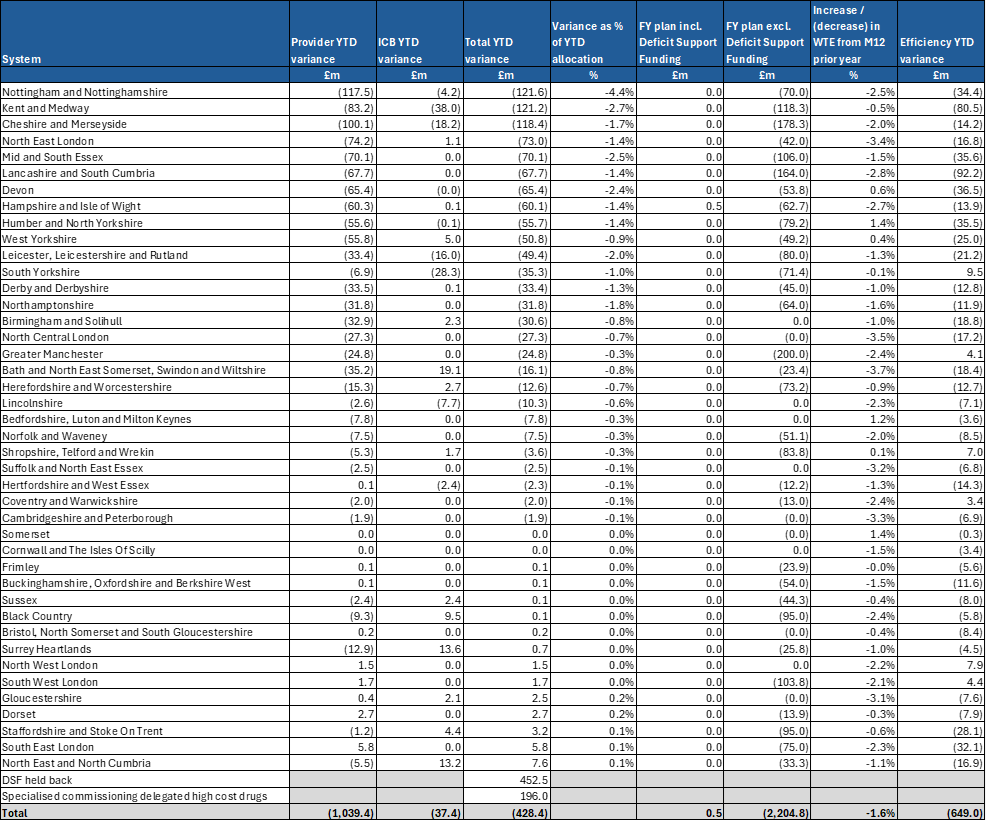
3. Fifteen systems and 56% of providers have delivered in line with their plans up to month 10. At the same point last year systems had overspent by £1,089m with only six systems delivering in line with their plans to that point. Details of individual system variances are set out in annex 1, providers with a YTD adverse variance to plan of greater than £5m are listed in annex 2.
4. System overspends are largely driven by slippage against efficiency plans, including workforce costs above planned levels. The financial impact of five days of industrial action in July has also adversely impacted system positions due to the increased cost of staff cover during the strikes. NHS England has provided funding to providers for the more recent industrial action.
Table 2: Forecast outturn financial position at month 10
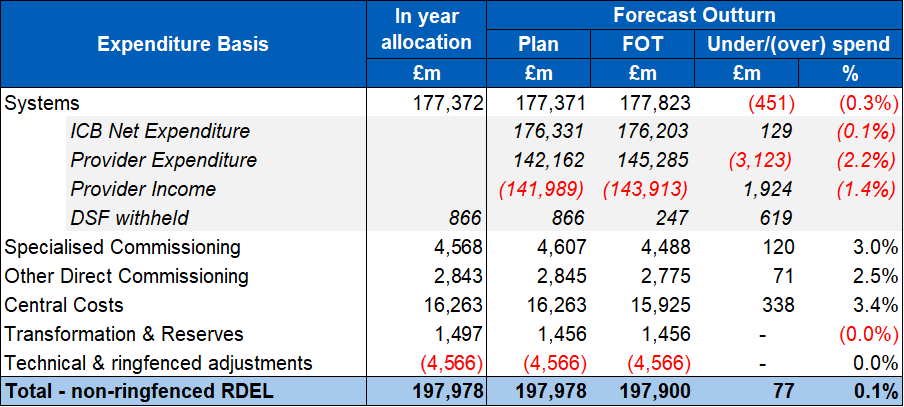
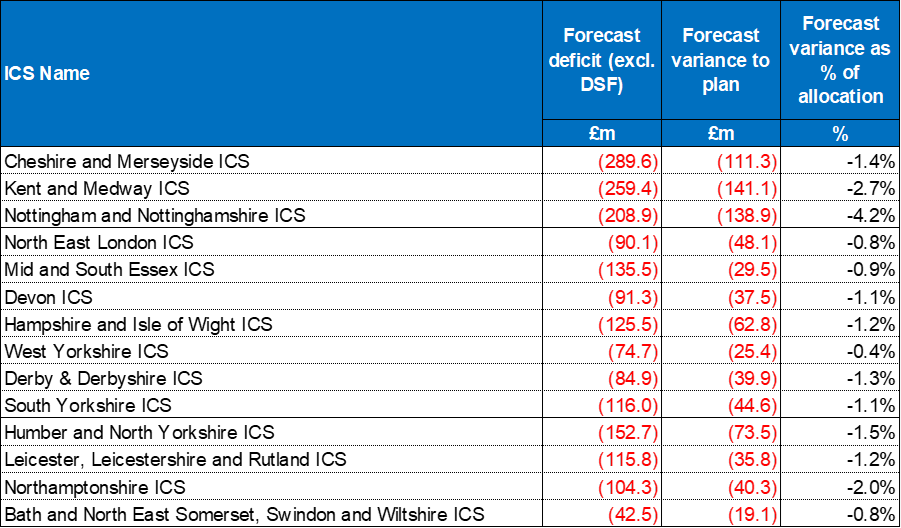
5. At month 10, fourteen systems which have been behind their planned financial performance during the year, are now formally forecasting a year-end overspend. Where applicable, these systems will not receive their share of quarter 4 DSF.
6. Systems and individual organisations forecasting an overspend were required to complete a board assurance statement signed by their chair and chief executive, to confirm their board had been fully briefed on the change to the forecast, the resulting impacts and their commitment to the delivery of the recovery plan. In addition to this, each organisation contributing to a system forecast overspend was required to formally notify NHS England.
7. Systems forecasting overspends have also been asked to work closely with NHS England regional teams to identify further actions this year to improve the reported position and reduce the run-rate carried into 2026/27. The more that efficiencies and cost reductions can be brought forward and accelerated this year, the stronger the starting position will be next year.
8. In addition, Boards have been reminded of the 2026/27 Business Rules, specifically section 22, which states: “Where an NHS trust does not deliver its agreed plan position in 2025/26, NHS England may adjust NHS trust plan limits, including any associated deficit support funding, in 2026/27 as a consequence for not delivering the 2025/26 plan.”
9. The table below shows the fourteen systems that are no longer expected to deliver their financial plans for the year. The financial position for each shows the total expected deficit for the year excluding all deficit support funding, and the variance to plan which reflects only the system overspend without the impact of the lost DSF.
Table 3: Systems with forecast overspends at month 10
10. Forecast underspends within NHS England national budgets – arising from tightened financial controls, together with underspends in non-delegated Specialised Commissioning – are expected to be sufficient at a macro level to deliver balance across the NHS as a whole. We remain confident that the NHS will deliver its financial targets for the year.
11. We have seen significant improvements in 25/26, with several systems that have historically faced financial challenges making substantial progress toward delivering their plans for the year. These improvements have largely been driven by full board ownership of the challenges, resulting in much stronger financial grip, better delivery of efficiency plans, and focused action on key cost pressures such as continuing healthcare expenditure and agency staffing
12. We intend to reward ICBs and providers that have delivered their financial plans in 25/26. Unearned DSF to providers that have delivered their plans, are within a system that have delivered to plan, and that have submitted compliant 26/27 financial plans. In addition, providers that lost DSF due to system‑level underperformance, despite meeting their own plan, will be able to re‑earn that funding if they also submit a balanced plan for 26/27. Where an ICS has delivered its plan for the year, we will write off a portion of its cumulative deficit
Capital
13. Providers have spent £4,550 million on capital schemes to month 10 (including IFRS 16 expenditure relating to lease assets), representing 47% of their full year budget. The DHSC provider and commissioning capital budget for 2025/26 (including IFRS16) is set at £10,385 million against which we are currently forecasting an underspend of £179m. We need this level of underspend to make our contribution to managing the planned Group overcommitment and will use any remaining underspend to fund pressures and new priorities as part of our ongoing review of budgets in the usual way.
Annex 1: financial position by system at month 10 (surplus / deficit basis)
Annex 2: Providers with a YTD overspend greater than £5m at month 10