We want to hear from you. Help us understand your digital experience by taking part in our user research. Find out more now.

Revenue
1. The NHS remains broadly balanced at month 9 with a revenue (non-ringfenced RDEL) position to the end of December 2025 showing a £41m overspend (0.03% of year to date (YTD) allocation).
Table 1: YTD financial position at month 9
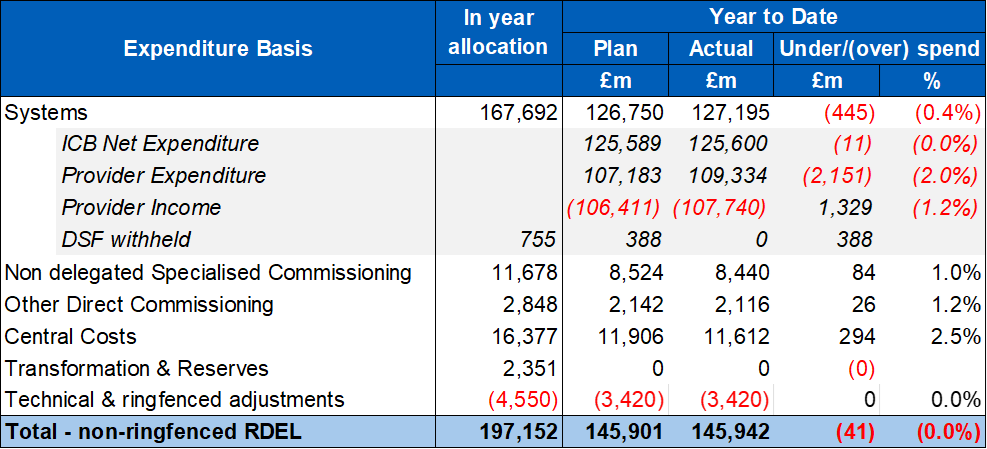
2. The month 9 YTD financial position is driven by overspends in systems of £445m. This figure reflects the impact of held-back deficit support funding (DSF).
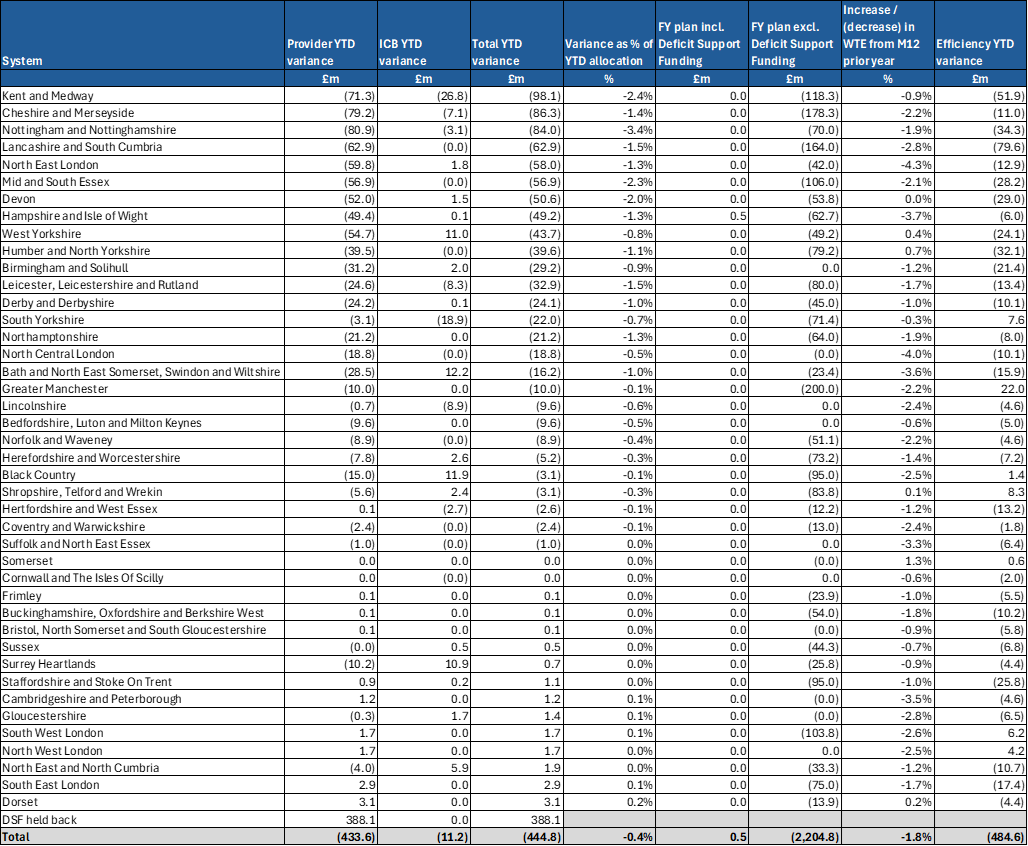
3. Six systems account for more than half of the total overspend. Seventeen systems and 61% of providers have delivered in line with their plans to month 9. At the same point last year systems had overspent by £1,031m with only 4 systems delivering their plans to that point. Details of individual system variances are set out in annex 1, providers with a YTD adverse variance to plan of greater than £5m are listed in annex 2.
4. System overspends are largely driven by slippage against efficiency plans, including workforce costs above planned levels. The financial impact of five days of industrial action in July has also adversely impacted system positions due to the increased cost of staff cover during the strikes. NHS England has provided funding to providers for the more recent industrial action.
5. Following a review of the Month 9 financial position, 13 systems will not currently receive DSF in the final quarter of the year and, without remedial action, will therefore end the year with an overspend. Several of these systems (2 ICBs and 21 trusts), which have been behind their planned financial performance during the year, are now formally forecasting a year-end overspend. Systems that revised their forecasts at Month 9 have been contacted and asked to work closely with Regional Teams to identify further actions this year to improve the reported position and reduce the run-rate carried into 2026/27. It is recognised that the more efficiencies and cost reductions that can be brought forward and accelerated this year, the stronger the starting position will be next year. Where a trust is unable to deliver its 2025/26 plan and has forfeited deficit support funding, confirmation has been requested that the Board is fully briefed on the implications.
6. In addition, Boards have been reminded of the 2026/27 Business Rules, specifically section 22, which states: “Where an NHS trust does not deliver its agreed plan position in 2025/26, NHS England may adjust NHS trust plan limits, including any associated deficit support funding, in 2026/27 as a consequence for not delivering the 2025/26 plan.”
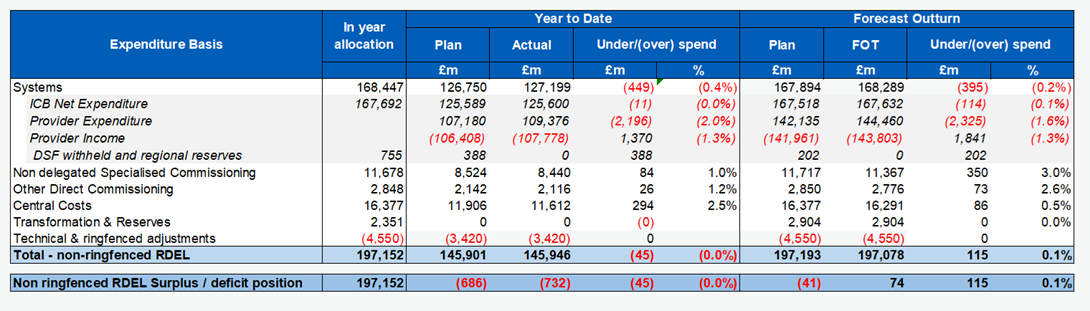
7. We will continue to work closely with these challenged systems but based on their month 9 position, where systems fall short of their board-approved plans, underspends within NHS England national budgets – arising from tightened financial controls, together with underspends in non-delegated specialised commissioning, are currently sufficient at a macro level to deliver balance across the NHS as a whole. We therefore remain confident that the NHS will deliver its financial targets for the year.
Table 2: NHS England revenue summary financial position with forecast outturn
Capital
8. Providers have spent £3,129 million on capital schemes to month 8 (including IFRS 16 expenditure relating to leased assets), representing 33% of their full year budget. The DHSC provider and commissioning capital budget for 2025/26 (including IFRS16) is set at £10,146 million against which we are currently forecasting an underspend of £432m. Some of this forecast underspend against budget is necessary to ensure that the NHS remains within its capital spending limit for the year. The remainder will be used to fund pressures and new priorities as part of our ongoing review of capital budgets.
Annex 1: financial position by system at month 9 (surplus / deficit basis)
Annex 2: Providers with a YTD overspend greater than £5m at Month 9