Executive summary and action required
This paper sets out the steps taken to ensure the NHS is effectively prepared for winter pressures, and the response to date. The Board is asked to note:
- Progress in delivering winter plans;
- The operational response in place to recover from Industrial Action and continue to respond to winter pressures;
- The current position on infection prevalence; in particular the unusually early start to the influenza season;
- The latest data on our vaccination programme.
Context
1. UKHSA winter scenarios produced in September indicated that the most likely outcome would be slightly higher levels of bed occupancy for the combination of COVID-19, Influenza, RSV and norovirus, than the peak combined occupancy in 2024/25.
2. This type of scenario was one of several tested in a series of NHS England regionally co-ordinated winter exercises held during September with integrated care boards (ICBs), trusts, and wider partners, to stress-test and finalise winter plans, following which gaps in assurance were identified and addressed.
3. As we approach the peak of winter, A&E waiting times remain challenged – as does capacity overall – with both 4 hour and 12 hour performance off track against trust’s own plans. Despite this, overall UEC performance is slightly improved compared to the previous year and there are signs of progress in some of our more challenged organisations.
4. Category 2 ambulance response times are in a stronger position going into winter – Category 2 average performance was 32:27 in October 2025, compared to 42:15 in October 2024, although risk remains as a result of hospital handovers.
5. Through the peak of winter, NHS England will focus on key safety measures including ambulance response times, long waits in department and general issues of ED crowding, and will lead a sprint to reduce long length of stay and high levels of occupancy ahead of the Christmas period. Our National Operations Centre is now fully stood up in support of maintaining safety and system flow throughout the period.
Latest data – infection prevalence and vaccinations
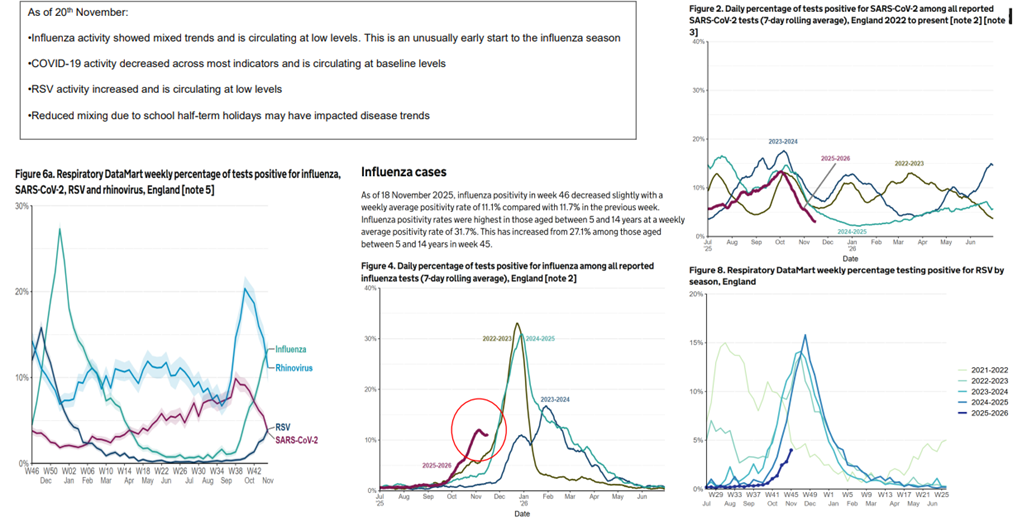
6. There has been an unusually early start to the influenza season which means flu cases are rising earlier this year.
7. COVID-19 activity (which is not seasonal) decreased across most indicators and is circulating at baseline levels and RSV activity increased and is circulating at low levels.
8. This is shown in more detail in Appendix 1 which also shows trends against previous years.
Vaccinations
9. Our vaccination programme is a key measure to prevent winter pressures and build resilience in populations.
10. The latest data (up to 30 November) for influenza vaccinations shows that:
Amongst adults:
- 41% in those aged six months to 64 years in a clinical risk group (excluding immunosuppressed) have been vaccinated
- 42% in those aged six months to 65 who are immunosuppressed have been vaccinated
- 42% of all pregnant women and 70% of those aged over 65 years and 71% of care home residents have been vaccinated
Amongst children:
- 40% of two to three year olds have been vaccinated.
11. Ongoing efforts are needed to improve uptake among school children and older adults to surpass last year’s totals. Data published by the UK Health Security Agency shows the 2025/26 flu vaccine is currently 70-75% effective at preventing hospital attendance in children aged 2 to 17 years, and 30-40% effective in adults.
12. The latest data (up to 30 November) for COVID vaccination shows that:
- 62% of all people aged 75 years and over, 67% of older adult care home residents and 38% of all people aged 6 months or over with a weakened immune system, who are living and resident in England had been vaccinated with a autumn 2025 covid dose since 1 October 2025.
13. NHS England is monitoring uptake via the UKHSA weekly official statistics in the National Influenza and COVID-19 Report and we continue to promote vaccination uptake across all communication channels.
14. The Board is asked to continue to endorse and support the vaccination programme roll-out.
Preparation for winter
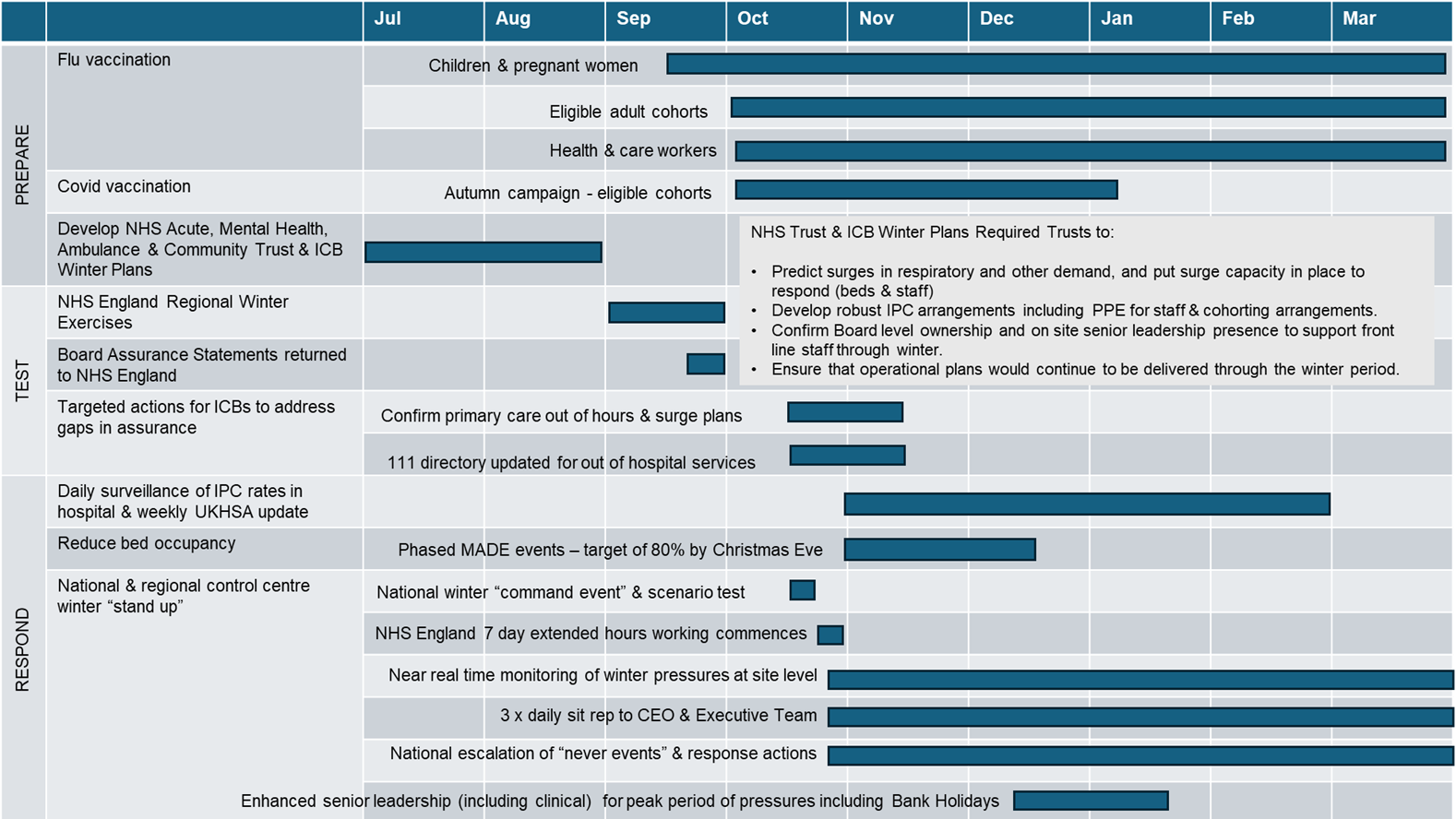
15. A summary of the winter plan is shown at Appendix 2 setting out our key activities for the NHS.
ICB and trust winter plans and assurance
16. In July, integrated care boards (ICBs) and NHS trusts were asked to develop comprehensive winter plans to ensure resilience during periods of peak demand. To test these arrangements, regionally led winter exercises were held in September, bringing together ICBs, Acute, Ambulance, Mental Health and Community trusts, as well as primary and social care colleagues.
17. Board Assurance Statements (BAS) were then returned to NHS England, with nearly all ICB Boards confirming that key preparatory steps are in place.
Primary and social care
18. In addition to Board Assurance Statements, we have followed up with ICBs on specific capacity questions to seek and confirm further assurance in relation to both primary and social care availability and capacity.
Improving non-admitted performance and reducing bed occupancy ahead of Christmas
19. In the approach to peak winter, all trusts are being asked to proactively focus on improving non-admitted performance to reduce the risk of Emergency Department (ED) overcrowding by seeing, treating, and signposting those patients who need urgent and emergency care but do not need to come into hospital. Alongside this, trusts will make a targeted reduction in bed occupancy in the run-up to the Christmas holiday period, with the headline aim of reducing occupied beds to 80k by Christmas Eve and again during the first week of January in order to create capacity for those patients who will need to be admitted with winter viruses through the peak period. Both workstreams are co-ordinated through weekly meetings with NHS England regions and through to trusts, using transparent site level data to benchmark across the country, and identify weekly goals for improvement.
20. The Discharge and Admissions Group (DAG) also continue to work with some of those areas experiencing the most significant discharge delays, with the Better Care Fund support programme providing targeted support to some of those areas too.
Ambulances
21. All Ambulance trusts are now implementing winter plans and have participated in the regional winter exercises and submitted Board Assurance Statements. The key areas of focus for Ambulance trusts include ensuring that all have plans to maintain levels of hear and treat and see and treat during winter pressures; ensuring clear Call Before Convey pathways are in place, implementing auto-dispatch for all Cat1 and Cat2a incidents, and identifying Cat5 patients to remain in their own homes overnight.
Winter response and operations
22. Since late October, the National Operations Centre (NOC) including the UEC Team has moved to extended operating hours to cover 0800 to 2000, 7 days, with 24/7 availability. The UEC operations team within NOC lead a daily “battle rhythm” to review overnight data; work with regional teams to resolve trust level issues through the day; escalating through regional teams and to National Directors to ensure that trusts and systems are supported to manage risk and maintain control and safety.
23. Recently, the Resilience team has also led on the tactical response to Industrial Action. During the recent strike action approximately 95% of planned care was maintained. We also saw a significant improvement in UEC performance and maintained critical services, including maternity and urgent cancer care.
24. To ensure the system maintains performance whilst recovering from the industrial action alongside managing increased winter pressures, NHS England is providing additional operational oversight and grip through national coordination and executive engagement across the next few weeks. Our collective focus will be patient safety; timely access to UEC services; and ensuring elective activity is in line with plans. In addition, we are continuing to develop and refine our approach to industrial action based on lessons learned.
Communications
25. A national strategic approach is in place, including:
- Communications toolkit with key messages, campaigns, and social media guidance shared across NHS providers, ICBs, and regional teams
- Marketing campaigns on where patients can access help during winter
- Focused vaccine campaign promoting flu, COVID-19, and RSV uptake
- Weekly alignment meetings with DH, UKHSA, and NHS England
- Weekly winter data reporting
Risk management
26. With a daily focus on safety through the UEC Operations team, NHS England will support trusts to mitigate and mange risks in real time, including for example cold weather, as well as monitoring the known risks set out above.
27. This will require our collective focus across NHS England and the wider NHS to manage effectively.
Appendix 1: National trends – primary pathogens
Appendix 2: Summary winter plan on a page