
Reducing duplication and delays with online patient registration
Sarah Armitage, Practice Manager at Treeton Medical Centre, Rotherham, describes how Register with a GP Surgery enables new patients to be registered without needing to visit the surgery or complete paper forms. This approach has particularly benefited patient groups who have traditionally found access more challenging.
One of the digital services that has had the greatest impact for our patients has been Register with a GP Surgery.
The service has particularly benefited patient groups who have traditionally found access more challenging, including working people, carers, residents of care homes and members of the deaf community who may find telephone-based processes difficult.
Information is entered directly by patients at a convenient time of their choosing, reducing errors and making it quicker and easier for practice staff to match patients to their NHS records accurately and efficiently.
The real-life impact of digital services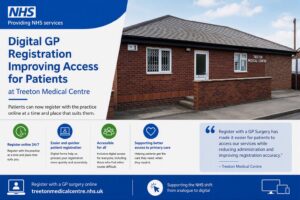
Digital services like this improve access by giving patients greater choice, flexibility and convenience. Patients can engage with their practice when it suits them rather than being restricted by opening hours or needing to wait on the phone.
Most importantly, it has made registration more accessible and inclusive. Online registration can be used by patients who may struggle with traditional routes, including those with hearing impairments, communication difficulties, mobility issues, caring responsibilities or demanding work schedules.
A particularly good example involved a patient who had recently moved into the area and needed ongoing medication for a long-term health condition. Rather than visiting the practice to collect and complete paper forms, they were able to register online at a time that suited them, providing all the required information through the digital registration service.
Because the information was clear, complete and submitted electronically, our team was able to quickly match the patient to their NHS record and complete the registration process without the delays that can sometimes occur with paper forms. This meant the patient was registered promptly, their medical history was available sooner, and arrangements for their continuing medication could be put in place without interruption.
For the patient, the process was straightforward and convenient. For the practice team, it reduced administrative work and enabled us to provide a faster and safer experience, ensuring the patient could access the care they needed as quickly as possible.
Saving administration time
Digital registration has delivered significant operational benefits for our team, reducing workload, improving data quality and creating a more efficient workflow for the practice. The quality of data submitted is much better than with paper forms, as there is no handwriting to decipher and mandatory fields help ensure key information is captured correctly first time. The system also supports catchment area checks and simplifies the patient record matching process, reducing the need for follow-up queries and administrative corrections.
We have also changed processes so links for new patient health check appointments can be sent out directly, freeing up reception time spent booking patients into appointments.
The time savings are even greater using the auto-registration feature. While the standard service already streamlines registration, auto-registration enables eligible registrations to be processed automatically, reducing manual data entry and administrative handling by practice staff. This allows registrations to move through the process more quickly and frees up team capacity to focus on patients who require additional support or more complex administrative work.
Overcoming challenges in introducing digital tools
Like many practices, one of the biggest challenges was adapting established processes and helping both staff and patients understand the new way of working. We invested time in communicating the benefits, updating website information, promoting the service to patients and supporting colleagues as they became familiar with the new processes.
As workflows became embedded, the benefits became increasingly clear. Information submitted digitally can be reviewed and acted upon more efficiently, reducing duplication and delays. Staff appreciate having access to clearer information, while patients value the convenience and flexibility. Looking back, the challenges of implementation were absolutely worthwhile given the long-term improvements for both patients and practice teams.
My advice to practice teams would be to focus on the patient benefits and give staff time to adapt to new processes. The greatest success comes when digital tools are integrated into everyday workflows rather than treated as an additional task.
My other tips for implementation success would be:
- Invest early in communicating the benefits to both staff and patients, as engagement is critical to success.
- Trust the process and be patient during implementation because, once demand stabilises, the long-term benefits for both patients and practice teams are apparent.
Supporting the shifts of the 10-year plan for health
Looking ahead, we want to continue expanding our use of digital tools that make access simpler and more convenient for patients while reducing administrative burden for staff. Services such as Register with a GP Surgery support the NHS shift from analogue to digital by replacing paper forms with streamlined online processes. We would also like to see greater integration between NHS systems so that information can flow seamlessly between organisations, reducing duplication and improving patient experience.