

The NHS net zero supplier roadmap sets out the steps suppliers must take to align with the NHS net zero ambition through to 2030. The purpose of this guidance is to provide further details on the implementation of the following milestones in the roadmap (Carbon Reduction Plan (CRP) and Net Zero Commitment (NZC) Policy):
From April 2023: For all new contracts above £5 million per annum, the NHS requires suppliers to publish a Carbon Reduction Plan for their UK Scope 1 and 2 emissions and a subset of scope 3 emissions as a minimum (aligning with PPN 006, previously PPN 06/21).
From April 2024: The NHS has proportionately extended the Carbon Reduction Plan requirements to cover all new procurements.
This guidance outlines how this requirement is applied in an NHS context and is intended to be used in conjunction with central government’s guidance documents on PPN 006. The guidance has been updated to reflect how these requirements should be considered under the current procurement regimes (the Provider Selection Regime (PSR) and the Procurement Act 2023 (PA23)). This policy also previously applied to procurements conducted prior to 24 February 2025 under the Public Contracts Regulations 2015 (PCR 2015), applying PPN 06/21.
The requirements apply to the commissioning and purchasing of goods, works and services (including pharmaceuticals and healthcare services) by in-scope organisations. In-scope organisations are defined as NHS organisations as well as organisations acting on their behalf.
To ensure the Carbon Reduction Plan (CRP) requirements are extended in a proportionate and relevant manner to all procurements from April 2024 the policy is applied in a two-tiered approach. This ensures that the majority of NHS suppliers are advancing along the NHS net zero supplier roadmap and supports suppliers to take early steps to prepare for future roadmap milestones.
A tiered approach applies as follows:
- a full Carbon Reduction Plan (CRP), as defined in the section “CRP Requirements”, is required for procurements of high value (£5m per annum including VAT and above) and new frameworks operated by in-scope organisations, irrespective of the value of the contract, where relevant and proportionate to the framework.
- a Net Zero Commitment, as defined in the section “Net Zero Commitment – Requirements”, is required for procurements of lower value (below £5m per annum including VAT and above the relevant published procurement threshold).
Detailed information on procurements in scope of the requirements is set out in the section NHS Carbon Reduction Plan and Net Zero Commitment requirements.
To ensure compliance with NHS England’s Commercial Function framework accreditation scheme, all future accredited frameworks are expected to apply the requirements set out in Table 1 below.
The requirement to provide a CRP or Net Zero Commitment is in addition to the inclusion of a minimum 10% weighting on net zero and social value in NHS procurements, which has been required since April 2022.
The Provider Selection Regime (PSR) replaces the National Health Service (Procurement, Patient Choice and Competition) (No 2) Regulations 2013 (the PPCCR) and, alongside its introduction, removes the procurement of health care services, when procured by relevant authorities under the PSR, from the scope of the Public Contracts Regulations 2015 (the PCR). Relevant authorities under the PSR are:
- NHS England
- Integrated care boards (ICBs)
- NHS trusts and NHS foundation trusts; and
- Local authorities or combined authorities
NHS Carbon Reduction Plan and Net Zero Commitment requirements
Whilst there are no applicable thresholds within the PSR, this policy uses the relevant thresholds used under PA23 and, prior to 24 February 2025, the PCR2015, as a guide to determine which requirements apply to PSR procurements. This is to ensure there is consistency in how the provisions of this policy are applied across all procurement activity carried out by in-scope organisations. Throughout this policy these thresholds are referred to as “the relevant published procurement thresholds”.
Table 1: Application of CRP and Net Zero Commitment Policy
| Policy Application | Procurement Regime | Procurements coming into scope | |
| From April 2023 | From April 2024 | ||
| CRP requirement | PA23 PCR2015 (in effect before 24 February 2025) PSR (came into effect 1 January 2024) | Contracts ≥ £5m per annum (including VAT since 24 February 2025*) New frameworks where it is anticipated that the individual value of any contract to be awarded under the agreement is £5m per annum (including VAT since 24 February 2025) or more. | All new framework agreements (PCR2015/PSR), dynamic purchasing systems (PCR2015), frameworks (PA23) and dynamic markets (PA23) operated by in-scope organisations, irrespective of the value of the contract**. |
| NZC requirement | PA23 PCR2015 (in effect before 24 February 2025) PSR (came into effect 1 January 2024) | No new in scope procurements | All new contracts below £5m per annum (including VAT since 24 February 2025) and above the published procurement threshold *** |
* To ensure alignment to the Procurement Act 2023, PPN 006 changed the requirements to include VAT in the threshold for CRPs. This could mean that more activity is captured compared to the application of previous PPN 06/21.
** Where NHS framework owners determine the CRP requirements not to be proportionate and relevant to the nature of the new framework and the framework is out of scope of central government’s CRP requirements, the owner should apply the NZC requirements.
*** When applying this policy under the PSR to lower value procurements, in-scope organisations should assess whether the application of an NZC requirement is relevant and proportionate to the value and nature of the contract, using published procurement thresholds as a guide, in combination with market intelligence, including pre-market engagement.
Carbon reduction plan requirements
A CRP identifies a supplier’s current carbon footprint and their plan to achieve net zero emissions.
The CRP requirements align with those of central government’s PPN 006. Therefore, any existing and current CRP developed according to the central government guidelines of PPN 006 will be accepted by the NHS.
To comply with the NHS CRP requirements, and align with the UK government’s PPN 006, the CRP must:
- confirm the bidding supplier’s commitment to achieve net zero by 2050 or earlier for their UK operations as a minimum geographical boundary. Note a global emissions boundary meets the requirements.
- provide the supplier’s baseline and current emissions for the sources included in scope 1 and 2 of the GHG Protocol, and a defined subset of scope 3 emissions (at a minimum). The five relevant GHG Protocol scope 3 categories are:
- upstream transportation and distribution
- waste generated in operations
- business travel
- employee commuting
- downstream transportation and distribution.
- provide emissions reporting in CO2e (carbon dioxide equivalent) for the seven greenhouse gases covered by the Kyoto Protocol (carbon dioxide [CO2], methane [CH4], nitrous oxide [N2O], hydrofluorocarbons [HFCs], perfluorocarbons [PFCs], sulphur hexafluoride [SF6] and nitrogen trifluoride [NF3])
- set out the environmental management measures in effect, including certification scheme or specific carbon reduction measures adopted; these should be measures the supplier can apply when performing the contract and support the supplier to achieve net zero by 2050 or earlier
- be board approved or company director approved if no board is in place
- be clearly signposted and published on the supplier’s website
- be updated regularly – at least annually.
When producing a CRP, suppliers should follow the government’s Technical standard for completion of CRPs.
The CRP should follow structure and length of central government’s PPN 006 CRP template, though stylistic differences are acceptable.
Net Zero Commitment requirements
NZC is a public commitment to achieve net zero by 2050 or earlier, and a confirmation that the supplier is taking steps to reduce their GHG emissions over time. The NZC requirements are a subset of the CRP requirements, therefore a supplier already complying with the CRP requirements is also complying with the NZC requirements and does not require further action.
To comply with the NHS Net Zero Commitment requirements, a supplier must:
- confirm the bidding supplier’s commitment to achieve net zero by 2050 or earlier for their UK operations on the sources included in scope 1 and 2 of the GHG Protocol, and the defined subset of scope 3 emissions, outlined in the “CRP Requirements” section. Note the UK is a minimum geographical boundary, and a global emissions boundary meets the requirements; and
- clearly signpost and publish the commitment on the supplier’s website.
To help the suppliers structure their Net Zero Commitment, an example format is provided in Annex 3. The commitment should clearly state the year by which net zero will be achieved, the emissions included, and the name of the entity committing to net zero.
As above, suppliers are encouraged to set a net zero target of 2045, although a target of 2050 will still meet the minimum requirements
Supplier entity in scope
Both a CRP and an NZC should be specific to the bidding entity, or they may cover the bidding entity and its parent organisation if the following criteria are met:
- the bidding entity is wholly owned by the parent entity
- the commitment to achieving net zero by 2050 or earlier is set out in the CRP or Net Zero Commitment for the parent entity and is supported and adopted by the bidding entity, demonstrated by the inclusion in the CRP or Net Zero Commitment of a statement that this will apply to the bidding entity
- the environmental measures set out in the CRP are stated to be able to be applied by the bidding entity when performing the relevant contract
- the CRP or Net Zero Commitment is published on the bidding entity’s website.
Applying the CRP and NZC Requirements under current procurement regimes in England
The CRP and NZC requirements apply under three procurement regimes: PA23, PSR and the PCR2015. This section sets out how the requirements should be applied in the context of the PA23 and PSR. As of February 2025, the PA23 replaced the PCR2015 for all new procurements. Detail on how the requirements have been applied under the PCR2015 can be found in Annex 2.
The Procurement Act 2023
The CRP and NZC requirements apply under the PA23, and should be applied in line with this guidance.
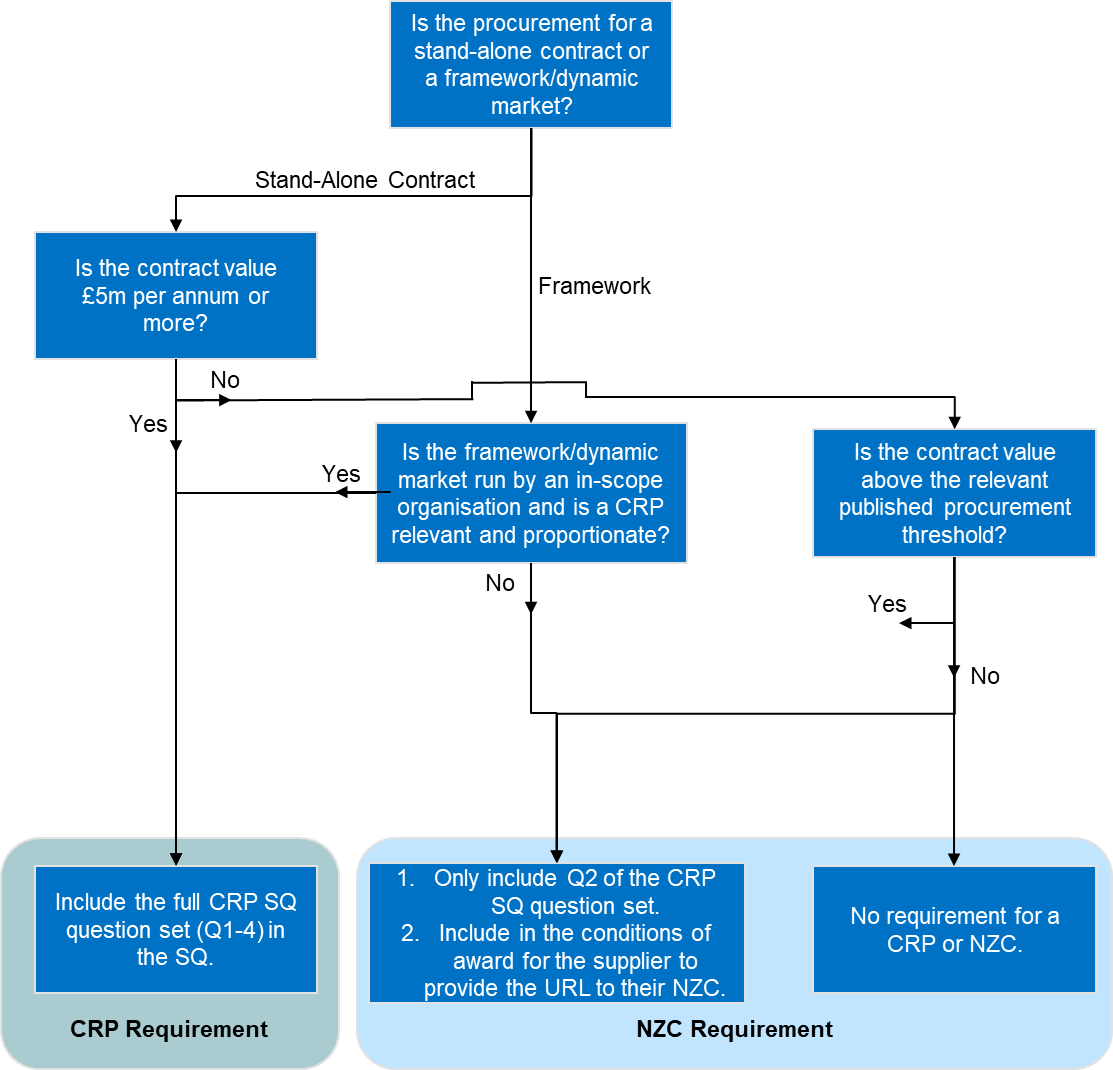
Annex 1 provides a decision flow diagram to help in-scope organisations understand how the CRP and NZC requirements should be reported for their procurement.
Reporting and assessment mechanism
In-scope organisations should include the relevant assessment questions as set out in the “CRP and Net Zero Commitment Assessment Methodology” section of this guidance in relevant supplier questions under the conditions of participation set out in accordance with the PA23.
Application of requirements to frameworks and open frameworks
All new NHS frameworks or open frameworks, irrespective of contract value, are required to apply the full CRP requirements. Where NHS framework owners determine the CRP requirements are not proportionate and relevant to the nature of the framework and out of scope of central government CRP requirements, the owner should apply the NZC requirements.
The CRP and NZC requirements should be applied at framework/open framework level, rather than to individual call-offs.
Dynamic markets
All new dynamic markets, irrespective of contract value, are required to apply the full CRP requirements as part of the conditions of membership. Where NHS dynamic market owners determine the CRP requirements are not proportionate and relevant to the nature of the dynamic market and out of scope of central government CRP requirements, the owner should apply the NZC requirements.
CRP requirements should not form part of conditions of participation when awarding contracts. This is to ensure that suppliers, particularly SMEs, are not required to submit information to multiple in-scope organisations.
Single Tender Actions (STAs) and Direct Awards (DAs)
STAs and DAs (where the requirement is not otherwise covered, for example in framework or open framework) are in scope of the requirements outlined in this guidance. Due to the nature of these procurements, the requirements should be included, where possible, as due diligence, but not assessed as a pass-fail requirement. Evidence that these requirements have been met should be provided by the supplier for informational purposes only.
The Provider Selection Regime
The PSR regulates the arrangement of healthcare services, and replaces the National Health Service (Procurement, Patient Choice and Competition) (No 2) Regulations 2013 (the PPCCR). The PSR removes the procurement of health care services when procured by relevant authorities under the PSR from the scope of the PA23 and the PCR2015. Relevant authorities under the PSR are:
- NHS England
- Integrated care boards (ICBs)
- NHS trusts and NHS foundation trusts; and
- Local authorities or combined authorities
Relevant authorities arranging contracts for health care services in accordance with PSR rules are in scope of the CRP and NZC requirements.
Where in-scope health care services are provided by NHS providers, please refer to the NHS to NHS Contracts section under Further information.
PPNs do not apply to procurements under the PSR, however relevant authorities are expected to implement the milestones set out in the NHS Net Zero Supplier Roadmap, which includes CRP and NZC requirements set out in guidance.
Reporting and assessment mechanism
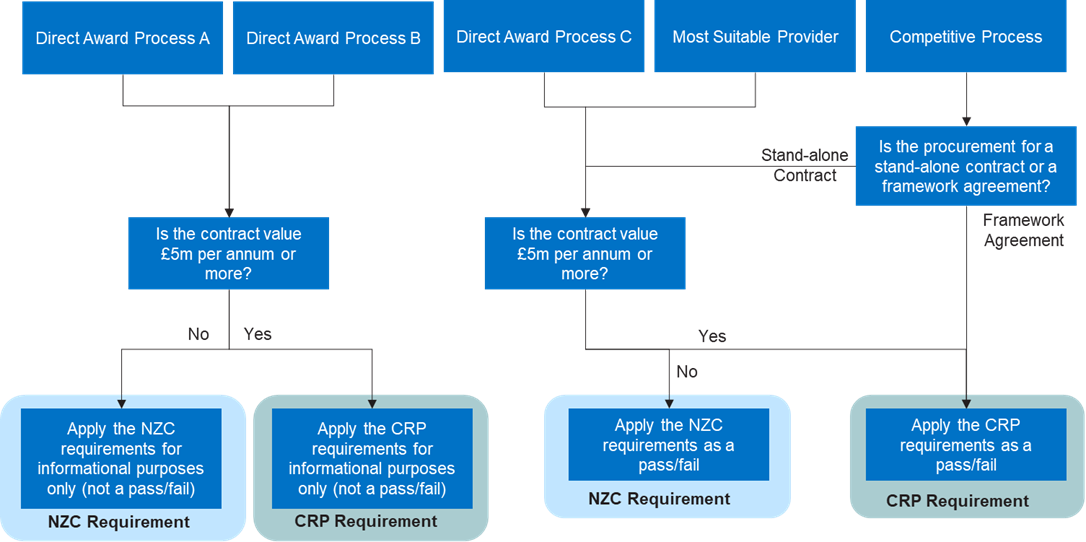
The PSR sets out discrete provider selection processes that relevant authorities use when commissioning healthcare services. How the CRP and NZC requirements are applied under the PSR will depend on the provider selection processes used. Annex 4 provides a decision flow diagram to help in-scope organisations understand how the CRP and NZC requirements should be applied for each process.
Direct Award Process A and B under the PSR
Due to the nature of both processes A and B under the PSR, the CRP and NZC requirements should be applied, where possible, as due diligence questions within the procurement process, but not assessed as a pass-fail requirement. Evidence that these requirements have been met is provided by the supplier for informational purposes only.
Direct Award Process C, Most Suitable Provider, Competitive Process under the PSR
In-scope organisations should apply the CRP and NZC requirements on a pass-fail basis as per the “CRP and NZC Assessment Methodology” in this guidance.
For contracts under the PSR, an NZC is currently required for certain procurements up to the value of £5M per annum (including VAT) as set out in NHS Carbon Reduction Plan and Net Zero Commitment Requirements section.
Application of requirements to Framework Agreements under the PSR
All new NHS framework agreements, including those arranged under the PSR, irrespective of contract value, are required to apply the full CRP requirements. Where NHS framework agreement owners determine the CRP requirements not to be proportionate and relevant to the nature of the framework, the owner should apply the NZC requirements. The CRP and NZC requirements should be applied at framework agreement level, rather than to individual call-offs.
Carbon Reduction Plan and Net Zero Commitment assessment methodology
The assessment confirms whether a supplier’s CRP or NZC meets the minimum requirements.
Suppliers whose CRP or NZC does not meet the minimum requirements will not be able to proceed to the next stage of the procurement process, except in exceptional circumstances as set out in Annex 5. CRPs and Net Zero Commitments will not be scored or compared against each other.
Annex 5 of this document sets out example scenarios and whether these meet the minimum requirements of the CRP and/or Net Zero Commitment.
The assessment questions are set out in the below section and are consistent across procurement regimes. The stage of the procurement process at which assessment and reporting will take place will depend on the regime being used and the specific procedure or process. Details of when this will be conducted under each regime is set out in the relevant sections of this guidance under Applying the CRP and NZC Requirements under Procurement Regimes section.
Assessment questions
In-scope organisations should use the questions set out in table 2 to assess the requirements. These are aligned to the assessment questions set out in PPN 006, which can be found in Annex A of the guidance on adopting and applying PPN 006.
For procurements which require a CRP, the in-scope organisation should use all 4 assessment questions.
For procurements that require an NZC only, the in-scope organisation should only use question 2 of the assessment questions. In addition, the URL to the page of the supplier’s website where the commitment is clearly stated should be requested during the tendering process or at the contract award stage.
Table 2: assessment questions
| 1 | Please confirm that you have detailed your environmental management measures by completing and publishing a carbon reduction plan that meets the required reporting standard. | Yes / No PASS / FAIL | |
| Provide a link to your most recently published carbon reduction plan here: | <link> | ||
| 2 | Please confirm that your organisation is taking steps to reduce your greenhouse gas emissions over time and is publicly committed to achieving net zero by 2050. | Yes / No PASS / FAIL | |
| Please confirm your net zero target date: for example 2050 | |||
Supplier emissions declaration
| 3 | Baseline year: | |
| Scope 1: | ||
| Scope 2: | ||
| Scope 3: | ||
| 4 | Reporting year: | |
| Scope 1: | ||
| Scope 2: | ||
| Scope 3: |
For those using the Atamis e-commerce system used by NHS organisations, standard templates have been configured to make this process as user-friendly as possible. The Procurement Specific Questionnaire issued by the Cabinet Office, includes these questions and should be utilised during procurement activity to ensure alignment.
Further information
NHS to NHS contracts
Where NHS organisations (including primary care organisations) are bidding for contracts with other NHS organisations, a current and published NHS trust and/or integrated care board (ICB) Green Plan is considered equivalent to a CRP and the NHS Net Zero Target is considered equivalent to an NZC, given the NHS England Public Board-approved public commitment to net zero and the regular public update of the NHS emissions.
NHS organisations should provide a link to their published Green Plan and complete the relevant required reporting questions, questions 1 and 2 of the Selection Questionnaire questions in the “CRP and NZC reporting mechanism” section of this document. NHS organisations do not need to complete the emissions reporting questions, 3 and 4, of the Selection Questionnaire as NHS organisations report emissions via central reporting processes.
Public bodies
Where other public bodies are bidding for NHS contracts, the public body will need a compliant CRP and/or NZC. Public bodies should provide a link to the published CRP and/or NZC and complete the required questions as part of the Selection Questionnaire as detailed in section ‘CRP and NZC reporting mechanism’.
Subcontractors
Subcontractors are not in scope of the CRP/NZC requirements and do not need to provide evidence of either. However, suppliers are encouraged to engage with their subcontractors to ensure they are taking actions to reduce their emissions.
Small and medium-sized enterprises (SMEs) and voluntary, community and social enterprises (VCSEs)
SMEs can find support and advice on how to take climate action on The UK Business Climate Hub, the hub is a collaboration between the UK Government, businesses and business groups across the UK to empower SMEs to take climate action.
In exceptional circumstances, for procurements where a CRP is required, where suppliers have an acceptable reason for being unable to gather emissions data, they can provide a CRP with the carbon emissions they have available and include the explanation why, if applicable, any data is not available. For example, where appropriate, SMEs or VCSEs with acceptable reasons may use this provision.
In line with PPN 006, this provision can apply to all suppliers. Please see ‘supplier response’ 7 of Annex 5 of this document for more information.
A supplier’s explanation will be assessed on a case-by-case basis by the contracting authority. Suppliers are also required to provide the steps they will take to improve the data.
If you are an SME or VCSE supplier to the NHS and require further support or guidance, please contact the NHS England Net Zero and Sustainable Procurement team at england.ccf-sustainability@nhs.net.
Useful resources
- NHS England’s Sustainable Supplier Accelerator
- Procurement Policy Note 006
- Carbon Reduction Plan Template
- Guidance on adopting and applying PPN 006: Selection criteria
- Technical standard for completion of Carbon Reduction Plans
- UK Business Climate Hub – find advice on energy saving and net zero for SMEs
Getting help
Further support for in-scope organisations
In-scope organisations applying the policy can refer to PPN 006 for technical questions on the content of CRP
For any other questions, NHS England’s Net Zero and Sustainable Procurement team can provide additional support to in-scope organisations to understand and meet the CRP requirements. Please contact england.ccf-sustainability@nhs.net.
Further support for suppliers
NHS England is offering support for suppliers to help them fulfil the requirements, including regular webinars and a CRP checking service. Suppliers can access support via the Sustainable Supplier Accelerator on the NHS England sustainable procurement webpage and the checking service by contacting the following email address: england.crp-check@nhs.net.
Stay up to date on NHS specific webinars by registering on the NHS England events website. You can also follow NHS England’s Commercial Function on LinkedIn.
Crown Commercial Service runs regular Q&A sessions for suppliers on PPN 006. Please visit their website for more information.”
Annex 1: Net Zero Commitment format
Below is a suggested format for suppliers to use to help clearly format their Net Zero Commitment. Note this is only a suggested format and suppliers can provide a Net Zero Commitment in a different format as long as the commitment is clear, concise and easy to locate on the supplier’s website (via a link).
“[Supplier name] is committed to achieving Net Zero emissions by 20XX for emissions scopes X, X and X. The commitment was made on DD/MM/YY by the [approving board/equivalent management body]”
Annex 2: Application of the CRP and NZC requirements under the Public Contracts Regulations (2015)
Until 24 February 2025 when the PA23 came into force, procurements out of scope of the PSR were awarded under the PCR2015. Contracts awarded before 24 February 2025, or those commenced prior to this date, will still be subject to the PCR2015 and, therefore, the CRP and NZC requirements should have been applied within the PCR2015’s context.
Under the PCR2015 the central government’s CRP requirements were set out under PPN 06/21, instead of PPN 006 which sets out the CRP requirements specifically under the PA23.
Reporting and assessment mechanism
CRP and NZC requirements were designed, where possible, to be reported via the Selection Questionnaire. In-scope organisations should have included the relevant assessment questions as set out in the “CRP and NZC Assessment Methodology” section of this guidance.
Application of requirements to Framework Agreements and Dynamic Purchasing Systems (DPS)
All new NHS framework agreements or DPSs, irrespective of contract value, were required to apply the full CRP requirements.
Where NHS framework or DPS owners determined the CRP requirements were not proportionate and relevant to the nature of the framework and out of scope of PPN 06/21, the owner should have applied the NZC requirements since April 2024. The CRP and NZC requirements should have been applied at framework agreement/DPS level, rather than to individual call-offs.
Single Tender Actions (STAs) and Direct Awards (DAs)
STAs and DAs (where the requirement is not otherwise covered, for example in framework or DPS agreements) were in scope of the requirements outlined in this guidance for PCR2015. Due to the nature of these procurements, the requirements should have been included, where possible, as due diligence, but not assessed as a pass-fail requirement. Evidence could have been provided by the supplier for informational purposes only.a relevant and proportionate manner. Reasons for not applying the measure should be documented by the contracting authority.
Annex 3: Decision flow of CRP and Net Zero Commitment reporting mechanisms
The below diagram has been designed to aid contracting authorities understand which CRP or Net Zero Commitment reporting mechanism should be applied for their procurement.
Annex 4: Decision flow of Carbon Reduction Plan and Net Zero Commitment reporting mechanisms under the PSR
The below diagram has been designed to aid in-scope organisations understand how to apply the CRP and NZC requirements when selecting providers for health care services under the PSR.
Annex 5: Examples of supplier response scenarios and exceptional circumstances
The supplier responses numbered 1-10 in the table below and the exceptional circumstance section in this annex is taken from the central government document Guidance on adopting and applying the PPN 006 – selection criteria.
| Relevance to CRP and/or NZC | Supplier response | Assessment criteria | Outcome |
|---|---|---|---|
| CRP Requirements | 1. CRP submitted that: confirms the supplier’s commitment to achieving net zero by 2050contains emissions reported for all required scopes (in accordance with the required methodology)indicates the environmental management measures that the supplier will be able to apply when performing the contractreporting period falls no more than 12 months prior to the date of commencement of the procurement.Where the CRP applies to the supplier and its parent company, please see requirements detailed in response 2 below. | Supplier has met the requirements | Pass |
| CRP and NZC Requirements | 2. Where the CRP or NZC applies to the supplier and its parent entity, the requirements of the CRP or NZC are met in full, as set out in the Technical Standard and Guidance, and all the following criteria are met: the bidding entity is wholly owned by the parent entitythe commitment to achieving net zero by 2050 for UK operations is set out in the CRP or NZC for the parent entity and is supported and adopted by the bidding entity, demonstrated by the inclusion in the CRP or NZC of a statement that this will apply to the bidding entity the environmental measures set out are stated to be able to be applied by the bidding entity when performing the relevant contractthe CRP or NZC is published on the bidding entity’s website | Supplier has met the requirements | Pass |
| CRP and NZC Requirements | 3. Parent company CRP/NZC fails to meet the requirements of the CRP/NZC and additional requirements listed in response 2 above. | Supplier has failed to meet the required reporting standard | Fail |
| CRP and NZC Requirements | 4. CRP/NZC not submitted. | Supplier has failed to meet the required reporting standard | Fail |
| CRP and NZC Requirements | 5. CRP/NZC fails to confirm supplier’s commitment to achieving net zero by 2050. | Supplier has failed to meet the required reporting standard | Fail |
| CRP Requirements | 6. Emissions in the CRP are not reported for any scopes or only for some scopes, without explanation why. | Supplier has failed to meet the required reporting standard | Fail |
| CRP Requirements | 7. Emissions in the CRP not reported for any scopes or only for some scopes, but supplier provides an acceptable explanation why. | Supplier has met the requirements | Pass |
| CRP Requirements | 8. Reporting period is more than 12 months from the date of commencement of the procurement. | Supplier has failed to meet the required reporting standard | Fail |
| CRP Requirements | 9. Reporting period is more than 12 months from the date of commencement of the procurement, but supplier provides an acceptable explanation why. | Supplier has met the requirements | Pass |
| CRP Requirements | 10. Supplier fails to indicate the environmental management measures that the supplier will be able to apply when performing the contract. | Supplier has failed to meet the required reporting standard | Fail |
| CRP and NZC Requirements | 11. An NHS organisation (including primary care organisations) is participating as a supplier in a procurement and completes the CRP assessment questions 1 and 2 (question 2 only for the NZC requirements) by providing a link to the published NHS Green Plan of their respective trust or ICB. | Supplier has met the requirements | Pass |
| CRP and NZC Requirements | 12. A public body bidding is participating as a supplier in a procurement for an NHS contract and completes the CRP assessment questions by providing the details and a link to their published CRP or NZC. | Supplier has met the requirements | Pass |
Exceptional circumstances
It may not be relevant or proportionate to apply these CRP and NZC requirements in the following exceptional circumstances (which may often be temporary):
- Where the market for a contract of this type is distorted/narrowed/struggling to such a significant extent that delivery of public services (for example patient care) is likely put at risk, or value for money is likely to be severely compromised.
- Where a light touch contract, framework or dynamic market is set up in accordance with PA23 to support SMEs or VCSEs to access public contracts, and the request to implement a CRP could be a barrier to entry. Market engagement is required to understand whether requesting a CRP is a barrier and this should be evidenced with market intelligence for this exceptional circumstance to apply.
- Where there is a civil emergency.
The scenarios outlined above are not an exhaustive list and in-scope organisations should ensure they apply the requirements in a relevant and proportionate manner. Reasons for not applying the measure should be documented by the in-scope organisation.
Publication reference: PRN00711