
How a blank sheet of paper is transforming a North East Lincolnshire community
When North East Lincolnshire was named one of 42 National Neighbourhood Health Implementation Programme (NNHIP) pioneer sites, the question wasn’t simply how to improve healthcare. It was how to fundamentally rethink the relationship between residents, services, and place.
For a community like West Marsh – an area enclosed by railway lines, fragmented by poor transport links, and showing some of the most complex social inequalities in the region – that challenge was always going to be a big one.
However, thanks to deeply rooted community partnerships, new ways of organising care, and a commitment to “go to where people are,” the area is already starting to show what truly localised, neighbourhood‑level working can achieve.
A new framework and a new approach
From the outset, the national programme asked sites to focus on people most at risk of escalating need: older adults with long‑term conditions, those with repeat A&E attendances, and people living in pockets of severe deprivation. In North East Lincolnshire, the initial cohort centred on around 85 people over 60 with multiple conditions and a history of emergency use. But two local practices working with highly vulnerable populations quickly reshaped the criteria, lowering the age to 30+ and adding thresholds such as five A&E attendances a year.
Adam Johnston
This early flexibility set the tone for the work to come. As Programme Manager Adam Johnston explained, neighbourhood working only makes sense when it reflects “the wider social determinants” – the environment, relationships, transport, housing, access to food and community space, “that have already influenced a person’s health long before they see a clinician.”
Implementing a new neighbourhood working model in the West Marsh
If any area demonstrates the need for a new neighbourhood‑based approach, it is the West Marsh.
Home to around 7,500 residents, the ward near Grimsby has no GP practice, limited transport, physical boundaries created by surrounding railway lines, and walking routes that quickly become barriers, explains Community Plan Lead Amy Quickfall:
“When you’re juggling two children, a pram, and a mile‑and‑a‑half walk to the nearest leisure centre in the rain it’s a real problem. Many residents need two bus journeys simply to reach a doctor.”
On paper, some streets nearby may appear stable or even “affluent.” But the data, when paired with lived experience, tells a different story: struggling primary schools with over 70% pupil‑premium eligibility and families facing poor-quality housing and overcrowding.
The cumulative impact on health is impossible to ignore.
“You can see how all those layers create inequalities,” Amy continues. “If the house is cold or full of damp, if there’s no safe park, no transport, no GP, high litter, no aspiration – of course it affects your physical and mental health. You can’t treat that in a ten‑minute GP appointment.”
Starting with a blank sheet of paper
One of the most powerful early decisions was to begin the engagement phase with a blank sheet of paper.
“We went in saying, ‘What does it feel like to live here?’” says West Marsh Lead Craig Doyley. “What’s good? What’s bad? If it’s bad, how would you change it? People know the answers – our job was to listen without assumption.”
“There was no survey, no pre‑loaded questions, no pre‑determined outcomes.” added Amy.
Over 10,000 words of feedback were submitted in the first round alone, later grouped into six themes: home, health and wellbeing, community, environment, transport, and work.
Residents spoke about unsafe housing, litter and fly‑tipping, visible substance misuse, isolation, poor public transport, closed roads, and a lack of safe play spaces. Young people wanted “safe homes, no litter, and a park where we can play.” This clarity was one of the most powerful levers for senior decision‑makers.
“You can’t argue with children asking for safety and a clean park,” Amy reflects. “It cuts through everything.”
Genuine co-collaboration wasn’t without its surprises Amy recalls:
“After sharing their views on aspiration, safety and play spaces, one pupil pointed out something missing from the draft plan – You haven’t said thank you.”
Community plans led by the community
One of the most distinctive features of North East Lincolnshire’s model is that the budget goes directly to a VCSE organisation, who becomes the steward of each ward’s community plan. In West Marsh, this approach has been transformative.
Rather than local services consulting residents and taking it back to their separate organisation, the community steward holds the decision‑making power. A steering group – including the council, NHS partners, VCSE representatives and local people -meets regularly. This has enabled the programme to bid for and receive small pots of funding quickly, signalling to residents that change will happen, not just be discussed.
Community plans are designed to feed into local decision-making processes, including local authority service planning and are also reaping rewards when it comes future funding applications.
“A lot of communities say, ‘People come in, ask us what we want, and nothing changes,’” Craig notes.
“It’s the first time we’ve been able to go back to residents and say, ‘We heard you -and here’s what we’ve done.”
Meeting people where they are
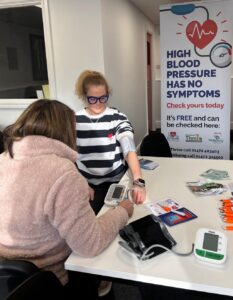
Amy Quickfall (R) tests out community BP checks
A core principle of the programme is simple: don’t ask people to come to you-go to them. Whether at the YMCA’s weekly £3.50 community dinner, cultural organisations like Health Gospel, homelessness services such as Doorstep, or school councils, the team takes engagement into real community spaces.
This has increased participation from seldom‑heard groups, including disabled children, young men at risk of homelessness, and newly arrived migrant communities.
Joined‑up care
Alongside long‑term community work, a multi‑agency “huddle” meets weekly to support people at risk of escalating need. GPs, community nurses, mental health teams, hospice staff, social prescribers, the hospital discharge team, digital leads and VCSE partners all share insights. What they hear isn’t always clinical.
“People talk about loneliness, damp housing, debt or difficult relationships,” Adam explains. “Understanding the whole person helps us support them properly.”
Doing the groundwork
The team’s vision is ambitious: services that work seamlessly across boundaries, community leaders influencing every level of decision‑making, and local children growing up in safer, healthier neighbourhoods.
The groundwork is already visible. For the North East Lincolnshire NNHIP team neighbourhood working isn’t just a programme, it’s a cultural change that’s built to last.
“We might not see all the results in our working lifetime,” Adam concludes. “But I’d love to know we helped set that future direction.”