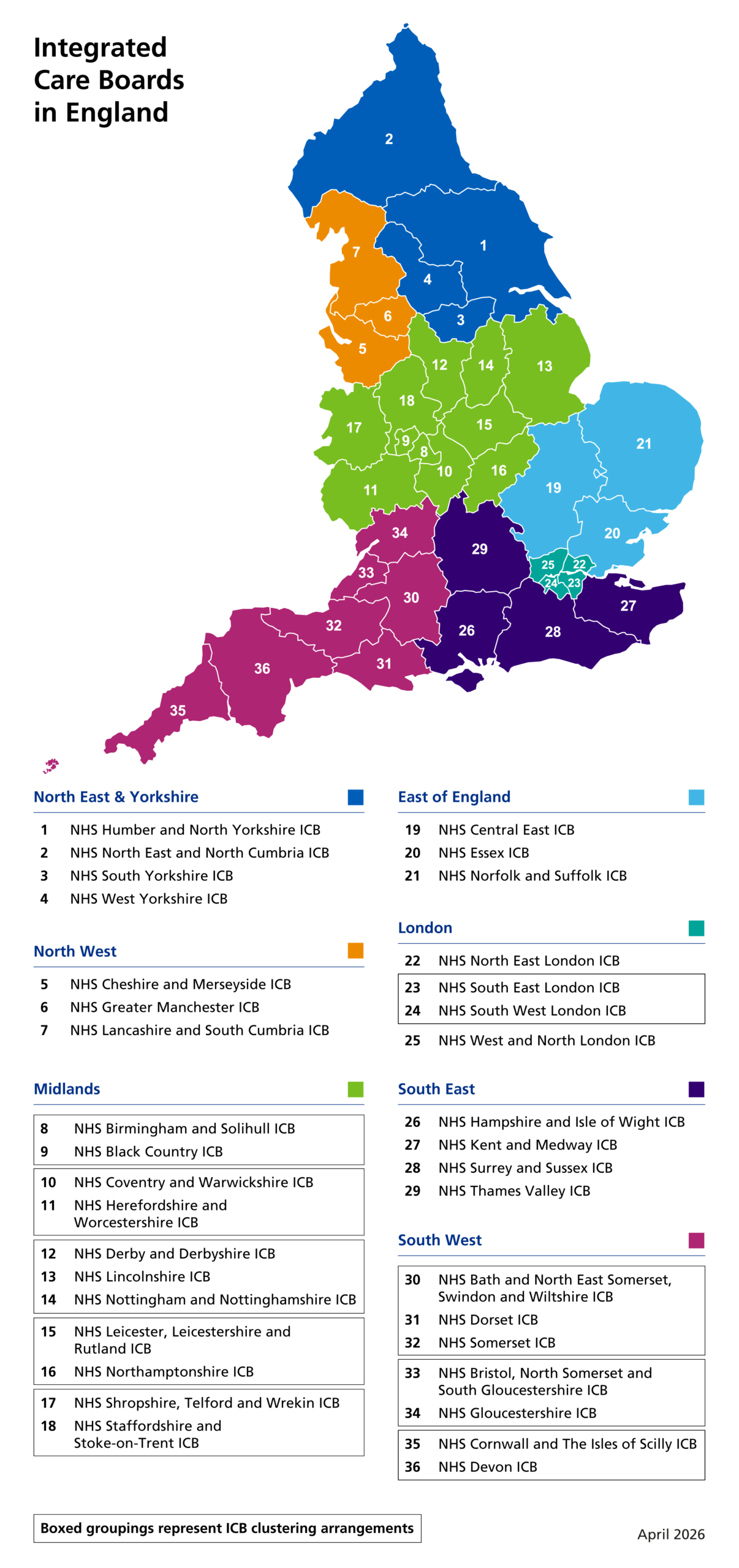
Integrated care in your area
Integrated care boards (ICBs) are introducing new organisational arrangements as they redesign their structures and footprints to support their focus on strategic commissioning and reduce running costs.
Six new ICBs were established and the boundary of an existing ICB was widened on 1 April 2026 through the abolition of 12 existing ICBs. The changes consolidate the reductions in running costs realised through clustering of these ICBs in 2025 and allow further efficiencies to be achieved.
These remaining clustering arrangements will stay in place and any future decisions on ICB footprints and mergers will be taken in light of the Local Government Reorganisation process.
The clusters have been agreed by NHS England’s Executive team and by ministers and allow those ICBs to harness a shared budget of sufficient size to improve efficiency and reduce running costs while ensuring the best arrangements for patients and communities.
Clusters allow ICBs to work together through shared leadership and combined teams. However, clustering ICBs remain separate legal entities with unchanged boundaries, separate financial allocations and legal duties. Clusters are shown within the key of the map of ICB areas.
Integrated care systems (ICSs) in England bring together their local health and care organisations to improve outcomes, tackle inequalities and create better services.
ICSs have the flexibility to make their own decisions about how partners work together in their area. This will depend on factors like size, geography and population.
Most larger ICSs have a number of place-based partnerships that design and deliver integrated services for particular areas within the ICS. They involve a range of people interested in improving health and care, including the NHS, local councils, voluntary community and social enterprise and other local organisations, working alongside local people.
Find out more about systems:
- More about each ICS – outlines clustering arrangements and lists ICS leaders with links to ICS websites
- Map of ICB areas – updated April 2026
- The Integrated Care Boards (Establishment and Abolition) Order 2026
- ICS boundary changes and mergers procedure
Map of integrated care board areas – updated April 2026