
Understanding London
Our strengths and challenges as city for health and care innovation
London is one of the world’s most cosmopolitan and intellectually storied cities. Our ten million residents bring experiences and perspectives from across the globe, and the wide range of industries and institutions which have made our city a successful home over almost two thousand years of history make London a natural hub for progressive thinking and innovation.
In the fields of pharmaceutical, medical device, genomic and operational/productivity-improving health innovation – which we will refer to collectively as “life sciences” in this strategy – we have several notable strengths as a city.
These include:
- World-class research. London is home to three of the top 15 global universities for research, 17 NIHR Biomedical Research Centres and Clinical Research Facilities, and the London Secure Data Environment, providing de-identified data about the long-term health of the entire population. We are an established global destination for research and discovery, with infrastructure particularly well-suited to fostering data-driven precision medicine.
- An exceptional healthcare system. £30Bn is spent every year on the NHS in London – an integrated primary, secondary and tertiary healthcare ecosystem including world-class specialist hospitals. This ecosystem provides an unmatched clinical environment for real-world testing, evaluation and optimisation of innovation. A growing private market also provides a route for testing new technologies.
- First-class talent. London is consistently recognised as the world’s best city to live and work. Our universities feed a pipeline of tens of thousands of high-potential science and medicine graduates every year, and we are one of the world’s top cities for tech talent. Our world-leading ranking for human capital means there is no better location to build teams with the diverse skills needed for health and care innovation.
- Access to investment. London retains its long-standing position as Europe’s leading financial hub and the second-largest global financial centre. It is home to more than 50 venture capital investors with life sciences experience, and the UK accounts for the most biotech venture capital investment in Europe. These venture capitalists sit alongside specialist health funds, crossover investors, global banks and advisors – providing deep pools of early, mid and late-stage financing for innovation.London’s unique blend of funding availability and a health ecosystem suited to collecting real-world evidence at scale make it a particularly strong proposition for international innovators looking to demonstrate economic viability.
- A supportive operating environment. A globally competitive policy environment in terms of taxation (including generous research and development tax credits) is twinned with a high-performing and ambitious regulatory system with a focus on further enhancing the attractiveness of the UK as a health research and innovation hub.This environment is supported by leading accelerators such as DigitalHealth.London, incubators and other publicly-funded support facilities for health tech innovators – including three well-established health innovation networks.
- A thriving commercial ecosystem. London operates as a global hub for life sciences business growth, with a critical mass of innovators and established life sciences companies making it a perfect environment for building partnerships and scaling-up. More than 2,700 life sciences companies have a London presence, and our city is one of the largest and fastest-growing life sciences clusters in Europe, accounting for £30Bn of annual healthcare turnover and a further £4Bn of social care spend.Our life sciences ecosystem is spread across 10 hubs, bringing together pharmaceutical, medical device and digital health companies with academia and the NHS:
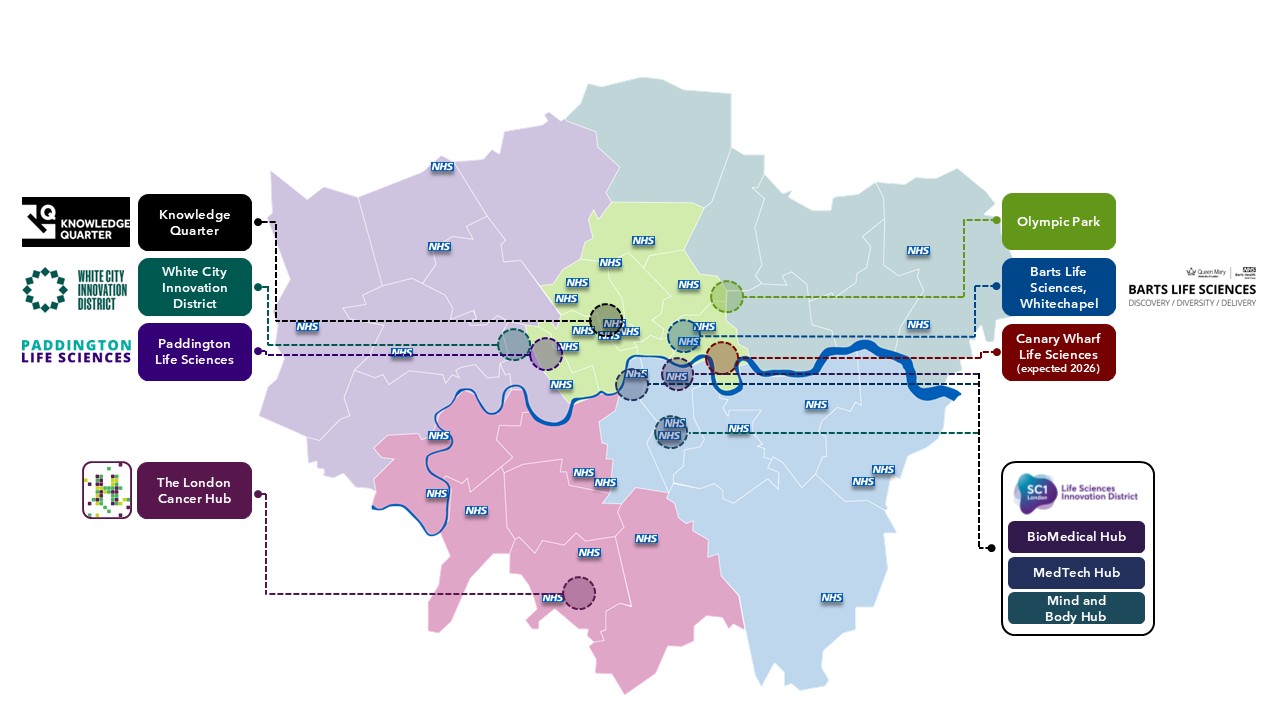
However, despite London’s impressive strengths, our health and care system has not yet had a comprehensive, coordinated approach to scaling-up and adopting innovation across the capital.
This has meant that celebration of our many notable life sciences sector successes has been tempered by examples where the impact of innovation has been less impressive.
For example, our diverse population has not seen the full benefit of the innovations which should have led to reductions in health inequalities; instead, many health inequalities have worsened since the Covid-19 pandemic.
And while innovation in London has driven significant progress in outcomes for some diseases – such as pioneering work using precision medicine and genomics to transform outcomes for rare diseases including sickle-cell disease and familial hypercholesterolaemia – others have lagged behind.
Some of the conditions which cause the greatest harm to our local population (for example cardiometabolic disease) are included in that category of illnesses where progress has been slower than hoped, and where innovation has encountered difficulties scaling. We believe more can be done to connect our life sciences sector to the challenges on its own doorstep, allowing it to play a truly focused role in improving the health of our population.
It is worth noting too, that satisfaction with the NHS in the UK is almost as low as it has ever been. There is broad agreement that innovation is critical to improving services and restoring public trust; achieving this shift in London could be greatly aided by stronger and more strategic coordination with the life sciences sector.
Finally, London is a city of huge wealth – wealth which the life sciences sector already makes a significant contribution towards – but it is also a city which contains pockets of significant deprivation. Could we shape a life sciences sector which plays a greater role in not just creating wealth, but also in helping to address pernicious issues of economic inequity such as rising youth unemployment? We believe so.