
Triangulating feedback: a 4-step process to support improvement in discharge
To gain a rich understanding of the experience of discharge, it’s important to look at different sources of feedback. This could be existing data including national surveys, local data or complaints. Using different sources can help to give you a clearer picture of any themes in the feedback and where to focus your co-produced improvements.
On this page, we set out a 4-step process to triangulating feedback, with a focus on the experience of discharge for people who use services and their unpaid carers, which has been shown to correlate strongly with overall experience of care1.
Step 1: Identify and review relevant data sources
Here are some examples of data sources that can be used to find out more about experiences of hospital discharge.
1. Adult inpatient survey results
The Adult inpatient survey looks at the experiences of people who stayed at least one night in hospital as an inpatient.
What data is available?
The survey includes questions about the experience of discharge planning, involvement in decisions, and post-discharge support. The questions relevant to hospital discharge are listed in the Appendix.
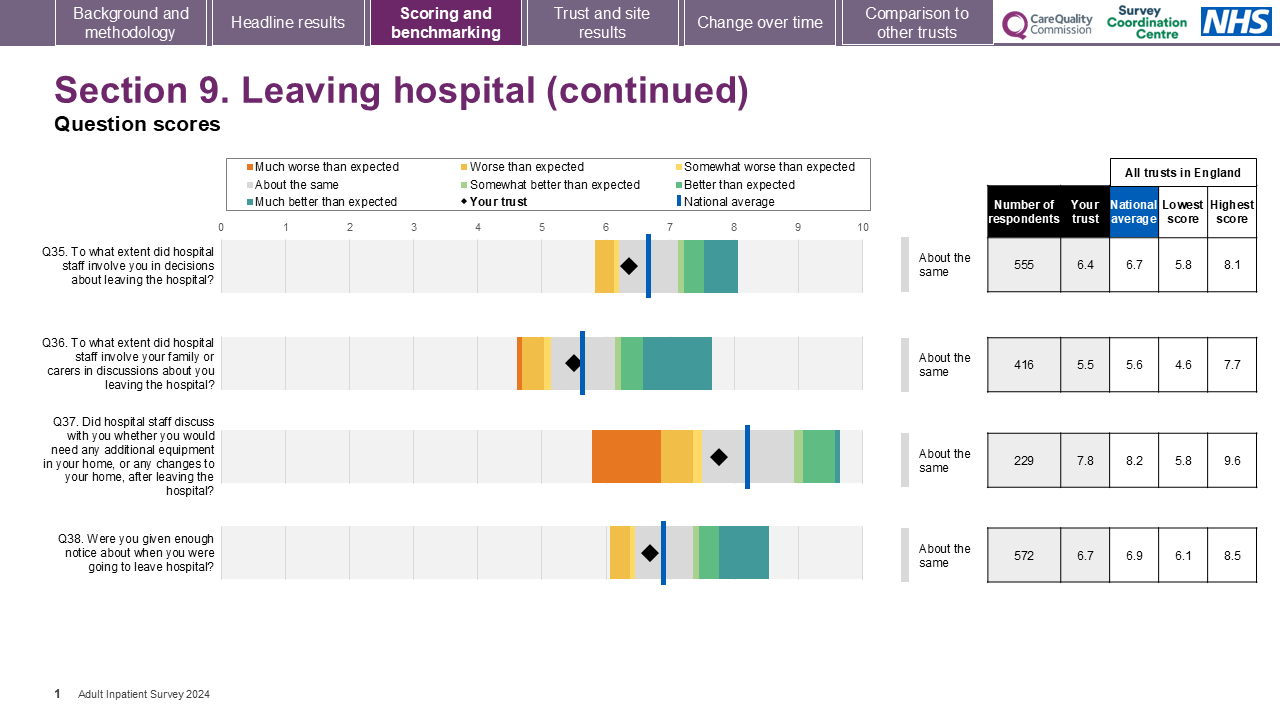
Each trust is provided with a benchmark report showing the results for each question over time and in comparison to other trusts. Reports also provide results at hospital site where data is available. Figure 1 shows an example of a Trust level benchmark report slide from the Adult inpatient survey, showing question scores relating to hospital discharge.
Responses to qualitative questions about what was good about hospital care and what could be better are also shared with survey leads at each NHS trust.
Figure 1: Example of Adult inpatient survey report slide
2. Other national survey results
If it is relevant to your area of work, you may also find useful questions and feedback about discharge in these national surveys (relevant questions have been listed in the Appendix):
-
-
- Urgent & Emergency Care Survey – results are available at national and trust level.
- Maternity Survey – results are available at national and trust level.
- National Cancer Patient Experience Survey – results are available at national, trust, Cancer Alliance and ICB level. Free-text workbooks which have categorised data, including a category on discharge, are shared directly with survey leads at each trust and also shared with Cancer Alliances.
- Under 16 Cancer Patient Experience Survey – results are available at a national and Principal Treatment Centre (PTC) level. Free-text workbooks which have categorised data, including a category on discharge, are shared directly with survey leads at each PTC.
-
3. Friends and Family Test feedback
The Friends and Family Test (FFT) captures near real-time feedback. There is a single question about the overall experience of services and people also have an opportunity to leave written comments.
The FFT is often completed after a person has finished their treatment or after discharge, but it is up to each provider to decide how FFT works in practice. The FFT question can be used as a question within local surveys, or providers can add questions to the FFT question, changing these over time in order to focus on areas that need more attention. It’s possible that providers are already using FFT to gather more feedback on discharge processes.
What data is available?
Frequently reported data, such as monthly FFT quantitative results, can be tracked over time using Statistical Process Control (SPC) charts. The FFT analysis site has SPC charts available at national, ICB and trust level. Making Data Count guides you through more information about SPC charts to identify when changes over time for a given metric are significant and require further investigation and action.
For the qualitative data, your hospital or trust will collect this feedback and have access to the free-text responses to the FFT. Step 9: Making Qualitative Data Count guides you through analysing your free-text data. If you have an interest in using AI to better utilise large volumes of qualitative patient experience data, you can contact england.insight-queries@nhs.net.
4. PALS and complaints data
Feedback can be shared locally with the Patient Advice and Liaison Service (PALS) or through formal complaints.
What data is available?
Your hospital or trust will have records of PALS and complaints data. You could review your formal complaints data (KO41 which covers admissions, discharge and transfer) alongside your more informally collected PALS data to identify whether there are themes related to discharge.
5. Your local data
Your hospital or trust may run local surveys to understand the experience of people using services and their unpaid carers. Local Healthwatch teams may have run projects related to discharge. Or there may be local forums, community groups, focus groups or social media including Care Opinion that collect detailed feedback. These can be rich sources of data specific to your local area and can help you to focus on targeted improvements.
It may also be beneficial to work in partnership with local groups to facilitate discussions to understand how it feels to experience discharge and co-produce improvements together, especially with communities that face health inequalities and/or barriers to access.
Step 2: Understanding your data sources
All of the sources listed above can help to identify good practice and opportunities for improvement. They work in different ways and serve different purposes. For example, the national surveys provide more statistically reliable data, which can be used to confidently establish differences over time, benchmark against other providers or identify issues for further investigation. National surveys are usually based on a representative sample of patients to give a snapshot of experience at a certain time and are usually reported on months after the experience.
Sources such as the FFT, PALS and complaints can provide nearer to real-time feedback and give all patients and service users the opportunity to share their experiences in their own words.
Before bringing insights from data sources together, you should consider who it would be good to get involved, for example data analysts and quality improvement specialists. You can then identify key findings from each source.
For the national surveys, you can look through the national and local level reports. For other data such as the FFT, the Making Data Count team provide a range of free resources and CPD accredited training that is designed to support people working in the NHS to make the best use of their data to inform judgements and decisions for action. Making Data Count consists of ten training modules that are designed to be followed in a set order starting with Step 1 to support analysis of quantitative and qualitative data.
Step 3: How to triangulate your data
Triangulation means bringing different data sources together to create insights. Once you understand your individual data sources and results, you can look across them for patterns and areas of difference. Keep in mind the strengths of each data type and what this means for your conclusions.
Making Data Count Step 7: Triangulating Data talks through how to triangulate data, with practical tips and advice.
Step 4: Creating an improvement plan
NHS IMPACT (Improving Patient Care Together) supports NHS providers to deliver continuous improvement and share best practice. There are also resources available to support you in working in partnership with people and communities to co-produce or co-design an improvement plan.
It can be valuable to understand how others have improved hospital discharge. The Adult inpatient survey results over recent years might help to identify those areas which have made progress. In addition, NHS England has published information on improving hospital discharge with good practice examples, guidance and case studies.
References
1 Adult inpatient survey 2024 – Care Quality Commission
Appendix
National survey questions that focus on discharge
Adult Inpatient Survey 2025
-
-
- Q32: To what extent did hospital staff involve you in decisions about leaving the hospital?
- Q33: To what extent did hospital staff involve your family or carers in decisions about you leaving the hospital?
- Q34: Did hospital staff discuss with you whether you would need any additional equipment in your home, or any changes to your home, after leaving the hospital?
- Q35: Were you given enough notice about when you were going to leave hospital?
- Q36: Before you left the hospital, were you given any information about what you should or should not do after leaving the hospital?
- Q37: To what extent did you understand the information you were given about what you should or should not do after leaving the hospital?
- Q38: Before you left the hospital, were your family or carers given the information they needed to care for you at home?
- Q39: Thinking about any medicine you were to take at home, were you given any of the following?
- Q40: Before you left the hospital, did you know what would happen next with your care?
- Q41: Did hospital staff tell you who to contact if you were worried about your condition or treatment after you left hospital?
- Q42: Did hospital staff discuss with you whether you may need any further health or social care services after leaving the hospital?
- Q43: After leaving the hospital, did you get enough support from health or social care services to help you recover or manage your condition?
- Free-text question: If there is anything else you would like to tell us about your experiences in the hospital, please do so here.
-
Urgent & Emergency Care Survey 2024
Type 1
-
-
- Q36: Before you left A&E, did hospital staff give you information on how to care for your condition at home?
- Q37: To what extent did you understand the information you were given on how to care for your condition at home?
- Q38: From the information you were given by hospital staff, did you feel able to care for your condition at home?
- Q39: Did hospital staff tell you who to contact if you were worried about your condition or treatment after you left A&E?
- Free-text question: If there is anything else you would like to tell us about your experiences in the A&E department, please do so here
-
Type 3
-
-
- Q33: Before you left the Urgent Treatment Centre, did health professionals give you information on how to care for your condition at home?
- Q34: To what extent did you understand the information you were given on how to care for your condition at home?
- Q35: From the information you were given by health professionals, did you feel able to care for your condition at home?
- Q36: Did a member of staff tell you who to contact if you were worried about your condition or treatment after you left the Urgent Treatment Centre?
- Free-text question: If there is anything else you would like to tell us about your experiences in the Urgent Treatment Centre, please do so here
-
Maternity Survey 2024
-
-
- D2: On the day you left hospital, was your discharge delayed for any reason?
- Free-text question: If there is anything else you would like to tell us about your maternity care, please do so here.
-
National Cancer Patient Experience Survey 2025
-
-
- Q38: Did hospital staff give you information about what you should or should not do after leaving hospital?
- Free-text question: Please tell us in the box below what you found to be positive about your experience of cancer care
- Free-text question: Please tell us in the box below how your experience of cancer care could have been better
-
Under 16 Cancer Patient Experience Survey 2024
-
-
-
- Free-text question: Was there anything particularly good?
- Free-text question: Was there anything that could be improved on?
-
-